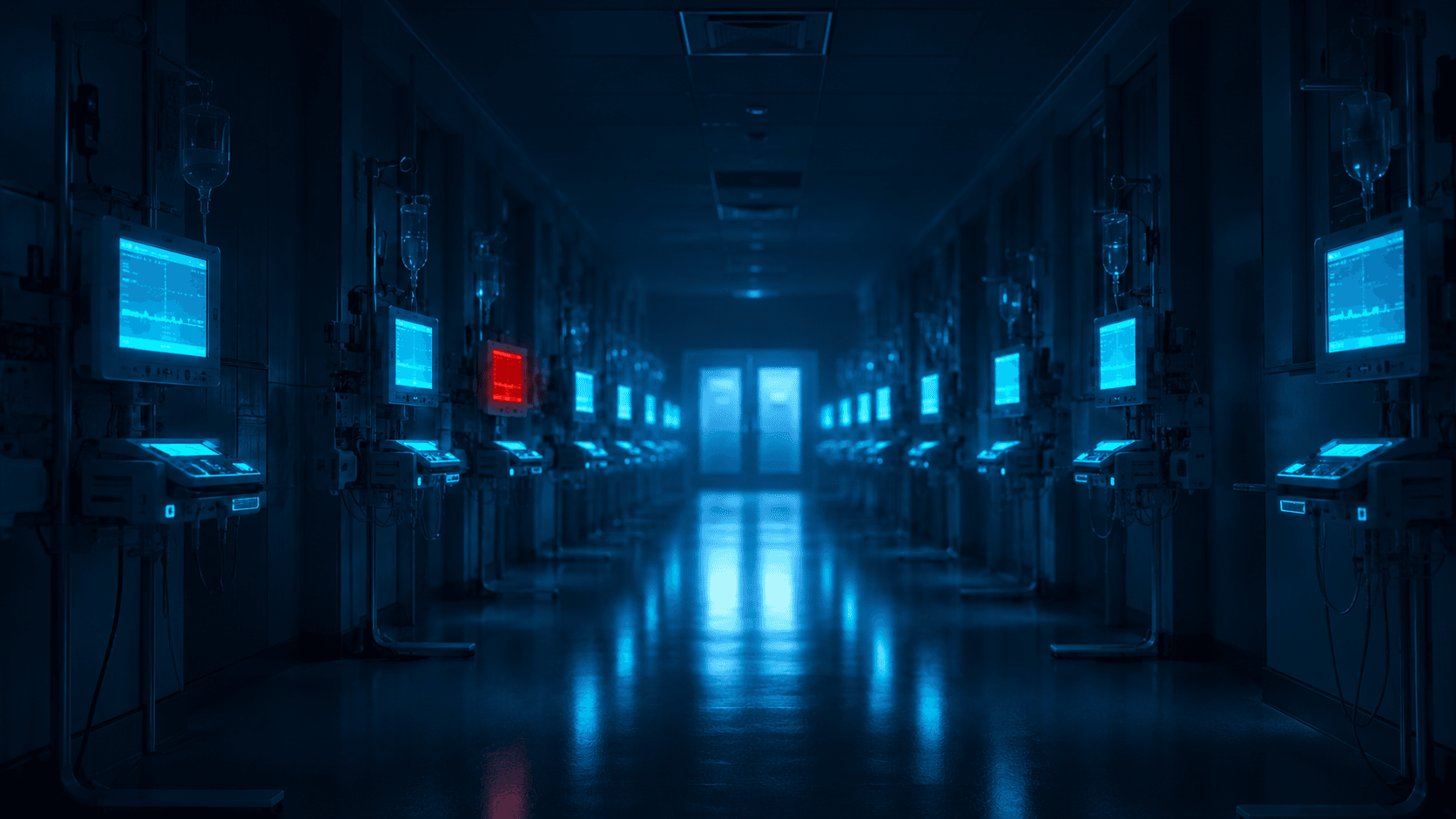
The honest answer is nuanced. Most medical device security vendors do not stop ransomware directly - they help you see it. Their core value is visibility: discovering every connected device, classifying it, and flagging anomalous behavior. That matters enormously in an environment where a single large hospital can run anywhere from 10,000 to 25,000 connected devices, many of which can't host a security agent and can't be patched on a normal cycle.
But visibility is not containment. Knowing that an infusion pump is beaconing to a suspicious host tells you a breach is underway; it doesn't, on its own, stop that breach from spreading to the systems that keep patients alive.
Why ransomware spreads inside hospitals
Healthcare networks are historically flat. Clinical devices, electronic health records, imaging archives and administrative endpoints frequently share the same broadcast domains and trust each other implicitly. Once an attacker gains a foothold - often through a phished credential or an exposed remote-access service - lateral movement is trivial. The device inventory becomes an attack surface map.
This is the gap that pure visibility tools leave open. They are excellent at telling you what you have and what looks wrong. They are not designed to enforce, in real time, the principle that a compromised endpoint should never be able to reach a system it has no business talking to.
What actually contains attacks
Containment comes from architecture, not alerts. Three controls do the heavy lifting:
Identity-based micro-segmentation. When access between systems is granted by verified identity rather than network location, a compromised device simply cannot reach the EHR or imaging archive - there is no implicit trust to abuse. Lateral movement stops at the first hop.
Zero Trust access with no inbound exposure. Remote and vendor access to clinical systems should never open an inbound port. Outbound-only, identity-verified connections keep protected systems invisible and remove the exposed gateways ransomware operators scan for.
Governed, encrypted data exchange. Records and images that must move between systems should travel under encryption, content control and a complete audit trail - never through flat file shares an attacker can sweep.
Where TerraZone fits
truePass brings these controls together under one identity model. Grid delivers the identity-based segmentation that isolates medical IoT and contains ransomware; Gate secures remote and telemedicine access without inbound ports; Gravity governs the exchange of records and scans across systems. The result isn't another dashboard that tells you you've been breached - it's an architecture that keeps a single intrusion from becoming a hospital-wide outage.