

A Practical Roadmap for Financial Institutions Embracing the “Never Trust, Always Verify” Security Model
The traditional security perimeter is dead. In today’s banking landscape-where employees work remotely, customers demand 24/7 digital access, and cloud services handle critical workloads-the old “castle and moat” approach to cybersecurity simply doesn’t work anymore.
Consider these sobering statistics: Financial institutions are 300 times more likely to be targeted by cyberattacks than other industries. The average cost of a data breach in the financial sector reached $6.08 million in 2024. And a staggering 97% of U.S. banks experienced third-party data breaches in their supply chains last year.
The solution? Zero Trust architecture-a security framework built on one simple principle: never trust, always verify.
Organizations with a Zero Trust approach saw average breach costs $1.76 million lower than those without it. The Zero Trust Security market is projected to grow from $41.72 billion in 2025 to $88.78 billion by 2030, reflecting its rapid adoption across industries-especially banking.
This guide provides a practical, step-by-step roadmap for building a Zero Trust bank, complete with actionable strategies, implementation timelines, and measurable outcomes.
What Is Zero Trust Architecture?
Before diving into implementation, let’s establish a clear definition.
Zero Trust is a security model where no user, device, or network is inherently trusted-regardless of whether they’re inside or outside the corporate network. Every access request must be:
- Verified through strong authentication
- Authorized based on least-privilege principles
- Inspected and logged for anomalies
- Continuously validated throughout the session
CISA’s Zero Trust Maturity Model defines five pillars that organizations must address:
Pillar | Description | Banking Relevance |
Identity | Verify every user and service account | Employee, customer, and API authentication |
Devices | Validate device health and compliance | BYOD policies, branch equipment, ATMs |
Networks | Segment and encrypt all traffic | Core banking isolation, SWIFT protection |
Applications & Workloads | Secure applications and containers | Mobile banking, online portals, APIs |
Data | Classify, encrypt, and protect data | Customer PII, transaction records, compliance |
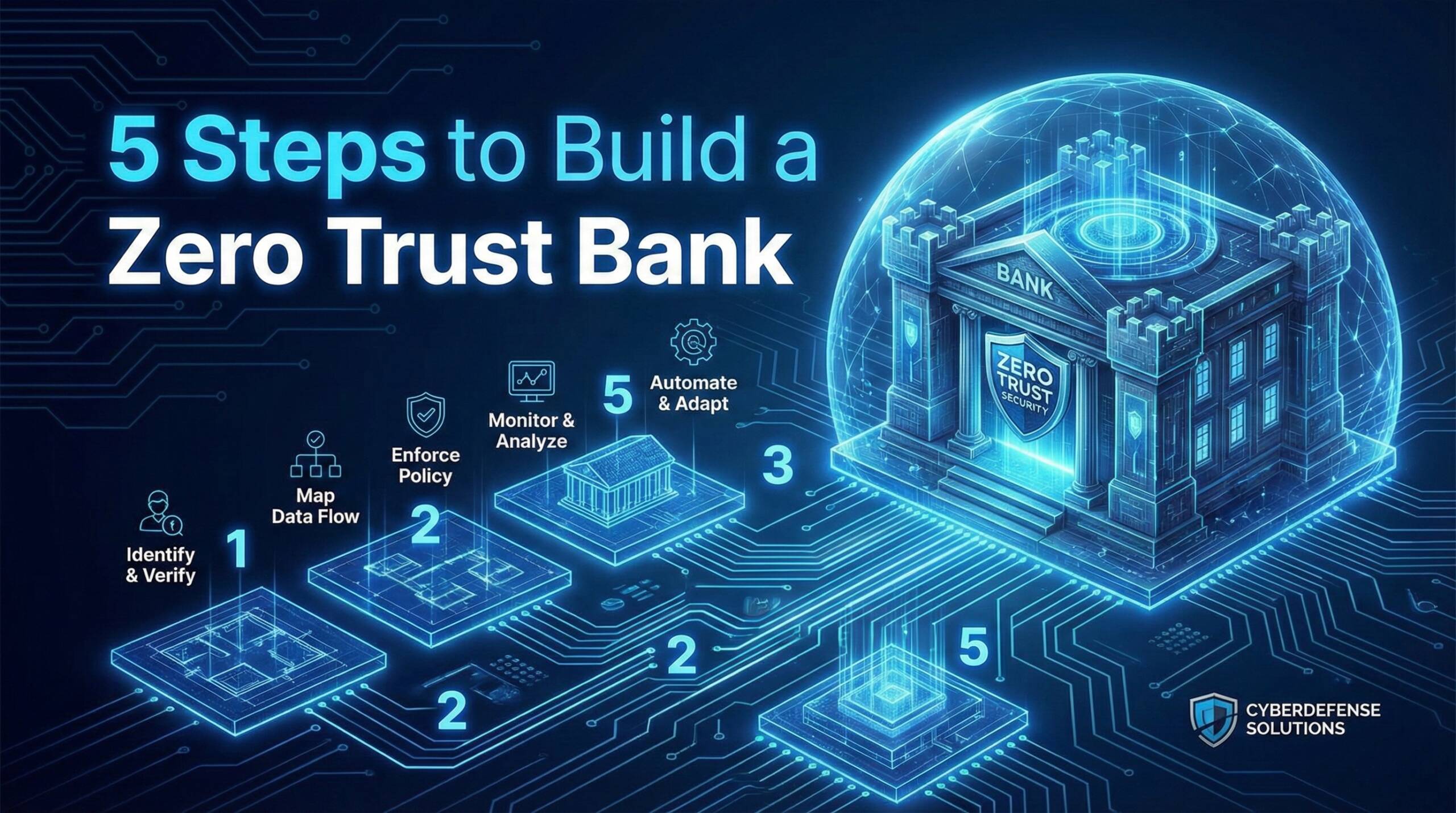
The 5 Steps to Building a Zero Trust Bank
Step 1: Change Your Mindset and Secure Executive Buy-In
The Challenge: Zero Trust isn’t just a technology deployment-it’s a fundamental shift in how your organization thinks about security. Without executive sponsorship and cultural change, implementation efforts will stall.
What This Looks Like in Practice:
The first step is acknowledging that the modern bank no longer has a traditional network edge. Networks are everywhere-on-premises, in the cloud, at branches, on employee devices, and embedded in third-party services. A single user may access core banking systems from a corporate laptop in the office, a personal tablet at home, and a smartphone while traveling-all in the same day.
Key Actions:
- Educate leadership on Zero Trust principles and business benefits
- Quantify the risk of current security posture (use breach cost data)
- Establish a Zero Trust steering committee with cross-functional representation
- Define success metrics aligned with business objectives
- Adopt a “secure by design” philosophy across all new initiatives
Table: Traditional vs. Zero Trust Mindset
Aspect | Traditional Mindset | Zero Trust Mindset |
Trust Model | “Trust but verify” | “Never trust, always verify” |
Network Assumption | Internal = safe, External = dangerous | All networks are potentially hostile |
Access Default | Allow unless explicitly denied | Deny unless explicitly allowed |
Authentication | One-time at login | Continuous throughout session |
Security Focus | Perimeter defense | Data and identity-centric |
Incident Response | Detect and respond | Assume breach, contain and minimize |
Success Metrics for Step 1:
- Executive sponsor identified and engaged
- Zero Trust strategy document approved
- Budget allocated for multi-year implementation
- Cross-functional team assembled
Timeline: 4-6 weeks
Step 2: Map Your Assets and Identify Crown Jewels
The Challenge: You can’t protect what you don’t know exists. Banks operate complex technology ecosystems with legacy mainframes, modern cloud services, and everything in between. A complete asset inventory is essential before implementing Zero Trust controls.
What This Looks Like in Practice:
Financial services companies must know exactly what their technical landscape encompasses and how best to protect those assets. This means identifying the systems that process the highest volumes of transactions, store the most sensitive data, and generate the most revenue.
Key Actions:
- Conduct comprehensive asset discovery across all environments
- Classify assets by criticality and sensitivity (Tier 1, 2, 3)
- Map data flows between systems, users, and external parties
- Document existing access controls and identify gaps
- Prioritize protection for “crown jewel” systems
Table: Asset Classification Framework for Banks
Tier | Asset Type | Examples | Protection Priority |
Tier 1 – Critical | Core banking systems | Transaction processing, SWIFT, payment gateways | Highest – Immediate protection |
Tier 2 – High | Customer data repositories | CRM, loan systems, account databases | High – Phase 1 implementation |
Tier 3 – Medium | Operational systems | Email, HR systems, internal portals | Medium – Phase 2 implementation |
Tier 4 – Standard | General productivity | Document management, collaboration tools | Standard – Phase 3 implementation |
Banking-Specific Asset Considerations:
- Legacy systems: Many banks run critical transactions on mainframes that are difficult to patch and modify
- ATM networks: Often connected to main infrastructure, creating potential attack vectors
- Third-party integrations: Payment processors, credit bureaus, and fintech partners expand the attack surface
- Customer-facing applications: Mobile banking, online portals, and APIs require protection without impacting user experience
Success Metrics for Step 2:
- 100% of assets inventoried and classified
- Data flow diagrams completed for Tier 1 systems
- Gap analysis documented with remediation priorities
- Third-party connections mapped and risk-assessed
Timeline: 6-8 weeks
Step 3: Establish Strong Identity and Access Management
The Challenge: Identity is the foundation of Zero Trust. If you don’t know with certainty who is accessing your systems, no other security control matters. Yet only 44% of organizations rate their IAM platform as “very or highly effective.”
What This Looks Like in Practice:
Successful identity and access management binds everything together in a Zero Trust architecture. Today’s identities aren’t just human-they include service accounts, APIs, bots, and machine identities. A comprehensive digital identity strategy must securely connect both people and machines to data and services.
Key Actions:
- Deploy multi-factor authentication (MFA) for all access
- Implement single sign-on (SSO) to reduce password fatigue
- Establish privileged access management (PAM) for administrative accounts
- Deploy identity governance for lifecycle management
- Implement continuous authentication based on behavior analytics
Table: MFA Adoption Statistics
Metric | Statistic | Source |
Organizations with MFA implemented | 72% | Ponemon Institute 2025 |
Consumers enabling MFA for online banking | 60% | Prove Identity |
SMBs requiring MFA for third-party access | 95% (US) / 5% (Global) | Industry Research |
Attack risk reduction with MFA | 99.9% | Microsoft |
Companies adopting MFA after a breach | 25% | ElectroIQ |
Identity Verification Levels for Banking:
Access Type | Authentication Required | Additional Controls |
Customer online banking | MFA (SMS/App/Biometric) | Device fingerprinting, behavioral analytics |
Employee standard access | MFA + SSO | Device compliance check |
Privileged administrator | MFA + PAM + Just-in-time access | Session recording, approval workflow |
Third-party vendor | MFA + Time-limited access | IP restrictions, activity monitoring |
API/Service account | Certificate + Token | Rate limiting, anomaly detection |
The Evolution to Passwordless:
Forward-thinking banks are moving beyond traditional MFA toward passwordless authentication using:
- Biometrics (fingerprint, facial recognition)
- Hardware security keys (FIDO2)
- Mobile device-based authentication
- Behavioral biometrics (typing patterns, mouse movements)
Success Metrics for Step 3:
- 100% MFA coverage for all user access
- Privileged accounts under PAM management
- Service account inventory complete with owners assigned
- Mean time to provision/deprovision reduced by 50%
Timeline: 8-12 weeks
Step 4: Implement Network Segmentation and Microsegmentation
The Challenge: Once attackers breach the perimeter, they typically move laterally through the network to reach high-value targets. Traditional flat networks provide no barriers to this movement. According to research, 74% of security leaders say microsegmentation is important for boosting cyber defenses.
What This Looks Like in Practice:
Microsegmentation divides your network into small, isolated segments with individual security policies. Even if an attacker compromises one endpoint, they cannot move laterally to access core banking systems, customer databases, or payment networks.
Key Actions:
- Map network traffic flows to understand normal patterns
- Define segmentation policies based on asset classification
- Deploy microsegmentation technology starting with critical systems
- Implement east-west traffic inspection within segments
- Enable adaptive policies that respond to threat conditions
Table: Segmentation Approaches Compared
Approach | Granularity | Implementation Complexity | Lateral Movement Protection |
VLANs | Network level | Low | Minimal |
Firewalls | Subnet level | Medium | Moderate |
Software-Defined Segmentation | Application level | Medium-High | Good |
Microsegmentation | Workload/Process level | High | Excellent |
Identity-Based Microsegmentation | User + Workload level | High | Superior |
Banking Microsegmentation Use Cases:
Segment | What It Protects | Isolation Benefit |
Core Banking | Transaction processing | Compromised endpoints can’t reach core systems |
SWIFT Network | International transfers | Dedicated protection for critical financial messaging |
Customer Data | PII, account information | Regulatory compliance, breach containment |
ATM Network | Cash dispensing systems | Isolates ATM vulnerabilities from main network |
Development/Test | Non-production environments | Prevents dev compromises from affecting production |
ROI of Microsegmentation:
Organizations implementing microsegmentation report:
- 40% reduction in average breach cost
- 82% reduction in lateral movement incidents
- 58% faster breach containment
- $3.50+ return for every dollar invested
Success Metrics for Step 4:
- Critical systems (Tier 1) fully segmented
- East-west traffic visibility achieved
- Lateral movement attempts blocked and logged
- Compliance audit findings reduced by 70%
Timeline: 12-16 weeks
Step 5: Deploy Zero Trust Network Access (ZTNA) and Continuous Monitoring
The Challenge: Traditional VPNs provide broad network access after authentication-the opposite of Zero Trust. With 238% increase in VPN-targeted attacks between 2020-2022, organizations need a better approach. Additionally, 67% of enterprises are considering remote access alternatives to VPN.
What This Looks Like in Practice:
Zero Trust Network Access (ZTNA) replaces VPNs with application-specific access that verifies identity, validates device posture, and provides only the minimum required permissions. Combined with continuous monitoring, ZTNA ensures that trust is never assumed and always verified throughout every session.
Key Actions:
- Replace or augment VPN with ZTNA solutions
- Implement device posture verification before granting access
- Deploy continuous monitoring with behavioral analytics
- Enable session recording for privileged access
- Establish automated response to detected anomalies
Table: VPN vs. ZTNA Comparison
Feature | Traditional VPN | Zero Trust Network Access |
Access Model | Network-level (broad) | Application-level (specific) |
Trust Assumption | Trusted after connection | Never trusted, always verified |
Attack Surface | Exposed ports required | No exposed ports (reverse access) |
Scalability | Degrades with users | Cloud-native scalability |
User Experience | Often slow, complex | Seamless, transparent |
Lateral Movement Risk | High | Minimal |
Visibility | Limited | Complete session monitoring |
Cost Model | High CapEx/OpEx | Predictable subscription |
Continuous Monitoring Capabilities:
Monitoring Type | What It Detects | Response Action |
Behavioral Analytics | Unusual access patterns | Risk-based authentication step-up |
Session Recording | Policy violations | Alert, terminate session |
Device Posture | Compliance drift | Block access until remediated |
Data Loss Prevention | Sensitive data exfiltration | Block transfer, alert SOC |
Threat Intelligence | Known malicious indicators | Automatic blocking |
The ROI of ZTNA:
Independent research shows significant returns from ZTNA deployment:
- 210% ROI over three years (AppGate study)
- $11.6 million NPV for enterprise deployments
- 15% reduction in legacy security costs
- 3,000+ hours saved in vendor management annually
Success Metrics for Step 5:
- VPN dependency eliminated or reduced by 80%
- 100% session visibility for privileged access
- Mean time to detect threats reduced by 60%
- Automated response to 90%+ of common threat patterns
Timeline: 8-12 weeks (can run parallel with Step 4)
Implementation Timeline Summary
Table: Zero Trust Bank Implementation Roadmap
Phase | Steps | Duration | Key Deliverables |
Foundation | Steps 1-2 | Weeks 1-14 | Executive buy-in, asset inventory, strategy document |
Identity | Step 3 | Weeks 8-20 | MFA deployment, PAM implementation, SSO rollout |
Network | Step 4 | Weeks 12-28 | Microsegmentation for Tier 1 assets, traffic visibility |
Access | Step 5 | Weeks 16-28 | ZTNA deployment, VPN reduction, continuous monitoring |
Optimization | Ongoing | Week 28+ | Policy refinement, coverage expansion, maturity advancement |
Total Timeline: 6-9 months for initial deployment, ongoing optimization thereafter
Measuring Zero Trust Maturity
Use CISA’s Zero Trust Maturity Model to assess progress:
Table: Zero Trust Maturity Levels
Level | Characteristics | Typical Banking Status |
Traditional | Perimeter-based, static policies, manual processes | Legacy institutions |
Initial | Some automation, basic identity controls, limited visibility | Early adopters |
Advanced | Cross-pillar coordination, centralized visibility, automated response | Progressive banks |
Optimal | Fully automated, continuous optimization, AI-driven analytics | Industry leaders |
Key Takeaways
Building a Zero Trust bank requires commitment, investment, and cultural change-but the returns are substantial:
✅ $1.76 million savings in average breach costs
✅ 210% ROI from ZTNA investments over three years
✅ 82% reduction in lateral movement incidents
✅ 99.9% attack prevention with proper MFA implementation
✅ Regulatory compliance simplified through continuous controls
The journey to Zero Trust is a marathon, not a sprint. Start with executive alignment, understand your assets, establish strong identity controls, segment your network, and implement modern access technologies. Each step builds on the previous one, creating a security architecture that protects your bank against today’s threats-and tomorrow’s.
Next Steps
Ready to begin your Zero Trust journey? TerraZone provides banking-specific solutions that integrate microsegmentation, Zero Trust Network Access (truePass), and comprehensive identity controls into a unified platform designed for financial institutions.
Schedule a consultation to assess your current security posture and develop a customized Zero Trust roadmap for your organization.