
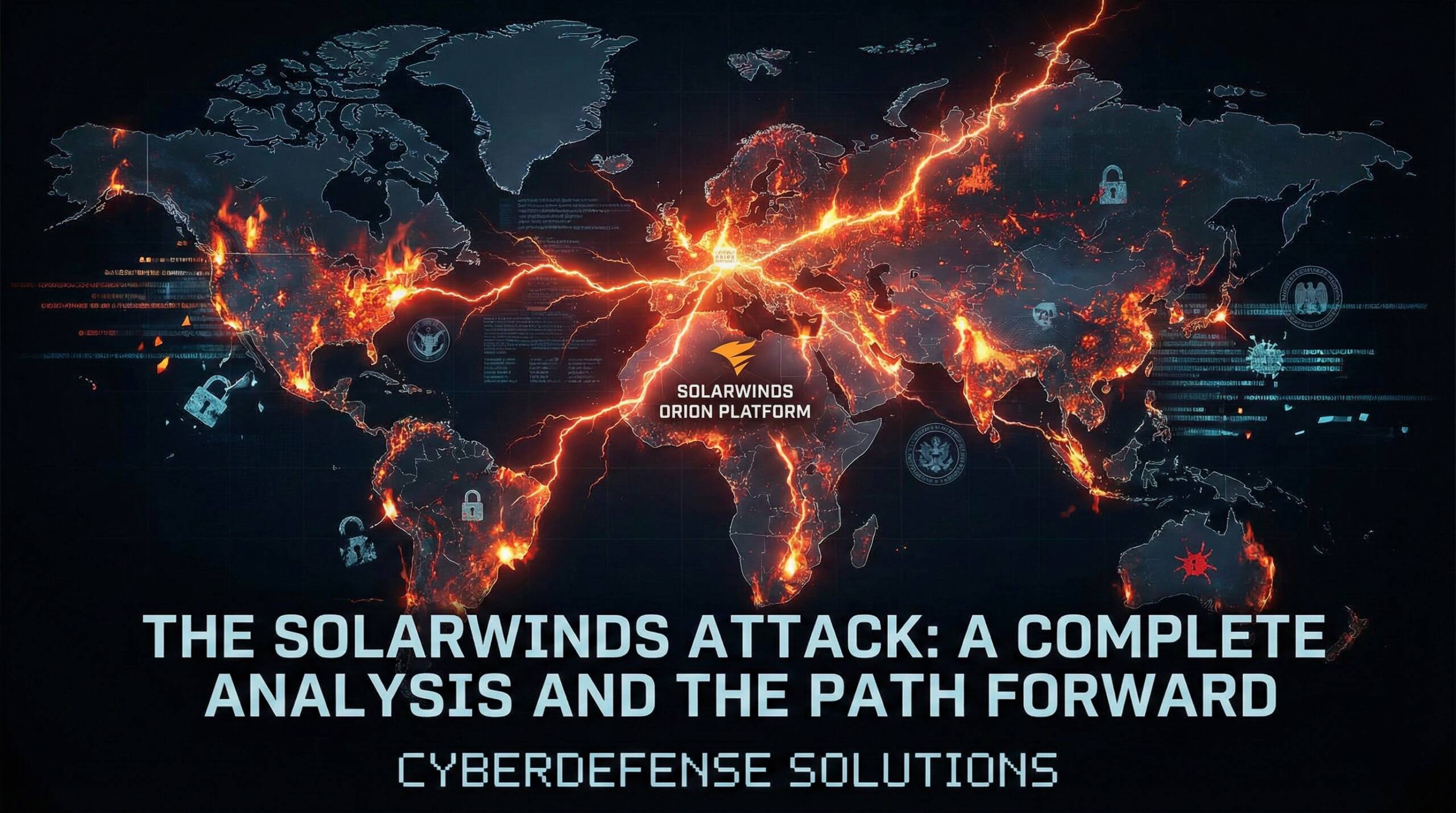
The SolarWinds hack stands as one of the most sophisticated and consequential cyber attacks in history. Discovered in December 2020, the SolarWinds breach exposed fundamental vulnerabilities in how organizations manage supply chain security and third-party access. This comprehensive analysis examines the SolarWinds attack from initial compromise through discovery, explores its far-reaching impact, and outlines the security principles that can prevent similar incidents in the future.
Understanding the SolarWinds cyber attack is essential for any organization that relies on third-party software, managed services, or external vendors-which is to say, virtually every organization operating today.
What Was SolarWinds? Understanding the Target
SolarWinds is a Texas-based company that provides IT management software to organizations worldwide. Its flagship product, the Orion Platform, offers network monitoring and management capabilities used by approximately 33,000 customers across government agencies, Fortune 500 companies, and critical infrastructure operators.
The platform’s widespread adoption made it an ideal target. Orion software typically operates with elevated privileges to monitor network traffic, manage configurations, and access systems across an organization’s infrastructure. This privileged position meant that compromising Orion would grant attackers extraordinary access to victim networks.
Key Facts About SolarWinds Pre-Attack:
Metric | Detail |
Total Orion Customers | ~33,000 organizations |
Fortune 500 Users | 425+ companies |
US Government Agencies | All five branches of the military, Pentagon, State Department, and numerous civilian agencies |
Industries Served | Government, healthcare, financial services, telecommunications, critical infrastructure |
Orion’s Network Access | Administrative privileges across monitored systems |
The SolarWinds Hack: A Technical Timeline
Phase 1: Initial Compromise (September 2019)
The SolarWinds attack began with threat actors-later attributed to APT29 (also known as Cozy Bear), a group associated with Russia’s Foreign Intelligence Service (SVR)-gaining access to SolarWinds’ internal development environment. Security researchers later determined that attackers first tested their ability to modify code in October 2019 by injecting innocuous test code.
Phase 2: SUNBURST Deployment (February 2020)
In February 2020, the attackers deployed the malicious code that would become known as SUNBURST. They inserted a backdoor into the Orion software’s source code with remarkable sophistication. The malicious code was designed to:
- Remain dormant for approximately two weeks after installation
- Masquerade as legitimate Orion activity
- Communicate with command-and-control servers using DNS traffic disguised as normal SolarWinds telemetry
- Only activate in environments that met specific criteria, avoiding sandbox detection
The SUNBURST malware demonstrated exceptional operational security. It avoided systems running certain security tools, checked for specific process names before executing, and randomized its communications to blend with normal network traffic.
Phase 3: Distribution (March-June 2020)
Between March and June 2020, SolarWinds unknowingly distributed the compromised software updates to customers. The trojanized updates were digitally signed with SolarWinds’ legitimate code-signing certificates, making them appear authentic. Approximately 18,000 organizations downloaded and installed the malicious updates.
Phase 4: Active Exploitation (March-December 2020)
Of the 18,000 organizations that received the compromised update, the attackers selectively targeted approximately 100 for deeper intrusion. These high-value targets included:
- U.S. Treasury Department
- U.S. Department of Commerce
- U.S. Department of Homeland Security
- U.S. Department of State
- Parts of the Pentagon
- National Institutes of Health
- Microsoft
- Intel
- Cisco
- Deloitte
For selected victims, attackers deployed additional malware (dubbed TEARDROP and RAINDROP) and used legitimate credentials to move laterally through networks, access email systems, and exfiltrate sensitive data.
Phase 5: Discovery (December 2020)
The SolarWinds breach was discovered in December 2020 when cybersecurity firm FireEye (now Mandiant) detected unauthorized access to its own systems. During the investigation, FireEye identified the SolarWinds Orion platform as the attack vector and publicly disclosed the compromise on December 13, 2020.
SolarWinds Attack Timeline:
Date | Event |
September 2019 | Attackers gain access to SolarWinds development environment |
October 2019 | Test code injection |
February 2020 | SUNBURST backdoor inserted into Orion source code |
March 2020 | First trojanized updates distributed to customers |
March-December 2020 | Active exploitation of ~100 high-value targets |
December 8, 2020 | FireEye discovers breach of its own systems |
December 13, 2020 | Public disclosure of SolarWinds compromise |
December 2020-January 2021 | Emergency response across government and private sector |
The Impact of the SolarWinds Breach
Scope and Scale
The SolarWinds cyber attack’s impact was unprecedented in several dimensions:
Organizations Affected:
- 18,000 organizations installed compromised updates
- ~100 organizations actively exploited for deeper access
- 9 federal agencies confirmed breached
- Multiple Fortune 500 companies compromised
Financial Impact:
According to industry analysis, the SolarWinds attack cost affected companies an average of 11 percent of their annual revenue. For SolarWinds itself, the company reported spending more than $40 million in the first three months following discovery on investigation and remediation.
The U.S. Securities and Exchange Commission later pursued enforcement action against SolarWinds, resulting in settlements and ongoing legal proceedings. Individual executives faced scrutiny over pre-attack security disclosures.
National Security Implications:
The breach of multiple federal agencies raised serious national security concerns. Attackers had access to:
- Email communications of senior government officials
- Sensitive but unclassified government data
- Network configurations and security architectures
- Intelligence about U.S. cyber capabilities
The Trust Collapse
Perhaps more significant than the immediate damage was the fundamental erosion of trust in software supply chains. Organizations that had followed security best practices-keeping software updated, using reputable vendors, verifying digital signatures-found themselves compromised precisely because they had done so.
This created a paradox: the security measure of installing vendor updates became the attack vector.
Why Traditional Security Failed
The SolarWinds attack succeeded because it exploited assumptions embedded in traditional security models.
Implicit Trust in Vendors
Most organizations operate with implicit trust toward established software vendors. Updates signed with valid certificates from reputable companies are typically installed with minimal scrutiny. The SolarWinds hack demonstrated that this trust can be weaponized.
Perimeter-Focused Defenses
Traditional security architectures focus on keeping threats outside the network perimeter. Once the trojanized Orion update was installed inside the perimeter, it operated with the trust accorded to legitimate internal systems.
Insufficient Monitoring of Privileged Access
The Orion platform required extensive network access to perform its monitoring functions. This privileged access was treated as normal operational necessity rather than a potential attack surface requiring continuous verification.
Lateral Movement Opportunities
Once inside victim networks, attackers found few obstacles to lateral movement. The ability to move from the initially compromised system to email servers, file shares, and other sensitive systems indicated insufficient internal segmentation.
Traditional Security Model Gaps Exploited by SolarWinds:
Security Assumption | How It Was Exploited |
Vendor updates are trustworthy | Malware delivered via legitimate update mechanism |
Signed code is safe | Malicious code signed with valid certificates |
Internal traffic is trusted | Attackers moved freely once inside |
Network monitoring tools need broad access | Privileged position used for reconnaissance |
Perimeter defenses stop threats | Threat entered through trusted supply chain |
Lessons from the SolarWinds Attack
Lesson 1: Assume Breach Mentality
The SolarWinds hack validated the security principle of “assume breach”-operating under the assumption that adversaries may already have access to your environment. This mindset shifts focus from prevention alone to detection, containment, and resilience.
Organizations must architect systems so that compromise of any single component-including trusted vendor software-does not grant unrestricted access to the entire environment.
Lesson 2: Zero Trust Architecture
The concept of Zero Trust-“never trust, always verify”-directly addresses the vulnerabilities exploited in the SolarWinds attack. Zero Trust principles include:
- Verifying every access request regardless of source
- Enforcing least-privilege access for all users and systems
- Assuming the network is hostile
- Continuously validating trust throughout a session
Implementing Zero Trust means that even legitimate software like Orion would be constrained to only the specific access it requires, with that access continuously verified.
Lesson 3: Microsegmentation
If organizations had implemented granular network segmentation, the lateral movement that characterized the SolarWinds breach would have been significantly impeded. Microsegmentation creates security boundaries around individual workloads, applications, or data sets rather than relying on broad network zones.
Under a microsegmented architecture, the Orion platform would be confined to its designated network segments with explicit policies governing any cross-segment communication. Anomalous lateral movement attempts would trigger alerts.
Lesson 4: Vendor Access Controls
The SolarWinds attack highlighted the need for rigorous controls over third-party and vendor access. This includes:
- Inventorying all vendor connections and software
- Implementing just-in-time access for vendor support
- Monitoring vendor activity with the same scrutiny applied to internal users
- Requiring multi-factor authentication for all privileged access
- Recording and auditing vendor sessions
Lesson 5: Software Supply Chain Security
Organizations must extend security considerations to their entire software supply chain. This means:
- Evaluating vendors’ security practices during procurement
- Implementing software composition analysis
- Monitoring for anomalous behavior in trusted applications
- Maintaining offline backups of critical system states
- Developing incident response plans that account for supply chain compromise
Modern Security Architectures: Addressing SolarWinds-Style Threats
The Shift to Identity-Based Security
Post-SolarWinds security thinking increasingly centers identity as the primary control plane. Rather than trusting systems based on network location, modern architectures verify the identity of users, devices, and applications for every access request.
Identity-based microsegmentation takes this further by creating security policies tied to verified identities rather than IP addresses or network segments. This approach remains effective even when network topology changes or when workloads move between environments.
Reverse Access Architectures
Emerging security architectures eliminate inbound connection exposure entirely through reverse access models. In these designs, internal resources initiate outbound connections to secure gateways, rather than accepting inbound connections from external sources.
This approach would significantly complicate attacks like SolarWinds. Even if attackers compromise vendor software, the outbound-only architecture prevents them from directly connecting to internal systems. The gateway brokers all access, providing a natural point for monitoring, verification, and policy enforcement.
Organizations implementing reverse access architectures report substantial reductions in their attack surface, as internal resources become invisible to external reconnaissance.
Continuous Verification and Behavioral Analytics
Modern security frameworks emphasize continuous verification throughout sessions, not just at initial authentication. Behavioral analytics establish baselines for normal activity and flag deviations that may indicate compromise.
In the context of a SolarWinds-style attack, continuous verification would detect anomalies such as:
- The Orion software suddenly accessing systems outside its normal scope
- Unusual DNS communication patterns
- Privilege escalation attempts
- Data exfiltration activity
Comparison: Pre-SolarWinds vs. Modern Security Architecture:
Capability | Pre-SolarWinds Approach | Modern Approach |
Trust Model | Implicit trust for internal systems and signed software | Zero Trust-verify every request |
Network Design | Flat networks with perimeter focus | Microsegmented with identity-based policies |
Vendor Access | Persistent VPN/credentials | Just-in-time, recorded, least-privilege |
Monitoring | Perimeter-focused, periodic | Continuous behavioral analysis |
Incident Assumption | Focus on prevention | Assume breach, design for containment |
Third-Party Software | Trust vendor signatures | Verify behavior, constrain access |
Industry Response and Regulatory Changes
Government Action
The SolarWinds breach prompted significant government response. In the United States:
- President Biden issued Executive Order 14028 on improving the nation’s cybersecurity, emphasizing Zero Trust adoption and supply chain security
- The Cybersecurity and Infrastructure Security Agency (CISA) released guidance on supply chain risk management
- Federal agencies accelerated Zero Trust implementation timelines
- New requirements emerged for software vendors selling to the government
Industry Standards Evolution
Industry frameworks have evolved to address supply chain risks highlighted by SolarWinds:
- NIST updated its Cybersecurity Framework and released supply chain-specific guidance
- SOC 2 and other compliance frameworks increased scrutiny of vendor security practices
- Software Bill of Materials (SBOM) requirements gained momentum
- Third-party risk management programs expanded in scope
Implementing Lessons: A Practical Framework
For organizations seeking to prevent SolarWinds-style attacks, the following framework provides actionable guidance:
Assessment Phase
- Inventory all third-party software and vendor access points-understanding what software runs in your environment and what access vendors have is foundational
- Map data flows-document how information moves between systems, especially involving privileged management tools
- Evaluate current segmentation-identify flat network areas where lateral movement would be unimpeded
- Review vendor security requirements-assess whether contracts include adequate security obligations
Architecture Phase
- Design Zero Trust architecture-plan implementation of identity verification, least privilege, and continuous validation
- Implement microsegmentation-create granular security boundaries around sensitive workloads and data
- Deploy behavioral monitoring-establish baselines and detection capabilities for anomalous activity
- Modernize vendor access-implement just-in-time access, session recording, and strict scope limitations
Operations Phase
- Conduct regular threat hunting-proactively search for indicators of compromise
- Test incident response-exercise scenarios including supply chain compromise
- Monitor continuously-maintain visibility across all network segments and vendor activities
- Update threat intelligence-stay current on emerging supply chain threats and TTPs
Supply Chain Security Maturity Assessment:
Capability | Basic | Intermediate | Advanced |
Vendor Inventory | Partial | Complete | Dynamic with risk scoring |
Network Segmentation | Perimeter only | Zone-based | Microsegmented by workload |
Vendor Access Control | Persistent credentials | Time-limited with MFA | Just-in-time with full audit |
Software Monitoring | Signature-based AV | EDR deployment | Behavioral analytics |
Trust Model | Implicit internal trust | Network-based Zero Trust | Identity-based Zero Trust |
The Path Forward
The SolarWinds attack was a watershed moment for cybersecurity. It demonstrated that sophisticated adversaries will exploit trusted relationships and that traditional perimeter-focused security cannot address supply chain threats.
Five years after the SolarWinds hack, the security industry has developed architectures and technologies that directly address the vulnerabilities exploited in the attack. Zero Trust principles, microsegmentation, reverse access architectures, and continuous behavioral monitoring provide the foundation for more resilient security postures.
However, adoption remains uneven. Many organizations still operate with flat networks, implicit vendor trust, and insufficient monitoring of privileged access. The lessons of SolarWinds have been identified; the challenge now is implementation.
For organizations evaluating their security architectures, the SolarWinds breach offers clear guidance: assume that any component-including trusted vendor software-could become an attack vector. Design systems so that compromise of any single element does not cascade to enterprise-wide impact. Verify continuously, segment granularly, and monitor relentlessly.
The next supply chain attack is not a matter of if but when. The question is whether your organization will be architected to detect, contain, and survive it.
Conclusion
The SolarWinds cyber attack reshaped how organizations think about supply chain security and third-party risk. What began as a compromise of a single software vendor’s development environment became one of the most significant cyber espionage campaigns ever documented, affecting government agencies, Fortune 500 companies, and critical infrastructure operators.
The lessons are clear. Trust must be earned continuously, not granted implicitly. Access must be limited to what is strictly necessary. Networks must be segmented so that compromise of one component cannot cascade. Behavior must be monitored to detect anomalies that signature-based tools miss.
Organizations that internalize these lessons and implement modern security architectures-Zero Trust, microsegmentation, identity-based access, continuous verification-will be substantially better positioned to prevent, detect, and contain the next SolarWinds-style attack. Those that do not will remain vulnerable to the same class of threats that the SolarWinds breach so dramatically exposed.
The security community has learned from SolarWinds. The question is whether every organization will act on those lessons before they become the next case study.