

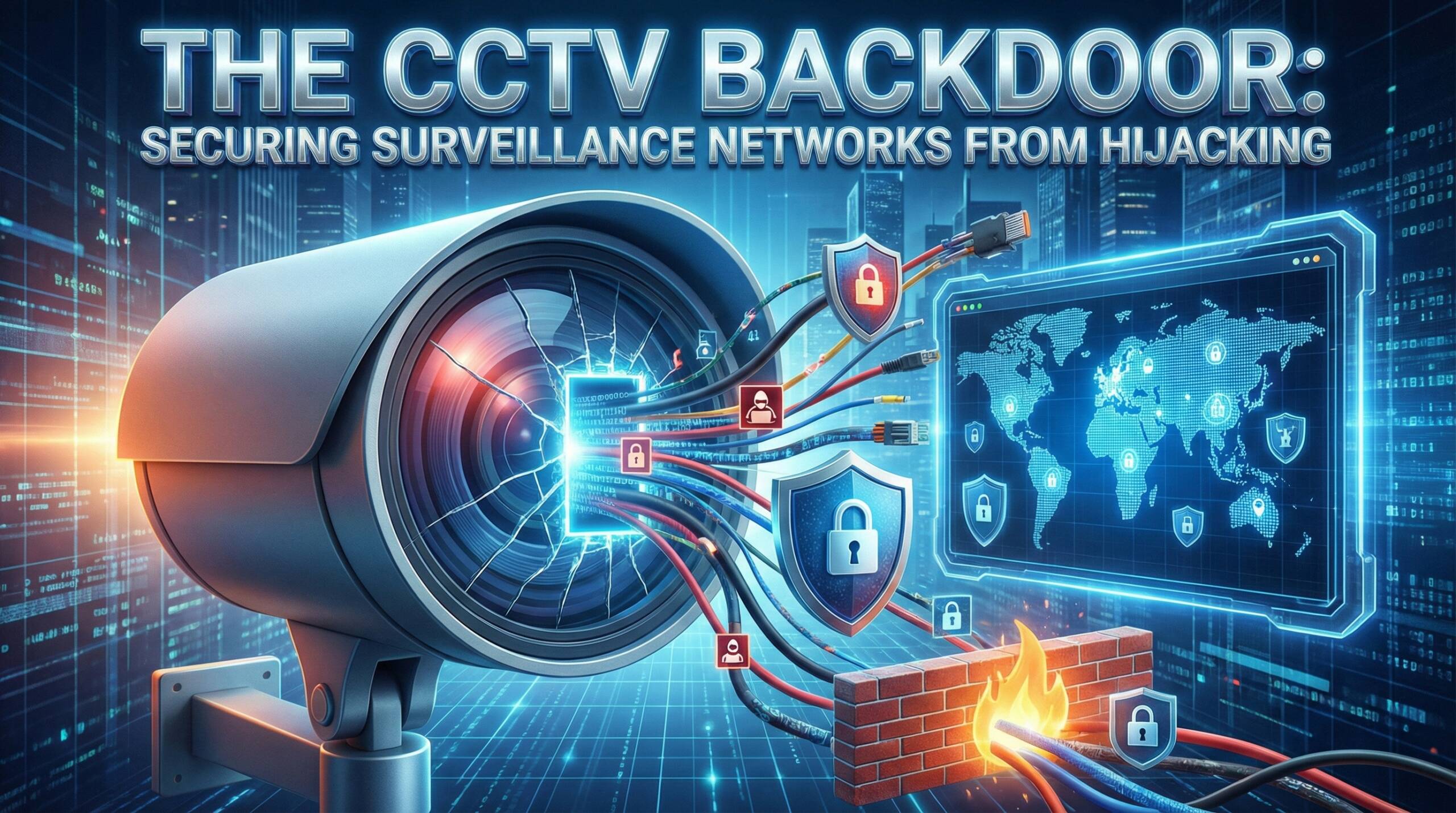
In the modern surveillance state, the camera is ubiquitous. From the high-definition Pan-Tilt-Zoom (PTZ) units guarding airport perimeters to the thermal sensors monitoring power substations and the license plate readers (LPR) scanning city traffic, the “eye in the sky” is the cornerstone of physical security.
However, a dangerous paradox has emerged. As we have migrated from closed-circuit analog systems (Coax) to IP-based digital networks (IoT), we have inadvertently transformed our greatest security asset into our most significant liability.
The IP camera is no longer just a lens; it is a fully functional Linux computer sitting on the edge of the network. It has a processor, memory, an operating system, and a network interface card. And, crucially, it is often the least secured device in the entire infrastructure.
For Homeland Security (HLS) agencies, Municipalities, and Critical Infrastructure operators, the threat is not merely voyeurism. The threat is The CCTV Backdoor. Adversaries are utilizing compromised cameras not just to spy, but as a beachhead to launch lateral attacks against the core network, deploy ransomware, or blind security forces during kinetic operations.
This article provides an exhaustive analysis of the surveillance threat landscape. We will explore the mechanics of camera hijacking, dissect real-world attack scenarios, analyze the economic impact of these breaches, and outline a rigorous, Zero Trust defense strategy leveraging TerraZone solutions to seal the backdoor forever.
The Evolution of the Threat
To understand the vulnerability, one must understand the architectural shift.
From Closed Circuit to Open Internet
Twenty years ago, CCTV (Closed-Circuit Television) was truly “closed.” Cameras connected via coaxial cables to a DVR in a locked room. Hacking it required physical intrusion.
Today, “CCTV” is a misnomer. Modern systems are Video Surveillance as a Service (VSaaS) or complex IP networks. Cameras are Power-over-Ethernet (PoE) devices plugged into switches that share infrastructure with corporate data, HVAC controls, and Wi-Fi networks. To facilitate remote monitoring for police and guards, these Video Management Systems (VMS) are exposed to the internet.
The “Insecurity by Design” Problem
The surveillance market is driven by a race to the bottom in terms of price. Manufacturers prioritize resolution (4K) and features (Night Vision) over security.
- Default Credentials: Millions of devices ship with admin/12345 and users rarely change them.
- Backdoor Accounts: Manufacturers often leave “debug” accounts hardcoded in the firmware for support purposes, which hackers discover and exploit.
- Outdated Libraries: The Linux kernels running on these cameras are often years old, riddled with vulnerabilities like Dirty COW or Log4j that are never patched.
Table 1: The Security Gap – Analog vs. IP Surveillance
Feature | Legacy Analog (Coax) | Modern IP Surveillance (IoT) | Security Implication |
Connectivity | Point-to-Point (Physical cable) | Networked (TCP/IP, Wi-Fi, 5G) | Attack surface expands from physical access to global remote access. |
Intelligence | Dumb Sensor | Edge Computing (AI/Analytics) | The device can run malicious code (Botnets) if compromised. |
Protocols | NTSC/PAL (Video only) | RTSP, HTTP, ONVIF, MQTT | Complex protocols introduce multiple vulnerabilities (e.g., Buffer Overflow). |
Updates | None | Firmware OTA (Over-The-Air) | Update mechanisms can be hijacked to inject malware. |
Dependencies | Proprietary DVR | Windows/Linux VMS Servers | The central server becomes a single point of failure and a ransomware target. |
Attack Scenarios – The “What If” Analysis
For a Homeland Security official, the risk must be contextualized. What happens when the camera is turned against the state?
Scenario A: The Trojan Horse (Lateral Movement)
Target: A Government Ministry or Defense Contractor.
- The Setup: The organization has a robust firewall and secure servers. However, the physical security team installed a new set of IP cameras in the lobby and parking lot. These cameras are on the same VLAN as the building management system.
- The Attack: A hacker finds a vulnerability in the camera model (e.g., a buffer overflow in the RTSP service). They exploit it and gain “Root” access to the camera operating system.
- The Pivot: The camera is now a jump-box. The hacker uses the camera to scan the internal network. They find the badge reader controller, exploit it, and then pivot to the corporate Wi-Fi controller.
- The Impact: The attacker is now inside the secure network, bypassing the perimeter firewall entirely. The camera was the Trojan Horse.
Scenario B: The “Ocean’s Eleven” (Loop Injection & Blindness)
Target: Critical Infrastructure (e.g., a Power Station or Port).
- The Setup: A coordinated physical attack is planned to steal materials or sabotage equipment.
- The Attack: Days before the physical raid, cyber-attackers compromise the Video Management Server (VMS). They do not shut the cameras off (which would trigger an alarm). Instead, they record 10 minutes of “normal” footage—empty corridors, quiet fences.
- The Execution: During the raid, the attackers inject this pre-recorded loop into the guard’s monitor feed.
- The Impact: The Security Operations Center (SOC) sees a quiet night while the facility is being breached. This is “Man-in-the-Middle” applied to video streams. With the rise of Generative AI (Deepfakes), attackers can even generate fake footage of guards walking patrols.
Scenario C: The Botnet Cannon (DDoS)
Target: National Internet Infrastructure.
- The Context: The Mirai Botnet (2016) was a wake-up call. It enslaved 600,000 IoT devices, mostly IP cameras and DVRs, to launch the largest DDoS attack in history, taking down Twitter, Netflix, and CNN.
- The Attack: An adversary infects thousands of municipal surveillance cameras with a silent worm. The cameras continue to work normally.
- The Execution: On command, all 50,000 cameras send junk traffic to the national banking system or emergency services (911) website.
- The Impact: Critical digital services collapse under the weight of the traffic generated by the city’s own security infrastructure.
The Economic and Strategic Impact
The cost of a compromised surveillance network extends far beyond the price of replacing a camera. It involves operational downtime, legal liability, and regulatory fines.
The Cost of Downtime
For a Smart City, if the traffic camera network is held for ransom, the cost is measured in gridlock and economic paralysis. For a retailer or bank, a failure of the CCTV system often mandates a closure of the branch due to insurance regulations.
Regulatory Fines (GDPR / Privacy)
If a camera network is breached and footage of citizens is leaked to the dark web, this constitutes a massive privacy violation. Under GDPR (Europe) or various US state privacy laws, fines can reach 4% of global turnover.
Table 2: Estimated Financial Impact of a Major CCTV Breach (Mid-Sized City/Agency)
Cost Category | Description | Estimated Range (USD) |
Forensic Investigation | Hiring Incident Response (IR) teams to identify the breach source. | $50,000 – $150,000 |
Hardware Replacement | “Bricked” cameras or untrustworthy hardware that must be ripped out. | $200,000 – $1,000,000 |
Operational Downtime | Cost of shutting down facilities or manual guarding during outages. | $10,000 per day |
Legal & Fines | GDPR/Privacy suits, regulatory penalties for negligence. | $500,000 – $5,000,000 |
Ransomware Payment | (If applicable) Cost to decrypt VMS servers. | $250,000 – $2,000,000 |
Reputation Damage | Loss of public trust, scrutiny on leadership. | Unquantifiable |
Technical Vulnerability Deep Dive
Why is this happening? We must look under the hood of the IP Camera.
1. The ONVIF Standard and Open Ports
ONVIF (Open Network Video Interface Forum) is a global standard that allows cameras from Manufacturer A to talk to a Recorder from Manufacturer B.
- The Risk: To be compatible, ONVIF requires opening multiple ports (HTTP-80, RTSP-554, WS-Discovery-3702). These ports are often left open to the entire network, creating a massive attack surface. Hackers scan specifically for Port 3702 to find cameras.
2. P2P (Peer-to-Peer) “Easy Connect” Features
To make setup easy for non-technical users, many cameras come with a “P2P” feature enabled. This allows the camera to punch a hole through the firewall to communicate with the manufacturer’s cloud server, allowing the user to view video via an app without configuring a VPN.
- The Risk: This is a persistent outbound connection to a server (often in China or overseas) that bypasses the firewall. If the manufacturer’s cloud is compromised, the attacker has a direct tunnel into the camera inside the secure network.
3. Firmware Signing (Or Lack Thereof)
In enterprise IT, updates are cryptographically signed. If you try to install a modified Windows update, the system rejects it.
- The Risk: Many CCTV cameras accept any firmware file. An attacker can modify the firmware, inject a backdoor, and “update” the camera. The camera accepts the malicious code as a legitimate upgrade.
The Strategic Solution – Beyond the Firewall
HLS agencies often rely on “Air Gapping” (physically disconnecting the network) or perimeter firewalls. Neither works in 2026. Air gaps are bridged by maintenance technicians with laptops; Firewalls are bypassed by P2P features and phishing.
We need a Zero Trust Architecture specifically for surveillance. This is where TerraZone provides a paradigm shift.
Pillar 1: Microsegmentation (The Digital Cell)
We must assume the camera will be hacked. The goal is to prevent the camera from attacking anything else.
Microsegmentation isolates each device.
- The Policy: “Camera #402 can speak to the VMS Recorder on IP 10.0.0.5 via Port 554. It is DENIED access to everything else.”
- The Result: If Camera #402 is hacked, the attacker is trapped in a digital cell. They cannot scan the network, they cannot reach the badge reader, and they cannot reach the internet to download malware.
- TerraZone Advantage: TerraZone allows for Identity-Based Segmentation. Even if the camera’s IP changes, the policy follows the device identity, ensuring continuous lockdown.
Pillar 2: Network Cloaking (The Dark Cloud)
Why let attackers find your NVR (Network Video Recorder) on Shodan?
- The Strategy: Application Cloaking. The VMS server and the cameras are hidden from the public internet. They do not respond to Ping, Telnet, or Port Scans.
- The Implementation: Authorized users (Command Center) connect via a secure broker (TerraZone TruePass). To the outside world, the surveillance network simply does not exist.
Pillar 3: Secure Maintenance Access (Stopping the Third-Party Threat)
Surveillance networks are maintained by third-party integrators. These contractors need remote access to fix focus, update firmware, and troubleshoot.
- The Old Way: Giving the contractor a VPN credential. (High Risk).
- The TerraZone Way: Clientless Zero Trust Access. The contractor logs into a web portal. They are granted access only to the specific camera web interface they need to fix. They cannot see the rest of the network. The session is recorded, audited, and terminates automatically.
Pillar 4: Content Disarm (CDR) for Video Exports
When video evidence is exported for police or court use (MP4/AVI files), it often moves via USB drives or email.
- The Risk: Attackers can embed malware in the video file headers.
- The Solution: Content Disarm and Reconstruction (CDR). The system strips the video file of all metadata and executable scripts, reconstructing a clean, safe video file before it enters the judicial network.
Compliance and The Supply Chain (NDAA & NIS2)
Securing the network is not enough if the hardware itself is compromised at the factory.
The NDAA (National Defense Authorization Act)
In the US, and increasingly in allied nations, the NDAA Section 889 bans the use of telecommunications and video surveillance equipment from specific Chinese companies (e.g., Huawei, Hikvision, Dahua, Hytera) in federal projects due to espionage risks.
- The Challenge: These brands are often “White Labeled” (rebranded) by other vendors. An agency might buy a “Honeywell” camera that is actually a Hikvision device inside.
- The Solution: Network behavior analysis. TerraZone can detect if a device is attempting to “phone home” to servers in restricted geolocations, regardless of the brand logo on the box.
NIS2 Directive (European Union)
The NIS2 directive designates “Digital Infrastructure” and “Public Administration” as essential entities. This mandates strict cyber hygiene, incident reporting, and supply chain security for surveillance networks. Failure to comply can result in fines of up to €10 million or 2% of global turnover.
Table 3: Vulnerability Checklist for HLS Architects
Check | Vulnerability | Action Required |
☐ | Default Credentials | Scan network for devices using admin/admin. Enforce password complexity policies. |
☐ | P2P / Cloud Services | Block all outbound traffic from cameras to the internet (Geo-block China/Russia). |
☐ | Unencrypted RTSP | Ensure video streams are encrypted (SRTSP) or tunnelled via VPN/SD-WAN. |
☐ | Flat Network | Check if cameras are on the same VLAN as Office IT or SCADA. Segment Immediately. |
☐ | Exposed Ports | Run a Shodan scan on your public IPs. Are your login pages visible to the world? |
☐ | Firmware Age | Audit firmware versions. Replace devices that are End-of-Life (EOL) and no longer receive patches. |
Strategic Roadmap for Securing the Surveillance Grid
For the City Manager or CISO, ripping and replacing 10,000 cameras is not feasible. We need a retrofit security strategy.
Phase 1: Discovery and Inventory (Months 1-3)
- Automated Scanning: Use passive network scanners to identify every camera, NVR, and encoder.
- Risk Classification: Categorize devices. (e.g., “Critical – Face Recognition at Airport” vs. “Low – Park Maintenance Yard”).
- Shadow IT Purge: Identify and disconnect unauthorized cameras installed by departments without IT approval.
Phase 2: Segmentation and Containment (Months 3-6)
- Deploy Microsegmentation: Implement TerraZone to ring-fence the surveillance VLAN.
- Policy Enforcement: Create “Allow-Lists.” Cameras talk to NVRs. NVRs talk to Control Room. No other traffic is permitted.
- Disable Internet Access: Block the default gateway for cameras. They should not have a route to the internet.
Phase 3: Access Control Modernization (Months 6-12)
- Retire VPNs: Transition all vendor maintenance to TruePass (Clientless ZTNA).
- MFA Implementation: Enforce Multi-Factor Authentication for all control room operators.
- Credential Rotation: Implement automated password rotation for the root accounts of the cameras.
Phase 4: Continuous Monitoring (Ongoing)
- Behavioral Analytics: Set alerts for anomalies. (e.g., “Why is Camera #50 sending 5GB of data at 3 AM?” or “Why is the NVR scanning port 445?”).
- Red Teaming: Hire ethical hackers to try and breach the perimeter via a physical camera connection.
Conclusion: Closing the Eye in the Sky
The surveillance camera is a double-edged sword. It provides the visibility necessary to protect the public, but creates the connectivity necessary to endanger them. As we move toward “Smart Cities” powered by AI and 5G, the number of these endpoints will explode, and so will the attack surface.
The “CCTV Backdoor” is real. We have seen it in the Mirai botnet, in the Verkada breach, and in countless ransomware attacks on municipalities.
The days of treating CCTV as a separate, “low-risk” auxiliary system are over. Surveillance networks must be treated as Critical IT Infrastructure. They require the same rigor—Zero Trust, Segmentation, Encryption—as a banking mainframe.
By adopting a defensive posture that assumes the hardware is vulnerable and focusing on architectural containment through solutions like TerraZone, Homeland Security agencies can ensure that their surveillance networks remain tools of protection, rather than weapons of disruption.
The lens must remain focused on the threat, not become the threat itself.
About TerraZone for Homeland Security
TerraZone empowers Homeland Security and Defense agencies to operate securely in a connected world. By providing military-grade Microsegmentation, Zero Trust Network Access, and Content Disarm capabilities, TerraZone protects critical surveillance infrastructure from cyber-physical threats.
Table 4: Summary of TerraZone Solutions for CCTV Security
Challenge | Traditional Solution | TerraZone Solution | Benefit |
Lateral Movement | VLANs (Static) | Identity-Based Microsegmentation | If a camera is hacked, the attacker is trapped. No pivot possible. |
Vendor Access | VPN (Full Network Access) | TruePass (Clientless ZTNA) | Vendors access only the camera web interface via browser. No malware transfer. |
Public Exposure | Port Forwarding / Firewall Rules | Application Cloaking | Infrastructure is invisible to internet scanners (Shodan/Nmap). |
Video Export | Antivirus Scanning | Content Disarm & Reconstruction (CDR) | Sanitizes video files of hidden threats/scripts before they enter the judicial network. |
Compliance | Manual Audit | Automated Logs & Reporting | Full audit trail of who watched what and when. Meets GDPR/NDAA requirements. |