

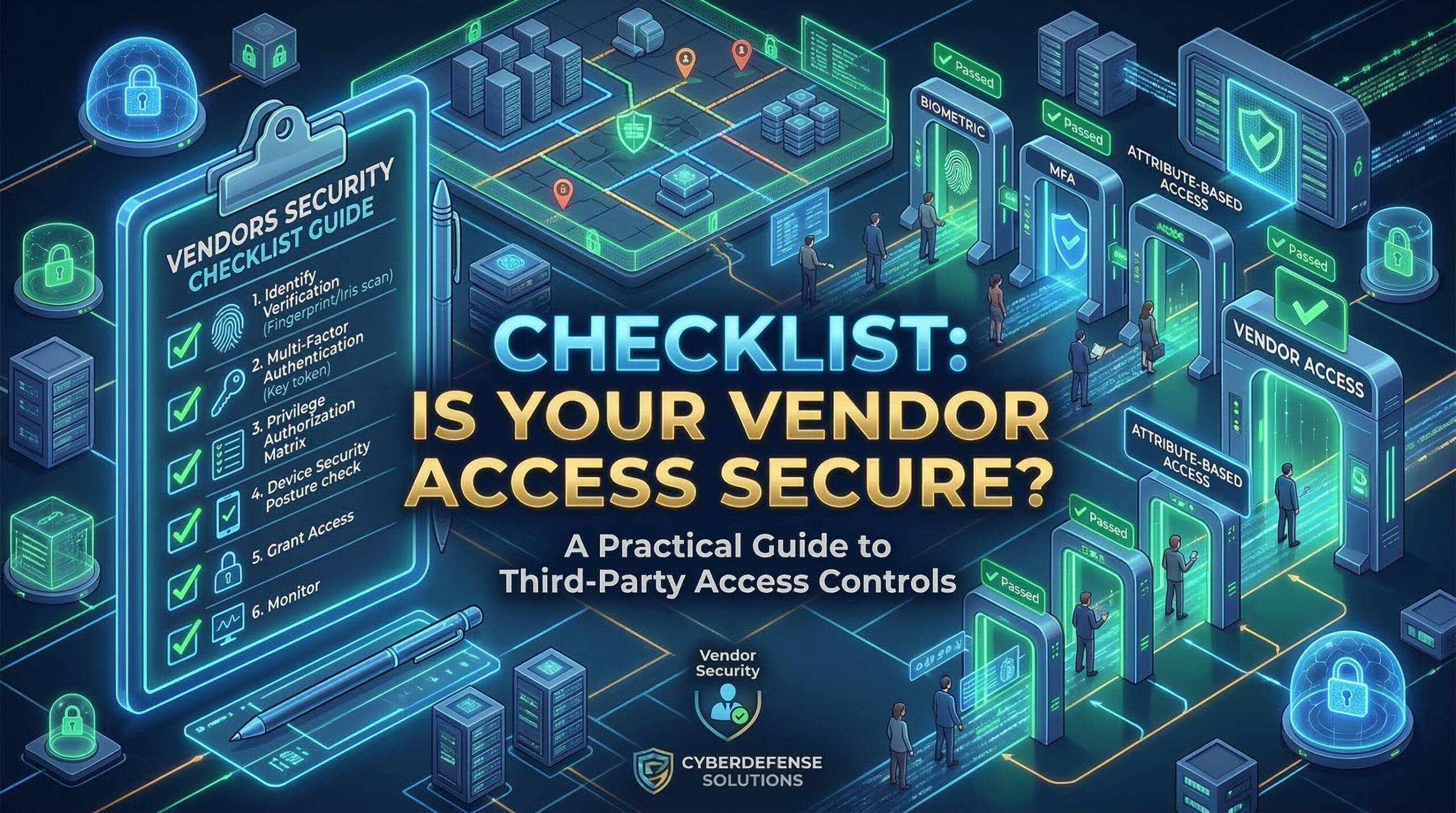
Your organization may have world-class internal security – hardened endpoints, encrypted data, trained employees, and a well-funded SOC. But none of that matters if a vendor with a weak password and excessive permissions can walk straight into your most sensitive systems.
This is not a hypothetical risk. It is the dominant attack pattern of 2024 and 2025. According to SecurityScorecard’s 2025 Global Third-Party Breach Report, at least 35.5% of all data breaches in 2024 originated from third-party compromises – a 6.5% increase from the previous year. Separate analysis from Censinet found that 48% of 2024 data breaches came through third-party vendor connections, with 70% involving overly permissive accounts.
The financial impact is severe. IBM’s 2025 Cost of a Data Breach report identified vendor and supply chain compromise as the second most costly attack vector, averaging $4.91 million per incident. Across all reported incidents in 2024, data from 1.36 billion individuals was exposed through third-party and vendor breaches alone.
The pattern is consistent: attackers do not need to breach your defenses directly. They breach your vendor, steal or reuse credentials, and pivot into your network through the trusted connections you gave them.
This article provides a comprehensive, practical vendor access security checklist that security teams can use to audit their current third-party access posture, identify critical gaps, and implement controls that prevent vendor connections from becoming the entry point for your next breach.
Why Vendor Access Is Your Largest Unmanaged Attack Surface
Before running the checklist, it is important to understand why vendor access security demands specific attention – separate from general access management.
The Scale of the Problem
Organizations today rely on a large and growing ecosystem of external vendors, contractors, managed service providers, cloud platforms, and SaaS applications – each with some level of access to internal systems. Research indicates that the average enterprise manages relationships with 250 to 500 vendors, many of whom have direct or indirect access to sensitive data.
The 2024 Verizon Data Breach Investigations Report found that supply chain breaches made up 15% of all breaches – a 68% increase compared to the previous year. Vulnerability exploitation accounted for roughly 90% of those supply chain interconnection breaches. And SecurityScorecard reported that 41.4% of ransomware attacks now originate through third parties.
Why Traditional Security Falls Short
Standard internal security controls were not designed for vendor access scenarios. The fundamental challenges include:
Vendors need access but should not be trusted like employees. They operate outside your security policies, use their own devices, and manage their own credentials. You cannot enforce your patch management, endpoint protection, or security training standards on their workforce.
Vendor access is often “set and forget.” Access is provisioned when the relationship begins and rarely reviewed afterward. Former vendor employees retain credentials. Project-scoped access outlives the project. Emergency access granted during an incident becomes permanent.
Visibility gaps are enormous. A Censinet study found that 63% of organizations lack clear oversight of vendor permissions, and 50% do not fully track third-party access or monitor vendor compliance effectively. Without a structured vendor risk management program, these gaps compound over time.
Table 1: Major Vendor-Related Breaches (2024-2025)
Incident | What Happened | Impact | Root Cause |
Change Healthcare (Feb 2024) | Ransomware attack via compromised vendor credentials at UnitedHealth’s Optum division | 190 million patient records exposed; $2-2.45 billion in response costs | Stolen credentials, lack of MFA on vendor account |
HealthEquity (Mar 2024) | Attackers used compromised vendor credentials to access SharePoint server | 4.3 million individuals affected | Compromised vendor credentials with excessive access to sensitive storage |
National Public Data (Apr 2024) | Third-party contractor failed to update security patches; attackers stole SSNs and addresses | 170 million individuals affected | Unpatched vendor systems, excessive data access |
Cleo File Transfer (Dec 2024) | Cl0p ransomware group exploited zero-day vulnerabilities in managed file transfer platform | 66+ organizations breached through single vendor vulnerability | Vulnerability in shared vendor infrastructure |
Co-operative Group UK (2025) | Attackers leveraged misconfigured contractor system to access customer data | £206 million in estimated disruption costs | Misconfigured third-party IT vendor system |
Qantas (Jun 2025) | Third-party customer service platform breached | 6 million customer records exposed | Insufficient security controls on vendor platform |
The Vendor Access Security Checklist
The following checklist covers five critical domains of third-party access. For each item, assess whether your organization fully implements the control, partially implements it, or has a gap. Any gap in the first three domains represents a critical vulnerability that should be addressed immediately.
Domain 1: Access Provisioning and Governance
This domain determines whether vendor access is granted with appropriate controls from the outset – or whether it expands silently over time.
- Is every vendor account provisioned through a formal access request process? Vendor accounts should never be created informally. Every account must go through a documented approval workflow that specifies what systems the vendor needs to access, for how long, and with what level of permissions.
- Does each vendor account follow the principle of least privilege? Vendors should receive the minimum permissions required to perform their specific function – nothing more. A vendor managing your HVAC system should not have access to your email server. A consulting firm reviewing your financial processes should not have write access to production databases. This is where 70% of breaches involving overly permissive accounts originate.
- Is vendor access time-bound with automatic expiration? Every vendor access grant should include an expiration date. When the project ends, the engagement concludes, or the contract term expires, access should be revoked automatically – not manually and not “whenever IT gets around to it.” Just-in-time (JIT) access provisioning ensures vendors receive elevated permissions only when actively needed and for the minimum required duration.
- Do you maintain a complete inventory of all vendor accounts and their permissions? If you cannot answer the question “which vendors have access to which systems right now” within minutes, your vendor access security has a critical visibility gap. Automated discovery and classification of vendor accounts should be continuous, not periodic.
- Is there a defined process for offboarding vendor access when relationships end? When a vendor contract terminates, all associated credentials, certificates, API keys, and VPN/ZTNA configurations must be revoked immediately. This includes shared accounts, service accounts, and any embedded credentials the vendor may have configured in automated workflows.
Domain 2: Authentication and Credential Management
Stolen vendor credentials are the leading cause of third-party breaches. This domain evaluates whether your credential management controls are strong enough to prevent credential-based attacks.
- Is multi-factor authentication (MFA) mandatory for all vendor access? No exceptions. Every vendor connection – whether interactive or automated – must require MFA. The Change Healthcare breach, which exposed 190 million records and cost over $2 billion, occurred because a vendor account lacked MFA. Phishing-resistant MFA (FIDO2 hardware keys) should be required for vendors accessing sensitive systems.
- Are vendor credentials managed through a Privileged Access Management system? Vendor credentials should be stored in a centralized vault, automatically rotated on a schedule, and injected into sessions without the vendor ever seeing or knowing the actual password. This eliminates the risk of credential reuse, credential sharing, and credentials persisting on vendor devices.
- Are shared vendor accounts prohibited? Every vendor user must have an individual account tied to a named person. Shared “vendor_admin” or “support_team” accounts make it impossible to audit who performed which action and create accountability gaps that attackers exploit.
- Are vendor credentials automatically rotated on a defined schedule? Passwords, API keys, and service account credentials used by vendors should rotate automatically – at minimum every 90 days for interactive accounts and every 30 days for service accounts. Credentials should also rotate immediately when vendor personnel change.
- Do you enforce unique credentials for each vendor relationship? Vendors should not use the same credentials across multiple client environments. If a vendor’s credentials are compromised at another client, your systems should not be affected.
Domain 3: Network Access and Segmentation
Even with strong authentication, vendor access must be constrained to prevent lateral movement if credentials are compromised. This domain evaluates your network-level controls.
- Are vendor connections segmented from your internal network? Vendors should never have access to the flat corporate network. Their connections must be isolated to specific network segments that contain only the resources they are authorized to access. Microsegmentation enforces this at a granular level, treating each endpoint and application as its own security zone with explicit communication policies.
- Do you use Zero Trust Network Access instead of VPN for vendor connections? Traditional VPNs grant vendors network-level access after a single authentication. Zero Trust access grants application-level access only – the vendor connects to a specific application without seeing or reaching anything else on the network. This eliminates lateral movement risk entirely.
- Are inbound firewall ports opened for vendor access? If your firewall has open ports dedicated to vendor connections, those ports are discoverable by attackers. Reverse access technology eliminates this risk by requiring no inbound connections – the application initiates an outbound connection to a cloud broker, and the vendor connects through the broker without any corporate infrastructure being exposed to the internet.
- Can vendors access your systems from unmanaged or non-compliant devices? Vendor device posture should be verified before access is granted. At minimum, verify that the connecting device has current OS patches, active disk encryption, an enabled firewall, and no known malware indicators. Non-compliant devices should be blocked regardless of credential validity.
- Is vendor access restricted to specific IP ranges, times, or geographic locations? Context-based access policies can significantly reduce vendor access risk. If your vendor operates from a specific office in a specific country during business hours, access attempts from outside those parameters should trigger additional verification or be blocked entirely.
Domain 4: Session Monitoring and Audit
When a vendor is inside your systems, you need visibility into exactly what they are doing. This domain evaluates your monitoring and audit capabilities.
- Are all vendor sessions recorded and logged? Every vendor access session – including screen activity, commands executed, files accessed, and data transferred – should be recorded in a tamper-proof audit log. This is essential for both security investigations and compliance requirements.
- Can you terminate a vendor session in real time? If a vendor session shows suspicious behavior – accessing unauthorized resources, executing unusual commands, or transferring unexpected data volumes – your security team must have the ability to terminate that session immediately.
- Do you receive alerts when vendor access patterns deviate from baseline? Establish baseline behavior for each vendor relationship: what systems they access, when they access them, what operations they perform, and how much data they transfer. Deviations from this baseline should trigger automated alerts and investigation.
- Do you conduct regular audits of vendor access logs? Automated logging is meaningless without review. Conduct monthly audits of vendor access activity focused on identifying excessive access, unauthorized resource access, off-hours activity, and dormant accounts that remain active.
- Are audit logs retained for a sufficient period to support incident investigation? Vendor-related breaches are often discovered months after the initial compromise. Retain vendor access logs for a minimum of 12 months – longer for vendors accessing systems subject to regulatory requirements.
Table 2: Vendor Session Controls – Minimum Standards
Control | Minimum Standard | Best Practice |
Session recording | All vendor sessions logged with timestamp, user ID, and actions performed | Full screen recording with keystroke logging for privileged sessions |
Real-time termination | Ability to end any vendor session within 60 seconds | Automated termination based on policy violations |
Access alerting | Alerts for after-hours access and failed authentication attempts | Context-based alerting on deviation from behavioral baseline |
Log retention | 12 months minimum | 24 months, with integration to SIEM for correlation |
Audit frequency | Quarterly manual review of vendor access logs | Monthly automated review with exception-based escalation |
Domain 5: Vendor Risk Assessment and Contractual Controls
Technical controls are essential, but they must be supported by governance processes that establish expectations, verify compliance, and allocate responsibility for security failures.
- Do you conduct security assessments of vendors before granting access? Every vendor that will access your systems should undergo a security assessment before onboarding. This assessment should evaluate the vendor’s security posture, including their credential management practices, endpoint protection, incident response capabilities, and their own third-party risk management program.
- Do your vendor contracts include specific security requirements? Contracts should specify MFA requirements, encryption standards, breach notification timelines, right-to-audit clauses, data handling restrictions, and liability allocation for security incidents originating from the vendor’s access or systems.
- Do you assess your vendors’ third-party risk (fourth-party risk)? Your vendor’s vendors are your risk too. SecurityScorecard recommends requiring vendors to maintain their own third-party risk management programs. The Cleo file transfer breach in December 2024 demonstrated how a single vulnerability in a shared vendor platform can cascade across 66+ organizations simultaneously.
- Do you require vendors to notify you of security incidents within a defined timeframe? Your vendor contract should specify mandatory breach notification – typically within 24-72 hours of discovery. Without this requirement, you may not learn about a vendor compromise until it has already been used to pivot into your systems.
- Do you conduct periodic re-assessments of existing vendor security posture? Initial assessments are insufficient. Vendor security posture changes over time – staff turnover, infrastructure changes, and their own security incidents can create new vulnerabilities. Conduct annual reassessments for all vendors with system access, and continuous monitoring for vendors with access to critical systems.
Table 3: Vendor Access Security Scoring Matrix
Use this matrix to score your organization’s vendor access posture across all five domains.
Domain | Questions | Fully Implemented (2 pts each) | Partially Implemented (1 pt) | Gap (0 pts) | Your Score |
Access Provisioning | Q1-Q5 | /10 | /10 | ||
Authentication & Credentials | Q6-Q10 | /10 | /10 | ||
Network Access & Segmentation | Q11-Q15 | /10 | /10 | ||
Session Monitoring & Audit | Q16-Q20 | /10 | /10 | ||
Vendor Risk Assessment | Q21-Q25 | /10 | /10 | ||
TOTAL | /50 |
Score Interpretation:
- 40-50: Strong. Your vendor access security controls are comprehensive. Focus on continuous improvement and emerging threat adaptation.
- 25-39: Moderate. Significant controls exist but gaps remain. Prioritize domains scoring below 6/10 for immediate remediation.
- 10-24: Weak. Critical vulnerabilities exist in your vendor access posture. The 2024 breach data strongly suggests organizations at this level will experience a vendor-related incident.
- Below 10: Critical. Vendor access is essentially uncontrolled. Treat this as an emergency remediation priority.
Implementation Priorities: Where to Start
If your organization scores below 40, the following implementation sequence addresses the highest-risk gaps first.
Immediate Actions (Week 1-2)
- Enforce MFA on all vendor accounts. This single action eliminates the most common attack vector. The Change Healthcare breach – 190 million records, over $2 billion in costs – happened because one vendor account lacked MFA.
- Inventory all active vendor accounts. Identify every vendor account, its permissions, and when it was last used. Disable any account that has not been used in 90 days.
- Revoke excessive permissions. Review the top 10 vendors with the broadest access and reduce their permissions to the minimum required for current activities.
Short-Term Actions (Month 1-3)
- Deploy Privileged Access Management for vendor credentials. Centralize credential storage, enforce automatic rotation, and implement credential injection so vendors never see actual passwords.
- Replace VPN-based vendor access with ZTNA. Migrate vendor connections from VPN to Zero Trust Network Access with application-level access controls, continuous identity verification, and device compliance checks.
- Implement session logging for all vendor access. Ensure every vendor session is recorded with sufficient detail to support forensic investigation.
Medium-Term Actions (Month 3-6)
- Deploy microsegmentation. Isolate vendor access zones from internal network segments to prevent lateral movement from any compromised vendor connection.
- Implement just-in-time access provisioning. Replace standing vendor access with time-bound, approval-based access that expires automatically.
- Establish continuous vendor security monitoring. Automate the assessment of vendor security posture using external risk scoring and integrate alerts into your security operations workflow.
How TerraZone Secures Vendor Access
TerraZone’s platform addresses the specific challenges of vendor access security – without requiring organizations to extend their internal network to external parties or trust vendor devices.
Zero Trust Access for Vendors
TerraZone’s truePass platform enforces application-level access for every vendor connection. Instead of granting network-level access through a VPN, truePass connects vendors directly to the specific applications they are authorized to use – nothing else on the network is visible or reachable.
Key capabilities:
- Patented Reverse Access Technology – eliminates all inbound firewall ports for vendor connections. The corporate network is completely hidden from the internet. Vendors connect through a cloud broker without any corporate infrastructure being exposed.
- Continuous Identity and Device Verification – every vendor session is continuously verified against identity, device compliance, and access policy. If a vendor device fails a posture check mid-session, access terminates immediately.
- Granular, Identity-Based Access Policies – define exactly which vendor users can access which applications, from which devices, during which hours, and from which locations. Each access request is evaluated independently.
Privileged Access Management
TerraZone’s PAM capabilities ensure that vendor credentials are never exposed, never shared, and never persistent. Credentials are stored in a centralized vault, automatically rotated, and injected into vendor sessions without the user seeing the actual password. Full session recording provides a complete audit trail for every privileged vendor action.
Microsegmentation
Even if a vendor account is compromised, TerraZone’s microsegmentation ensures the attacker cannot move laterally. Each network segment operates as an isolated security zone with explicit communication policies. A compromised vendor session in one segment cannot discover, scan, or reach resources in any other segment.
Table 4: Vendor Access – Before and After TerraZone
Vendor Access Scenario | Without TerraZone | With TerraZone |
Vendor connects to your network | VPN grants broad network-level access; lateral movement possible | ZTNA grants access to specific application only; network is hidden |
Vendor credentials are stolen | Attacker gains full network access with vendor’s permissions | MFA blocks unauthorized use; even if bypassed, access limited to single application; microsegmentation blocks lateral movement |
Vendor device is compromised | No device compliance checking; compromised device connects freely | Device posture verified before and during session; non-compliant device blocked automatically |
Vendor access outlives the engagement | Dormant accounts persist indefinitely | JIT access expires automatically; access reviews enforced through policy |
Vendor session activity | Limited or no visibility into vendor actions | Full session recording with keystroke logging and real-time termination capability |
Vendor infrastructure is exposed | Open firewall ports for vendor VPN connections are discoverable | No inbound connections; corporate network completely hidden via Reverse Access |
Conclusion
The data is unambiguous: vendor access is the fastest-growing attack vector in enterprise security. One-third of all breaches now originate through third parties. The average cost of a vendor-related breach exceeds $4.9 million. And the most damaging breaches of 2024 and 2025 – Change Healthcare, HealthEquity, National Public Data, Cleo, Qantas – all traced back to vendor access that was insufficiently controlled.
The 25-point checklist in this article provides a structured framework for evaluating and remediating your vendor access security posture. The critical priorities are clear: enforce MFA on every vendor account, eliminate excessive permissions, replace VPN access with Zero Trust, implement session monitoring, and establish governance processes that hold both your organization and your vendors accountable.
Every vendor connection is a door into your network. The question is whether that door has a lock, a guard, and a camera – or whether it is standing open.
Assess your vendor access posture today. TerraZone’s Zero Trust platform enforces application-level vendor access, continuous identity verification, privileged credential management, microsegmentation, and full session audit – ensuring that every vendor connection is controlled, contained, and visible.