

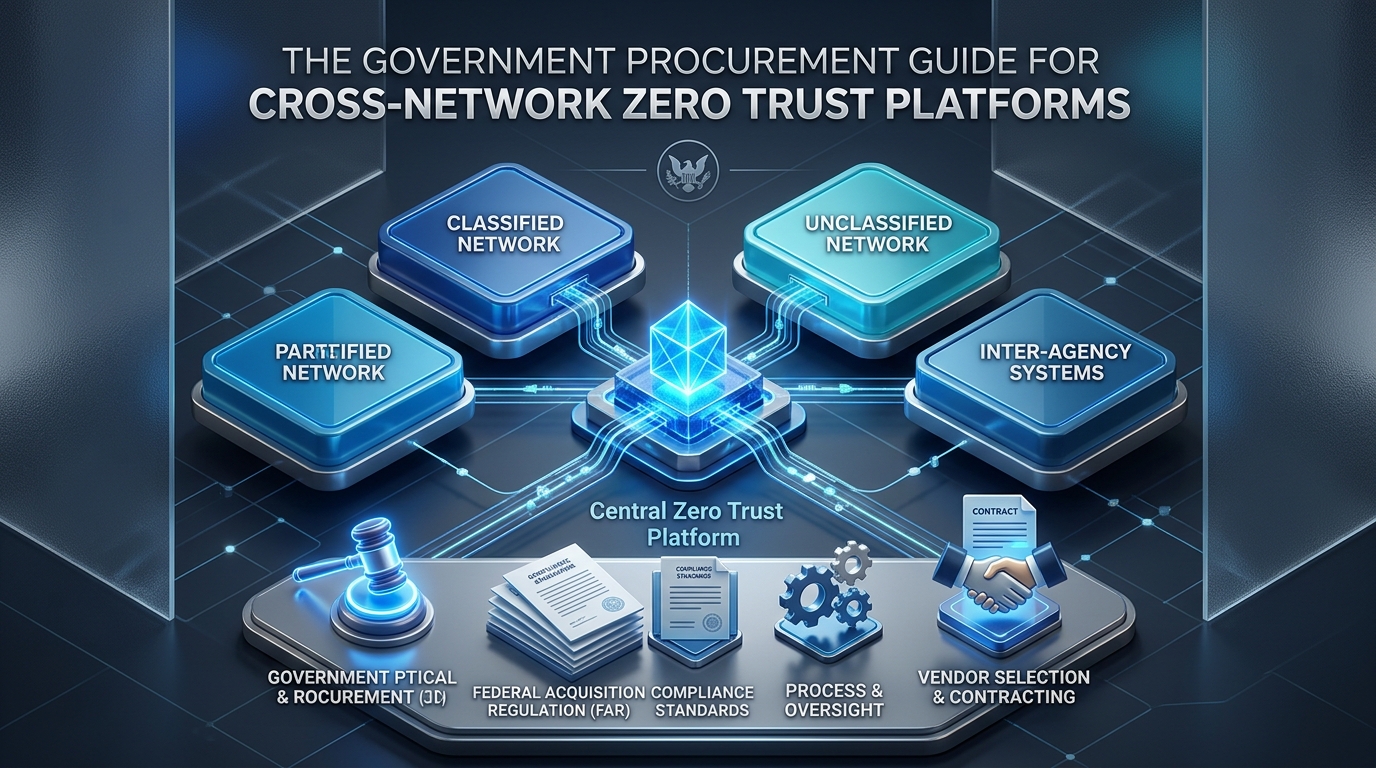
Why Government CISOs Need a Procurement-Specific Guide for Zero Trust
Government procurement of cybersecurity platforms is fundamentally different from commercial purchasing. A government CISO cannot simply evaluate a product, select a vendor, and issue a purchase order. The acquisition must navigate contract vehicles (GSA MAS, EIS, OASIS+, Polaris GWAC), comply with FAR and DFARS requirements, satisfy the Authorizing Official through the RMF process, demonstrate alignment with Executive Order 14028 and OMB M-22-09, and produce documentation that survives audit – all before a single component is deployed.
The challenge intensifies when the platform crosses network boundaries. A government procurement cross network zero trust platform must secure connectivity between classification levels, between IT and OT zones, between agency infrastructure and external partners, and between on-premises systems and cloud services. Each boundary introduces additional compliance requirements, authorization considerations, and architectural constraints that standard ZTNA procurement guides do not address.
As of early 2025, only 14% of DoD target-level Zero Trust activities had been completed. The FY 2026 NDAA allocated $15 billion for cyber modernization. Agencies are under simultaneous pressure to move faster and procure smarter. This guide provides the procurement framework that government CISOs need to acquire cross-network Zero Trust connectivity platforms through existing acquisition vehicles, with defensible requirements, structured evaluation criteria, and compliance documentation from day one.
What Procurement Vehicles Support Cross-Network Zero Trust Acquisition?
Government CISOs do not need new contracting authority to procure Zero Trust platforms. Existing vehicles already support this acquisition category – the challenge is selecting the right vehicle for the scope and timeline.
Mapping Acquisition Vehicles to Zero Trust Platform Procurement
Vehicle | Best For | Timeline | Key Considerations |
GSA MAS (Multiple Award Schedule) | Single-agency procurement; defined scope; commercial products | 2–6 months from requirement to award | SIN 54151S (IT Professional Services) and 518210C (Cloud and Cloud-Related IT Services); streamlined ordering procedures; best value determination required |
GSA EIS (Enterprise Infrastructure Solutions) | Network infrastructure and telecommunications; multi-site deployments | 6–12 months | BIC-designated; includes ZTA use cases; Task Order Unique CLINs (TUCs) for customized solutions; EIS sunsets 2032 |
OASIS+ / Polaris GWAC | Complex IT services; multi-domain requirements; integration-heavy deployments | 4–8 months per task order | OASIS+ Phase II opened January 2026; Polaris first awards issued late 2025; suitable for deployments requiring significant integration services |
Agency-specific IDIQ | Agency with existing IDIQ covering cybersecurity/network services | 2–4 months per task order | Fastest path if an existing vehicle covers the scope; may limit competition |
OneGov Agreement | Standardized enterprise-wide pricing; commercial software | Weeks to months | GSA negotiates pre-set terms; primarily for widely-used commercial products; expanding into cybersecurity in 2026 |
Direct contract (FAR Part 15) | Unique requirement; no existing vehicle covers scope | 12–18 months | Full and open competition; longest timeline; most procurement overhead; use only when no existing vehicle fits |
The Vehicle Selection Decision
For most government procurement cross network zero trust platform acquisitions, GSA MAS provides the fastest path for initial deployment, while EIS supports the network infrastructure components for larger multi-site rollouts. The GSA Zero Trust Architecture Technology Book explicitly maps EIS services to each pillar of the CISA Zero Trust Maturity Model, providing direct procurement-to-compliance traceability.
For defense agencies, DFARS-specific requirements (including CMMC alignment and ITAR considerations) may require agency-specific vehicles or OASIS+ task orders that incorporate cleared personnel and classified facility requirements.
What Should the Requirements Document Include?
The requirements document is where most government Zero Trust procurements succeed or fail. Requirements that are too generic attract solutions that check boxes but do not address cross-network connectivity. Requirements that are too vendor-specific risk protest. The following framework balances technical precision with competitive fairness.
Mandatory Technical Requirements
These are pass/fail criteria. A solution that does not meet every mandatory requirement is eliminated from evaluation.
Requirement Category | Specific Requirement | Why It Matters | Verification Method |
Architecture | Zero inbound firewall ports on protected networks | Eliminates the primary attack vector for ransomware in government OT environments | Architectural diagram review + external scan during pilot |
Architecture | On-premises deployment option with no data routing through vendor cloud infrastructure | Required for classified and sensitive environments where data cannot traverse commercial cloud | Deployment architecture review; data flow diagram verification |
Architecture | Support for multiple network boundaries (IT/OT, classified/unclassified, agency/external) from a single platform | Cross-network capability is the core requirement; multiple platforms for different boundaries defeats consolidation | Architecture review + pilot demonstration across two boundary types |
Identity | Per-session MFA for every access request (not just initial login) | DoD ZT framework and OMB M-22-09 require continuous authentication; VPN-level MFA is insufficient | Configuration review + pilot testing |
Identity | Native PIV/CAC integration through AD/LDAP certificate chain | Federal identity infrastructure requirement; solutions requiring workarounds for PIV/CAC create compliance gaps | PIV/CAC authentication test during pilot |
Identity | Named individual accounts for all users including vendors (no shared credentials) | Session attribution requires named identity; shared credentials make incident investigation impossible | Policy configuration review |
Access Control | Application-level access to specific resources (not network-level access) | Least privilege principle; network-level VPN access enables lateral movement | Policy demonstration: user accesses one workstation, cannot reach others |
Access Control | Per-workstation/per-application access policies with time-window and approval workflow support | Granular policy enforcement required by NIST 800-207 and DoD ZT capability outcomes | Policy configuration + scenario testing |
File Sharing | Integrated bidirectional file sharing with CDR (Content Disarm & Reconstruction) scanning | Cross-network file exchange without CDR is a malware delivery vector; separate products fragment the audit trail | File transfer test with known-malicious test files |
File Sharing | SMB protocol support with Kerberos/NTLM authentication and SMB Signing | Required for compatibility with existing government file sharing infrastructure | SMB share access test from standard Windows workstation |
Audit | Session recording (video + keystroke capture) for all interactive sessions | Required for classified environments; critical for incident investigation and compliance evidence | Session recording playback review |
Audit | Unified audit trail across all connectivity types (application access + file sharing + data transfer) with single Syslog feed | Fragmented logs from multiple products increase MTTI and create compliance gaps; consolidated audit reduces investigation time by 95% | SIEM integration test; log completeness review |
Compliance | Mappable to CISA ZTMM v2.0 across all five pillars | Required for OMB M-22-09 compliance reporting | Vendor-provided compliance mapping document |
Deployment | Deployable on standard VMs (no specialized hardware) | Eliminates hardware procurement cycle; enables phased deployment within existing infrastructure | Deployment architecture specification review |
Desirable Technical Requirements
These are scored criteria that differentiate competitive solutions. Higher capability earns more evaluation points.
Requirement | Scoring Criteria |
Device posture assessment at every session (OS, EDR, encryption, patch level) | Full posture check = 10 pts; partial = 5 pts; none = 0 pts |
Approval workflow integration (ServiceNow, ITSM) | Native API integration = 10 pts; manual workflow = 5 pts; not supported = 0 pts |
Support for legacy OT protocols (RDP to SCADA, SSH to engineering workstations) | Full OT support = 10 pts; IT-only = 0 pts |
Deployment within 2 weeks for initial pilot (excludes full migration) | ≤ 2 weeks = 10 pts; 2–4 weeks = 5 pts; > 4 weeks = 0 pts |
Vendor provides phased migration methodology with rollback criteria per phase | Documented methodology = 10 pts; ad hoc approach = 0 pts |
How Should the Evaluation Be Structured?
Evaluation Factors and Weighting
Government CISOs should weight evaluation factors to reflect the operational reality that cross-network connectivity platforms are security infrastructure, not commodity IT products. The recommended weighting:
Factor | Weight | Rationale |
Technical Capability | 40% | Does the solution meet all mandatory requirements? How does it score on desirable requirements? |
Security Architecture | 25% | Zero inbound ports, on-premises data path, application-level isolation, session recording – the architectural properties that determine actual security posture |
Past Performance | 15% | Demonstrated deployments in government and defense environments; references from agencies with similar classification and OT requirements |
Management Approach | 10% | Migration methodology, phased deployment plan, rollback procedures, training and knowledge transfer |
Price | 10% | Total cost of ownership including licensing, deployment, integration, and ongoing support – not just unit price |
Why Security Architecture Warrants Separate Weighting
Most government IT procurements weight Technical Capability and Price as the primary factors. For cross-network Zero Trust platforms, this is insufficient. Two solutions may both claim “zero trust” capability, but one routes all traffic through a vendor cloud while the other keeps all traffic on-premises. One opens inbound firewall ports while the other eliminates them. One requires separate products for file sharing and session recording while the other integrates them.
These architectural differences are not feature comparisons – they are fundamental security posture decisions that determine whether classified data stays within agency-controlled infrastructure and whether the agency’s attack surface increases or decreases. Weighting architecture separately ensures these decisions are evaluated on their security merit, not buried in a feature checklist.
The Pilot Demonstration
Every government procurement cross network zero trust platform should include a pilot demonstration as part of the evaluation. The pilot validates that the solution actually delivers what the vendor claims – in the agency’s environment, with the agency’s identity infrastructure, across the agency’s network boundaries.
Pilot scope (minimum 2 weeks):
- Deploy platform infrastructure (Access Controller + Gateway) in agency test environment
- Integrate with agency Active Directory / PIV infrastructure
- Configure 5 test sessions across at least 2 network boundaries (e.g., IT-to-OT and classified-to-unclassified)
- Demonstrate per-session MFA, device posture check, and session recording
- Execute bidirectional file transfer with CDR scanning
- Run external scan to verify zero discoverable services
- Export audit trail to agency SIEM; verify log completeness
- Demonstrate rollback: remove platform, verify legacy connectivity is unaffected
Evaluation during pilot:
Pilot Criterion | Pass/Fail | Notes |
Platform deploys with zero inbound firewall rules | Pass/Fail | Any inbound rule = automatic fail |
PIV/CAC authentication works natively | Pass/Fail | Workarounds or third-party bridges = fail |
Session recording captures complete session (video + keystroke) | Pass/Fail | Partial capture = fail |
CDR scanning blocks test malware in file transfer | Pass/Fail | Any unscanned file crossing boundary = fail |
External scan returns zero results | Pass/Fail | Any discoverable service = fail |
Unified audit trail in SIEM contains complete session records | Pass/Fail | Missing fields or fragmented records = fail |
What Compliance Documentation Should the Vendor Provide?
Government procurement requires compliance documentation at acquisition time, not after deployment. The vendor should provide the following as part of their proposal response:
Pre-Award Documentation
Document | Purpose | What to Look For |
CISA ZTMM Pillar Mapping | Demonstrates how the solution addresses each of the five ZTMM pillars and cross-cutting capabilities | Coverage across all five pillars; specific capability outcomes cited; maturity stage supported for each pillar |
NIST SP 800-207 Alignment | Maps solution architecture to Zero Trust Architecture tenets | Per-request access decisions; continuous verification; least privilege enforcement; data-plane/control-plane separation |
IEC 62443 FR Mapping (if OT applicable) | Maps solution to Foundational Requirements for OT security | FR1-FR7 coverage; specification of which security levels (SL1-SL4) the solution supports |
Data Flow Diagram | Shows exactly where data travels during all session types | Verification that no data routes through vendor-controlled infrastructure for classified use cases |
Architecture Security Assessment | Independent or vendor-provided assessment of the platform’s security architecture | Focus on attack surface analysis: inbound ports, internet-facing components, authentication chain, encryption standards |
Supply Chain Risk Management (SCRM) documentation | Addresses EO 14028 requirements for software supply chain security | SBOM availability; secure development practices; vulnerability disclosure process; origin of components |
Post-Award / Pre-Deployment Documentation
Document | Purpose |
Deployment architecture for agency environment | Site-specific architecture showing component placement, network boundaries, and data flows |
Security assessment report (SAR) for RMF | Supports the AO’s authorization decision; maps platform to applicable NIST 800-53 controls |
Ongoing assessment plan | Defines how the platform will be continuously monitored and assessed per FISMA requirements |
What Are the Common Procurement Mistakes – and How to Avoid Them?
Mistake 1: Procuring ZTNA as a Point Solution
What goes wrong: The agency procures a ZTNA solution for application access, then discovers it does not handle file sharing across classification boundaries. A separate procurement for an SMB proxy follows. Then another for session recording. The result is the same multi-vendor patchwork the agency was trying to escape – just with newer products.
How to avoid it: The requirements document must specify cross-network connectivity as the scope – application access AND file sharing AND session recording AND unified audit – in a single platform. The evaluation criteria must penalize solutions that require supplementary products to achieve full coverage. Solutions like truePass Gravity that integrate all three layers (reverse-access infrastructure, SMB Proxy with CDR, and Zero Trust application access) in a single platform should score higher than architectures requiring 2–3 separate procurements.
Mistake 2: Specifying Cloud-Delivered ZTNA Without Data Path Analysis
What goes wrong: The agency selects a cloud-delivered ZTNA solution based on FedRAMP authorization and feature comparison, without analyzing where data actually travels. After deployment, the compliance team discovers that classified or CUI data is routing through the vendor’s commercial cloud infrastructure – violating data sovereignty requirements.
How to avoid it: The requirements document must include a mandatory data flow analysis. For any environment handling classified, CUI, ITAR-controlled, or law enforcement sensitive data, the requirements should specify on-premises deployment with no vendor cloud data path. The truePass platform operates entirely within agency-controlled infrastructure – all traffic stays on-premises with zero dependency on external cloud services.
Mistake 3: Accepting Network-Level Access as “Zero Trust”
What goes wrong: The vendor claims “Zero Trust” but the solution provides VPN-like network-level access after authentication. Users can reach any device on the network segment – not just their authorized resource. The agency has a “Zero Trust” product in the ATO package but network-level lateral movement is still possible.
How to avoid it: The pilot demonstration must include a lateral movement test: after authenticating to one resource, the evaluator attempts to reach an adjacent resource on the same network. If the attempt succeeds, the solution does not provide application-level isolation and does not meet Zero Trust least-privilege requirements.
Mistake 4: Not Including Legacy Gateway Decommission in the SOW
What goes wrong: The agency deploys the new platform but the legacy VPN, jump server, and SMB proxy remain operational because the SOW did not include decommission planning. The attack surface increases – the agency now has the legacy stack plus the new platform.
How to avoid it: The SOW must include phased legacy gateway replacement with explicit decommission milestones, external scan validation at each milestone, and success criteria that include the removal of legacy inbound firewall rules.
Mistake 5: Evaluating on Price Per User Without Total Cost of Ownership
What goes wrong: The agency selects the lowest per-user license cost, then discovers that the solution requires separate products for file sharing ($X), session recording ($Y), CDR scanning ($Z), and integration services to connect them all. The total cost exceeds the higher-priced consolidated platform.
How to avoid it: The price evaluation must require vendors to quote the total cost of ownership for all connectivity types specified in the requirements – not just application access. The cost comparison table should include:
Cost Element | Vendor A (Consolidated) | Vendor B (Point Solution + Supplements) |
Platform license | Quoted | Quoted |
File sharing / SMB proxy | Included | Separate procurement required: $____ |
Session recording | Included | Separate procurement required: $____ |
CDR scanning | Included | Separate procurement required: $____ |
Integration services (connecting 3+ products) | Not required | Required: $____ |
SIEM integration (number of log sources) | 1 feed | 3–4 feeds: integration labor $____ |
Annual maintenance (all products) | Single contract | Multiple contracts: $____ |
Estimated vendor count | 1 | 3–4 |
What KPIs Should the CISO Track After Procurement?
Procurement is not the finish line – it is the starting point. The government CISO must establish measurable KPIs for OT connectivity security from day one to demonstrate that the investment is producing results:
KPI | Baseline (Legacy Stack) | Target (Post-Deployment) | Measurement Frequency |
Inbound Port Exposure Index | Document before deployment | 0 | Monthly (firewall audit + external scan) |
Connectivity Consolidation Ratio | Products ÷ connectivity types | ≤ 0.4 | Quarterly |
Session Attribution Coverage | % sessions with full identity + recording | 95%+ | Monthly |
Mean Time to Investigate (MTTI-OT) | Hours per session reconstruction | < 15 minutes | Per incident |
Zero Trust Coverage | % sessions meeting all 5 ZT criteria | 90%+ | Monthly |
These KPIs provide the evidence base for the agency’s next budget cycle, ATO renewal, and IG audit response.
What Does the Procurement Timeline Look Like End-to-End?
Phase | Timeline | Key Activities | Deliverables |
Requirements Development | Weeks 1–4 | Define cross-network scope; map to CISA ZTMM; draft mandatory/desirable requirements; identify acquisition vehicle | Requirements document; acquisition strategy memo |
Market Research | Weeks 5–8 | Issue RFI; conduct vendor demonstrations; analyze responses against requirements; validate vehicle selection | Market research report; vendor shortlist |
Solicitation | Weeks 9–16 | Issue RFQ/RFP through selected vehicle; evaluate proposals; conduct pilot demonstrations | Evaluation report; pilot results |
Award | Weeks 17–20 | Best value determination; award notification; debrief unsuccessful offerors | Contract award; SOW with decommission milestones |
Deployment Phase 1 | Weeks 21–28 | Deploy platform; integrate identity; migrate interactive access; decommission VPN + jump server | Phase 1 completion; external scan verification |
Deployment Phase 2 | Weeks 29–36 | Migrate file sharing; CDR validation; one-way flow evaluation | Phase 2 completion; full audit trail operational |
ATO / Compliance | Weeks 37–40 | RMF security assessment; ATO documentation; compliance mapping; KPI baseline | ATO decision; KPI dashboard operational |
Total timeline from requirements to operational ATO: approximately 10 months. For agencies using existing IDIQ vehicles with pre-competed task orders, the procurement phases (Weeks 1–20) can compress to 8–10 weeks.
Conclusion
Government procurement cross network zero trust platforms is not a standard IT acquisition. It requires procurement-specific planning that addresses classification boundaries, federal identity infrastructure, on-premises data sovereignty, legacy gateway decommission, and compliance documentation that satisfies both the acquisition authority and the Authorizing Official.
The framework in this guide – vehicle selection, requirements template, evaluation criteria with architectural weighting, mandatory pilot demonstration, compliance documentation requirements, TCO-based price evaluation, and post-procurement KPIs – provides the structure that government CISOs need to execute this acquisition defensibly and efficiently.
The mandate is clear: EO 14028, OMB M-22-09, DTM 25-003, and the CISA ZTMM all require Zero Trust implementation. The budget is allocated: $15 billion in the FY 2026 NDAA. The acquisition vehicles exist: GSA MAS, EIS, OASIS+, Polaris. What remains is the procurement execution – and the agency that starts with the right requirements, the right evaluation structure, and the right deployment partner for government and defense environments will reach operational Zero Trust faster than the agency that procures point solutions and discovers the gaps after award.