

What Makes a Zero Trust Platform “Best” for Enterprise?
The question “what is the best zero trust platform for enterprise?” appears simple. The answer is not. Enterprise environments vary dramatically – a global financial services firm with 200,000 cloud-first employees has fundamentally different requirements than a defense contractor managing classified networks alongside OT/SCADA systems. A healthcare organization balancing HIPAA compliance with clinical IoT security faces constraints that a SaaS company never encounters.
The ZTNA market is projected to grow from $1.34 billion in 2025 to $4.18 billion by 2030 at a CAGR of 25.5%. Gartner forecasted that by 2025, at least 70% of new remote access deployments would use ZTNA over VPN. A 2023 Gartner survey found that 63% of organizations worldwide had fully or partially implemented a Zero Trust strategy. The market is maturing rapidly – but maturity does not mean uniformity.
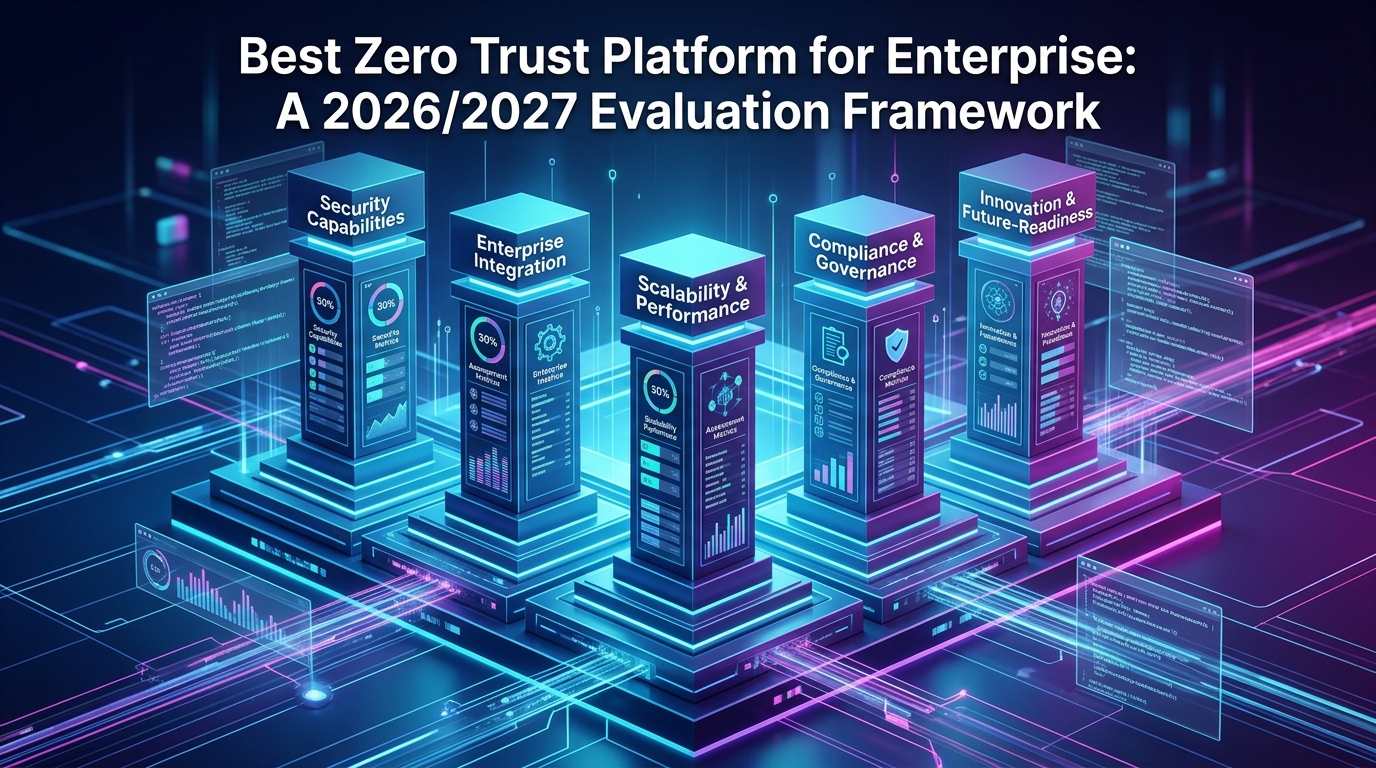
The best zero trust platform for enterprise depends on seven evaluation dimensions that this guide examines in depth: architecture model, deployment flexibility, connectivity scope, identity integration, compliance coverage, operational complexity, and total cost of ownership.
How Do Zero Trust Platform Architectures Differ?
Not all “Zero Trust” platforms are architecturally equivalent. The architecture determines where data travels, what attack surface exists, and which enterprise environments the platform can actually serve. Three primary architecture models dominate the market:
Cloud-Native (Traffic Routes Through Vendor Cloud)
Vendors like Zscaler, Netskope, and Cloudflare operate global cloud networks through which all user traffic is routed. The user connects to the vendor’s nearest point of presence (PoP), the vendor applies policy and inspection, and the connection is brokered to the target application.
Strengths: Global scale with hundreds of PoPs; low-latency access for distributed workforces; integrated SWG, CASB, and DLP; rapid deployment for SaaS-heavy environments.
Limitations: All traffic traverses vendor-controlled infrastructure – problematic for classified, ITAR-controlled, or sovereignty-restricted data. Limited OT/SCADA support (optimized for IT applications). Vendor dependency for availability and data path integrity.
Best for: Global enterprises with cloud-first IT environments, distributed remote workforces, and SaaS-dominant application portfolios.
Hybrid (Agent + Cloud Broker)
Vendors like Palo Alto (Prisma Access), Cisco (Secure Access), and Fortinet (FortiSASE) combine on-premises agents or connectors with cloud-based policy enforcement. Traffic may route through the vendor cloud or stay on-premises depending on configuration.
Strengths: Leverage existing vendor ecosystem (existing Palo Alto firewalls, Cisco switches); flexible deployment models; strong integration with vendor-native security tools.
Limitations: Complexity increases with hybrid configurations; multiple licensing tiers create cost unpredictability; OT support varies significantly. Data path depends on specific configuration – enterprises must verify where traffic actually travels for each use case.
Best for: Enterprises already standardized on a specific vendor’s security ecosystem seeking to extend into Zero Trust without rip-and-replace.
On-Premises Reverse Access (Traffic Stays Within Enterprise Infrastructure)
Platforms like truePass and AppGate SDP deploy entirely within enterprise-controlled infrastructure. A connector inside the protected network initiates outbound connections to a gateway – no inbound firewall ports, no vendor cloud data path, no traffic leaving the enterprise perimeter.
Strengths: Zero inbound ports (patented in truePass); all data stays on-premises; suitable for classified, regulated, and OT environments; no vendor cloud dependency; unified IT and OT connectivity from a single platform.
Limitations: No global PoP network (latency depends on enterprise network, not vendor infrastructure); enterprises must manage their own infrastructure; not optimized for SaaS-only environments.
Best for: Enterprises with on-premises applications, classified/regulated data, OT/SCADA environments, or data sovereignty requirements that prohibit traffic routing through external cloud infrastructure.
What Capabilities Should the Best Zero Trust Platform for Enterprise Include?
The market uses “Zero Trust” loosely. Some platforms provide ZTNA (application access only). Others provide SSE (SWG + CASB + ZTNA). A few provide full cross-network connectivity (application access + file sharing + session recording + microsegmentation). The best zero trust platform for enterprise should be evaluated against the full capability spectrum:
Capability Matrix: What Is Included vs. What Requires Separate Products?
Capability | Cloud-Native ZTNA (Zscaler, Netskope, Cloudflare) | Hybrid SASE (Palo Alto, Cisco, Fortinet) | Identity Platform (Okta, Microsoft Entra) | On-Premises Reverse Access (truePass, AppGate) |
Application-level access (RDP, SSH, HTTP) | Yes | Yes | Partial (web apps; RDP/SSH limited) | Yes |
SWG (Secure Web Gateway) | Yes (integrated) | Yes (integrated) | No | No (not the use case) |
CASB | Yes (integrated) | Yes (integrated) | Partial | No (not the use case) |
DLP (inline) | Yes | Yes | Partial | No (CDR scanning for file transfers) |
Bidirectional file sharing with CDR | No (separate product) | No (separate product) | No | truePass: Yes (integrated SMB Proxy + CDR). AppGate: No |
Session recording (video + keystroke) | Limited/add-on | Limited/add-on | No | truePass: Yes (built-in). AppGate: Limited |
OT/SCADA workstation access | Limited (IT-optimized) | Limited | No | Yes (primary use case for truePass) |
Microsegmentation | Limited | Palo Alto: Yes (via acquisition). Others: Limited | No | truePass: Yes (integrated). AppGate: Partial |
Zero inbound firewall ports | Yes (cloud side) | Depends on config | N/A | Yes (architectural) |
On-premises data path (no vendor cloud) | No | Configurable | No (cloud service) | Yes |
PIV/CAC/smartcard native support | Vendor-dependent | Vendor-dependent | Yes (Entra) | truePass: Yes. AppGate: Yes |
Per-session MFA | Yes | Yes | Yes | Yes |
Unified audit trail across all connectivity types | Yes (for ZTNA traffic) | Partial (depends on products in stack) | No (identity events only) | truePass: Yes (all connectivity types). AppGate: Partial |
What the Matrix Reveals
No single vendor category covers every capability. The best zero trust platform for enterprise depends on which capabilities matter most for the specific enterprise:
If the enterprise is cloud-first with SaaS-dominant applications and a distributed remote workforce: Cloud-native platforms (Zscaler, Netskope) provide the broadest capability coverage for this profile – SWG, CASB, DLP, and ZTNA in one platform with global scale.
If the enterprise has significant on-premises applications, classified data, or OT/SCADA environments: On-premises reverse access platforms provide capabilities that cloud-native solutions architecturally cannot – zero inbound ports, on-premises data path, integrated file sharing with CDR, session recording, and OT/SCADA workstation access. truePass Gravity uniquely combines all three connectivity layers (reverse-access infrastructure, SMB Proxy with CDR scanning, and Zero Trust application access with session recording) in a single platform.
If the enterprise is already standardized on a specific vendor ecosystem: Hybrid platforms from Palo Alto, Cisco, or Fortinet extend existing investments into Zero Trust without architectural disruption – but may require supplementary products for file sharing, session recording, and OT support.
If the primary requirement is identity governance: Okta and Microsoft Entra provide the strongest identity-centric Zero Trust but do not address network connectivity, file sharing, or OT environments directly.
How Should Enterprises Evaluate the Best Zero Trust Platform?
The 10-Point Evaluation Framework
# | Evaluation Criterion | What to Ask | Why It Matters |
1 | Data path | Where does traffic travel? Through vendor cloud or on-premises only? | Determines suitability for classified, regulated, and sovereignty-restricted environments |
2 | Inbound ports | Does the platform require inbound firewall ports on protected networks? | Every inbound port is a scannable, exploitable attack surface |
3 | Connectivity scope | Application access only? Or also file sharing, session recording, microsegmentation? | Point solutions create gaps that require supplementary products |
4 | OT/SCADA support | Can the platform provide RDP/SSH to OT workstations with the same controls as IT? | Enterprises with OT need a platform that works across both environments |
5 | Identity integration | Per-session MFA? PIV/CAC? Named accounts for vendors? Device posture? | Zero Trust requires continuous verification, not one-time VPN authentication |
6 | Audit completeness | Single audit trail across all connectivity types? Session recording? | Fragmented logs from multiple products increase investigation time and create compliance gaps |
7 | Compliance mapping | Does the vendor provide mapping to NIST 800-207, CISA ZTMM, IEC 62443? | Pre-built compliance documentation accelerates ATO and audit processes |
8 | Deployment timeline | How fast can the platform reach production? | Months-long deployments delay risk reduction and consume budget |
9 | Vendor consolidation | How many products/vendors are needed for full coverage? | Every additional product adds cost, complexity, and attack surface |
10 | Total cost of ownership | What is the all-in cost including supplementary products, integration, and maintenance? | Per-user licensing obscures the true cost when supplementary products are needed |
The Architecture Decision Tree
The most consequential decision in selecting the best zero trust platform for enterprise is architectural – and it should be made before evaluating individual vendors:
Question 1: Does any enterprise data require on-premises-only data paths?
- Yes (classified, ITAR, sovereignty, OT) → Eliminate pure cloud-native vendors for those data flows
- No → Cloud-native and hybrid vendors are both viable
Question 2: Does the enterprise have OT/SCADA environments requiring remote access?
- Yes → Require integrated OT support (RDP to SCADA workstations, file sharing with CDR, session recording)
- No → Standard ZTNA/SSE platforms are sufficient
Question 3: Does the enterprise need bidirectional file sharing across network boundaries with CDR scanning?
- Yes → Require integrated file sharing capability (eliminates most cloud-native and hybrid platforms unless supplementary products are acceptable)
- No → Application-level ZTNA is sufficient
Question 4: Is session recording (video + keystroke) mandatory for compliance or forensics?
- Yes → Require built-in session recording (eliminates platforms that rely on separate PAM products)
- No → Standard ZTNA audit trails are sufficient
Question 5: How many vendors is the enterprise willing to manage?
- 1 → Require a consolidated platform covering all connectivity types
- 2–3 → Acceptable to combine a ZTNA/SSE platform with supplementary products for file sharing and recording
- 4+ → Legacy approach; consider whether consolidation would reduce risk and cost
What Are the Most Common Enterprise Mistakes When Selecting Zero Trust?
Mistake 1: Equating “Zero Trust” with ZTNA
ZTNA is one component of Zero Trust – it handles application access. A complete Zero Trust architecture also requires microsegmentation, identity governance, data protection, device compliance, and continuous monitoring. Selecting a ZTNA-only platform and calling it “Zero Trust” leaves gaps in segmentation, file sharing, and data-level controls.
Mistake 2: Ignoring the Data Path for Regulated Environments
Cloud-delivered platforms route traffic through vendor infrastructure. For enterprises handling classified, HIPAA, PCI, or sovereignty-restricted data, the data path must be verified – not assumed. Vendor marketing materials may emphasize FedRAMP or ISO compliance without disclosing that data traverses commercial cloud infrastructure.
Mistake 3: Evaluating on Feature Checklists Instead of Architecture
Two platforms may both check “Zero Trust” on a feature comparison. But one opens inbound ports while the other eliminates them. One provides network-level access after authentication while the other provides application-level isolation. One requires four supplementary products for full coverage while the other integrates everything. Architecture comparisons reveal differences that feature checklists hide.
Mistake 4: Selecting Based on Existing Vendor Relationship
Enterprises standardized on Palo Alto, Cisco, or Microsoft often default to the same vendor’s Zero Trust offering. This can work – but only if the vendor’s platform actually covers the enterprise’s full requirement. Extending a firewall vendor’s portfolio into ZTNA may not address file sharing, session recording, or OT environments. Evaluate requirements first, then match to vendors.
Mistake 5: Underestimating OT Connectivity Requirements
Enterprises with manufacturing, energy, water, or critical infrastructure operations often evaluate Zero Trust for IT only – then discover that OT environments need the same controls but with different constraints (legacy protocols, latency sensitivity, vendor maintenance access). Selecting a platform that cannot extend to OT means a second procurement, a second vendor, and a second attack surface.
Frequently Asked Questions
What is the best zero trust platform for enterprise in 2026?
The best zero trust platform for enterprise depends on the enterprise’s specific architecture, compliance requirements, and connectivity needs. For cloud-first enterprises with distributed workforces, Zscaler and Palo Alto Prisma Access lead in SSE/SASE capabilities. For enterprises with on-premises applications, classified data, or OT/SCADA environments, truePass provides the broadest integrated capability set – zero inbound ports, on-premises data path, application access, file sharing with CDR, session recording, and microsegmentation in a single platform. For identity-centric requirements, Microsoft Entra and Okta provide the strongest IAM foundation. No single vendor is “best” for every enterprise – the evaluation framework in this guide provides the structure for matching requirements to architecture.
How does Zscaler compare to on-premises Zero Trust platforms?
Zscaler is the market leader in cloud-delivered Zero Trust, with FedRAMP High authorization, global PoP coverage, and integrated SWG/CASB/DLP. Its strength is securing distributed workforces accessing SaaS and cloud applications. Its limitation for certain enterprises is that all traffic routes through Zscaler’s cloud infrastructure – which may not be acceptable for classified, ITAR-controlled, or sovereignty-restricted data. On-premises platforms like truePass keep all traffic within enterprise infrastructure, support OT/SCADA environments, and integrate file sharing with CDR – capabilities that cloud-delivered platforms architecturally cannot provide for on-premises data.
Can one Zero Trust platform cover both IT and OT?
Most enterprise Zero Trust platforms are optimized for IT applications – SaaS access, web applications, remote desktops. OT environments add requirements that IT-focused platforms often do not address: RDP/SSH to SCADA workstations with per-session MFA and recording, bidirectional file sharing (firmware updates, configuration backups) with CDR scanning, zero inbound ports on OT network firewalls, and vendor access with named accounts, time-bounded sessions, and approval workflows. Platforms designed for IT/OT convergence – such as truePass, which integrates all three connectivity types in a single platform – provide unified coverage. IT-only platforms typically require 2–3 supplementary products to achieve equivalent OT coverage.
What is the cost difference between cloud-delivered and on-premises Zero Trust?
Cloud-delivered platforms (Zscaler, Netskope, Palo Alto Prisma Access) typically price per-user per-year, with costs ranging from $100–$300 per user annually depending on the capability tier. This is cost-effective for large distributed workforces accessing SaaS applications. On-premises platforms price differently – often per-site or per-connection rather than per-user – which can be more cost-effective for enterprises with concentrated user populations accessing on-premises resources. The critical cost comparison is total cost of ownership: does the platform cover all required connectivity types (application access, file sharing, session recording) or does the enterprise need supplementary products? A $150/user cloud platform that requires $80K in supplementary products per site for file sharing and session recording may cost more than a consolidated on-premises platform.
How long does enterprise Zero Trust deployment take?
Deployment timelines vary by platform and scope. Cloud-native platforms can reach initial production in 2–4 weeks for application access. Hybrid platforms with existing vendor infrastructure typically deploy in 4–8 weeks. On-premises platforms with full connectivity scope (application access + file sharing + session recording) typically complete phased deployment in 8–16 weeks. Full migration – including legacy VPN and jump server decommission, file sharing migration, and compliance documentation – typically requires 4–6 months regardless of platform type.
Does Zero Trust replace VPN entirely?
For application access – yes. Zero Trust provides application-level access with per-session MFA, device posture checks, and session monitoring that VPN does not. VPN grants network-level access after initial authentication, enabling lateral movement that Zero Trust eliminates. The transition is typically phased: Zero Trust platform deploys in parallel, interactive sessions migrate first, file sharing follows, and the VPN is decommissioned only after all connectivity types are validated on the new platform.
Conclusion
The best zero trust platform for enterprise is not a single vendor – it is the platform whose architecture and capabilities align with the enterprise’s specific requirements. Cloud-native platforms dominate for SaaS-first distributed workforces. Hybrid platforms extend existing vendor ecosystems. On-premises reverse-access platforms serve enterprises with classified data, OT environments, and data sovereignty constraints.
The evaluation framework – architecture model, connectivity scope, data path, identity integration, audit completeness, compliance mapping, deployment timeline, vendor consolidation, and total cost of ownership – provides the structure for making this decision on architectural merit rather than vendor marketing.
Start with the architecture decision tree. Determine whether data must stay on-premises. Identify whether OT/SCADA is in scope. Define the full connectivity requirement – not just application access. Then evaluate vendors whose architecture matches. The enterprise that defines requirements before evaluating vendors selects the right platform. The enterprise that evaluates vendors before defining requirements selects the vendor with the best marketing.