
Why Is Multi-Vendor Security the Government’s Most Expensive Unsolved Problem?
Executive Order 14240 (March 2025) directed federal agencies to eliminate waste by consolidating procurement. OMB Memorandum M-25-31 followed with specific guidance on centralized acquisition of common goods and services. GSA’s OneGov strategy has produced 19 enterprise-wide agreements with technology companies, delivering discounts up to 90% on widely used products. Federal CIO Greg Barbaccia made “buy smarter – no more paying top dollar for tools we don’t use or can’t connect” one of his three top priorities for 2026.
The consolidation mandate is clear across all federal procurement. But there is one area where consolidation has barely started: cross-network security infrastructure.
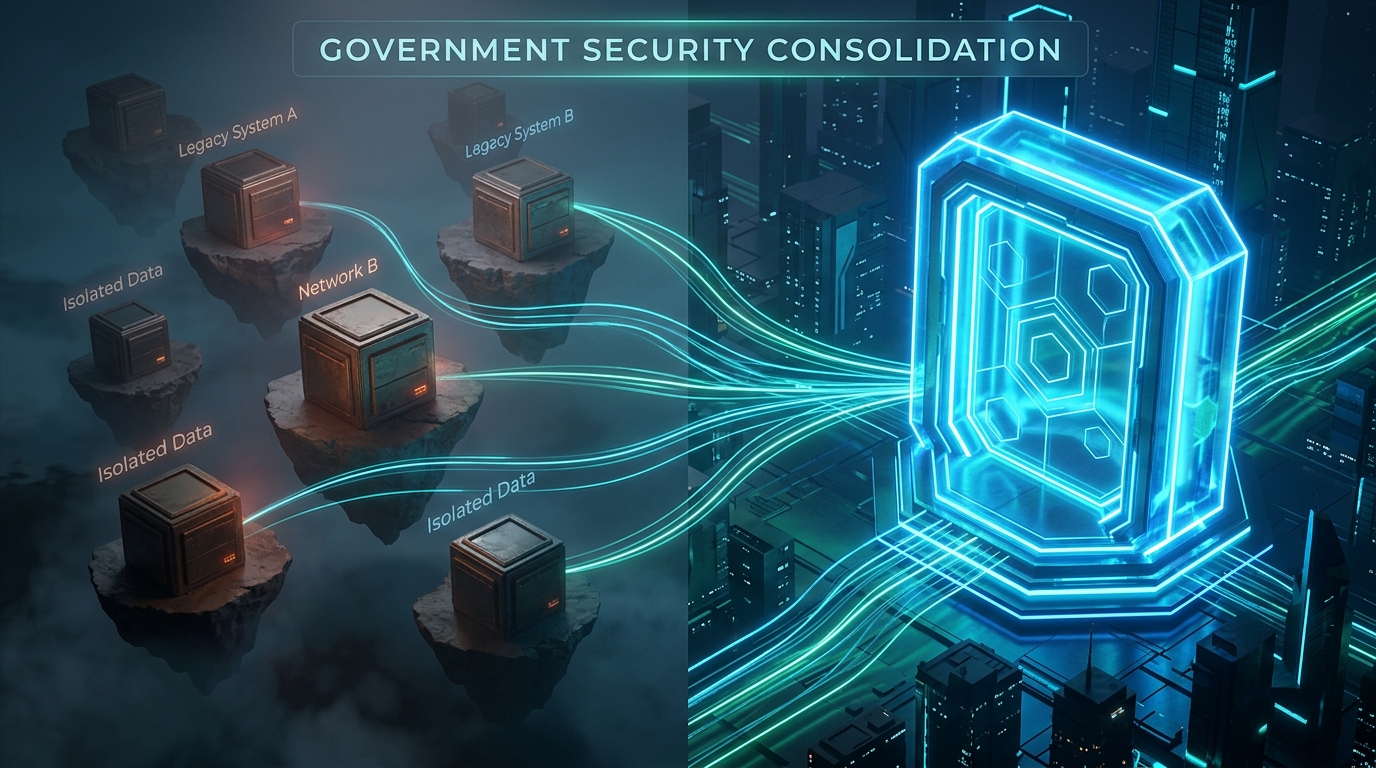
A typical government agency managing connectivity between classification levels, between IT and OT zones, or between agency infrastructure and external partners operates 4–7 separate security products from 3–5 different vendors at each network boundary. A VPN concentrator for remote access. A jump server for RDP. An SMB proxy for file sharing. A data diode for one-way transfers. Point TCP connectors for specific applications. A separate session recording tool (if one exists at all). A legacy MFA appliance.
Each product has its own contract, its own renewal cycle, its own console, its own log format, its own firmware update cadence, and its own attack surface. The CISO manages not one security boundary – but a stack of disconnected products that each address a fragment of the boundary.
The cost is not just procurement overhead. It is operational: 4–6 log formats that the SOC must normalize. 3–5 vendor escalation paths during an incident. 40–80 hours of SIEM integration labor per product. And the security gap between products – where attackers consistently enter.
Dragos reported that ransomware groups targeting industrial organizations increased 64% in 2025. These groups exploited VPN portals and remote access tools – the supplementary products that agencies deploy because no single product covered the full cross-network requirement. Claroty found that 82% of verified OT intrusions used internet-facing remote access tools as the initial entry point.
This article shows government CISOs how to government consolidate cross network security from a multi-vendor stack into a single platform – with specific product mapping, migration sequencing, compliance alignment, and measurable outcomes.
What Does “Cross-Network Security” Actually Include?
Before consolidating, government CISOs need to define exactly what “cross-network security” encompasses. It is not just application access. It is every connectivity type that crosses a boundary between security zones.
The Five Connectivity Types
Connectivity Type | What It Is | Current Product (Typical) | Why It Crosses a Boundary |
Interactive application access | RDP to workstations, SSH to servers, HTTP to web applications across zones | VPN + jump server | Users in one zone need to operate systems in another zone |
Bidirectional file sharing | Firmware updates, configuration backups, vendor deliverables, engineering documents | SMB proxy / file gateway | Files must flow in both directions between zones with different classification or security levels |
Unidirectional data transfer | Historian replication, syslog forwarding, SCADA telemetry export | Data diode | Operational data must flow outward for monitoring and analytics without allowing return traffic |
Vendor remote access | Third-party maintenance sessions to agency systems | Same VPN as employees (shared) | External vendors need controlled, time-bounded access to specific internal resources |
Machine-to-machine connectivity | API integration, real-time sensor data, cross-zone web services | Point TCP connectors | Applications in different zones need to exchange data programmatically |
The problem is visible in the product count: five connectivity types, five (or more) separate products. Each product from a different vendor. Each product addressing only its fragment of the boundary.
The Consolidation Opportunity
A government consolidate cross network security approach replaces the five-product stack with a single platform that handles all five connectivity types through a unified architecture, unified policy engine, unified audit trail, and unified management console. The truePass platform achieves this through patented Reverse Access technology – all connections originate outbound from the protected network, eliminating inbound firewall ports entirely – combined with integrated application access, file sharing with CDR scanning, and session recording in a single deployment.
What Products Get Eliminated and What Replaces Them?
Product-by-Product Replacement Map
Legacy Product | Function | Why It Gets Eliminated | What Replaces It |
VPN concentrator | Remote access (employees + vendors) | Opens inbound ports; primary ransomware entry vector; grants network-level access | Zero Trust Application Access – per-session MFA, application-level isolation, zero inbound ports |
Jump server / bastion host | RDP/SSH to internal systems | Lateral movement enabler; shared credentials; limited recording | Per-workstation RDP policies with named identity, session recording, clipboard/drive redirection disabled |
SMB proxy / file gateway | Bidirectional file sharing | Separate vendor/logs/policies; no identity integration; no CDR | Integrated SMB Proxy with Kerberos/NTLM, SMB Signing, encryption, CDR scanning |
Point TCP connectors | Application-specific bidirectional connections | Undocumented; invisible to SOC; no policy enforcement | Zero Trust Application Access for all TCP applications through the same tunnel |
Legacy MFA appliance | Two-factor authentication | Not per-session; may not support FIDO2/PIV/CAC natively | Built-in per-session MFA with FIDO2, PIV/CAC, authenticator app support |
Separate session recording tool | Video capture of admin sessions | Separate procurement; separate logs; limited to specific session types | Built-in session recording (video + keystroke) for all connectivity types |
What stays: The data diode – retained for flows where regulation mandates physical unidirectional enforcement (nuclear under RG 5.71, defense classified under IEC 62443 SL4). For non-regulated one-way flows (historian replication, syslog forwarding), the platform’s outbound-only architecture provides equivalent security with the added benefit of identity-based access control and unified audit.
Net result: 5–7 products from 3–5 vendors reduce to 1–2 products from 1–2 vendors. The diode remains only where mandated.
What Is the Consolidation Sequence?
Consolidation follows risk-priority order: the highest-risk legacy components are replaced first, the lowest-risk last. Parallel operation throughout – nothing is decommissioned until its replacement is validated.
Phase 1: Interactive Access (Weeks 1–8)
Replace VPN + jump server with the platform’s Zero Trust Application Access. This phase delivers the largest immediate security improvement because it removes the internet-facing VPN (the most exploited component) and the jump server (the lateral movement enabler).
What changes:
- Employees and vendors authenticate at the Access Gateway with PIV/CAC + MFA
- Each user receives application-level access to their specific authorized resource – not network-level access
- Every session is recorded (video + keystroke)
- VPN concentrator decommissioned; jump server decommissioned
- External scan confirms zero discoverable services
Consolidation metric: Products reduced from 5–7 to 3–5 (VPN and jump server eliminated; session recording now integrated).
Phase 2: File Sharing (Weeks 9–16)
Migrate bidirectional file sharing from the standalone SMB proxy to the platform’s integrated SMB Proxy. truePass Gravity provides this as Layer 2 of its three-layer architecture, with Kerberos/NTLM authentication, SMB Signing, end-to-end encryption, and CDR scanning – all governed by the same policy engine and recorded in the same audit trail as application access sessions.
What changes:
- All files crossing zone boundaries are CDR-scanned before entering the protected zone
- File transfers are attributed to named identities with full audit trail
- Standalone SMB proxy / file gateway decommissioned
Consolidation metric: Products reduced from 3–5 to 1–2 (standalone file gateway eliminated).
Phase 3: TCP Connectors and Vendor Access (Weeks 17–20)
Identify and migrate point TCP connectors and embedded vendor tunnels. This phase typically uncovers undocumented connections – the 14-day network flow analysis in pre-migration planning captures them.
What changes:
- All application integrations route through the platform with identity attribution and policy enforcement
- Vendor access migrates from shared VPN credentials to named individual accounts with time-bounded, approval-required sessions
- Point TCP connectors decommissioned; embedded vendor tunnels documented and migrated or removed
Phase 4: One-Way Flow Evaluation and Hardening (Weeks 21–26)
Evaluate each data diode-handled flow. Retain the diode for regulated flows. Migrate non-regulated one-way flows (historian, syslog) to the platform’s outbound-only architecture. Harden all zone firewalls to deny-all inbound. Run external scan validation. Complete compliance documentation.
Final consolidation metric: 1–2 products from 1–2 vendors (platform + diode if retained for regulated flows).
What Are the Measurable Outcomes of Consolidation?
Government CISOs must justify the consolidation investment with measurable outcomes – not architectural diagrams. The following table provides before/after metrics that translate directly into budget justification and compliance evidence.
Metric | Before (Multi-Vendor Stack) | After (Consolidated Platform) | Impact |
Products managing cross-boundary connectivity | 5–7 | 1–2 | 70–85% reduction in vendor management overhead |
Vendors under contract | 3–5 | 1–2 | 60–80% reduction in contract administration |
Inbound firewall ports on protected zones | 3–8 | 0 | 100% elimination of inbound attack surface |
Log formats for SIEM integration | 4–6 | 1 (single Syslog feed) | 80% reduction in SIEM integration labor |
Session attribution coverage | 40–60% | 95%+ | Full forensic capability for every cross-boundary session |
Mean time to investigate cross-boundary session | 3–6 hours | < 15 minutes | 95% reduction in investigation time |
Annual maintenance contracts | 3–5 separate contracts | 1 contract | 70% reduction in procurement overhead |
Vendor escalation paths during incident | 3–5 | 1 | Unified incident response |
DoD ZT pillars addressed | 2 of 7 (partial) | 7 of 7 | Full Zero Trust alignment |
External scan: discoverable services | 2–5 | 0 | Zero discoverable attack surface |
What Is the Cost Impact of Consolidation?
Direct Cost Savings
The most visible savings come from eliminating product licenses and maintenance contracts:
Cost Element | Multi-Vendor Stack (Per Site) | Consolidated Platform (Per Site) | Annual Savings |
VPN concentrator license + maintenance | $15K–$40K/year | Eliminated | $15K–$40K |
Jump server infrastructure + admin | $10K–$25K/year | Eliminated | $10K–$25K |
SMB proxy / file gateway license | $20K–$50K/year | Included in platform | $20K–$50K |
Session recording tool license | $15K–$35K/year | Included in platform | $15K–$35K |
Point TCP connector licenses | $5K–$15K/year per app | Included in platform | $5K–$15K per app |
Legacy MFA appliance | $5K–$15K/year | Included in platform | $5K–$15K |
Total direct savings per site | $70K–$180K/year |
For agencies with 5, 10, or 50 sites, multiply accordingly. The FY 2026 NDAA allocated $15 billion for cyber modernization – agencies that use modernization dollars to consolidate rather than add yet another product extract significantly more security value per dollar.
Indirect Cost Savings
The indirect savings often exceed the direct product savings:
SIEM integration labor. Each product generates logs in its own format. Integrating 4–6 log sources into the SIEM requires 40–80 hours of initial configuration plus ongoing maintenance. A single Syslog feed eliminates this entirely.
Incident response coordination. During a cross-boundary security event, the IR team currently coordinates across 3–5 vendor support channels, correlates logs from 4–6 systems, and reconstructs timelines across different time formats. With a consolidated platform, the IR team works with one vendor, one log, one timeline. Investigation time drops from hours to minutes.
Procurement overhead. Each vendor contract requires a separate procurement action, a separate renewal, a separate performance review, and a separate compliance documentation set for the ATO package. Reducing vendor count from 5 to 1–2 eliminates dozens of hours of contracting officer and ISSO labor per year.
Training. Each product requires operator training. Consolidated to one platform means one training program, one certification, one operational playbook.
How Does Consolidation Align with Federal Mandates?
Government CISOs operate under overlapping mandates that all point toward consolidation – though none of them use that word explicitly.
Mandate | What It Requires | How Consolidation Addresses It |
EO 14028 (Improving Cybersecurity) | Zero Trust architecture; secure software supply chain; enhanced logging | Single platform reduces supply chain risk; unified audit satisfies enhanced logging requirements |
OMB M-22-09 (Zero Trust Principles) | Agencies meet CISA ZTMM objectives across five pillars | Consolidated platform addresses all five pillars; multi-vendor stack addresses 1–2 |
EO 14240 (Consolidating Procurement) | Eliminate waste through procurement consolidation | Replacing 5–7 products with 1–2 is textbook procurement consolidation |
DTM 25-003 (DoD Zero Trust Strategy) | Target-level ZT across all systems; 91 capability outcomes for IT, 84 for OT | Integrated platform inherently addresses more capability outcomes than fragmented products |
FISMA | Continuous monitoring; comprehensive audit trails | Single audit trail with session recording exceeds fragmented log requirements |
CISA ZTMM v2.0 | Maturity progression across Identity, Devices, Networks, Apps, Data | Consolidated platform advances maturity across all pillars simultaneously |
The convergence is clear: every mandate benefits from fewer products, unified policy, and comprehensive audit. No mandate benefits from more vendors and more integration complexity.
What Are the Most Common Consolidation Failures in Government?
Failure 1: Consolidating Only Application Access
The CISO replaces the VPN with a ZTNA solution – but leaves the SMB proxy, session recording tool, and TCP connectors untouched. The “consolidation” reduces vendors from 5 to 4. The multi-vendor problem persists.
Prevention: Define the consolidation scope as all five connectivity types – not just application access. The platform must handle interactive access AND file sharing AND session recording AND unified audit. If the selected platform does not cover all five, the consolidation is incomplete.
Failure 2: Not Decommissioning Legacy Products
The platform deploys and handles new connections – but the VPN, jump server, and SMB proxy remain operational because “we might need them.” The agency now has more products, not fewer, and the attack surface is larger.
Prevention: Each migration phase includes explicit decommission criteria. External scan validates that legacy services are no longer discoverable. Legacy configurations are archived for 90-day rollback, then permanently removed.
Failure 3: Accepting Separate Consoles as “Consolidated”
The CISO selects products from the same vendor – but they require separate management consoles, separate policy engines, and produce separate log formats. Same vendor, still fragmented operations.
Prevention: The evaluation criteria must require single-console management, unified policy engine across all connectivity types, and single Syslog feed to the SIEM. Same-vendor is not the same as consolidated.
Frequently Asked Questions
How long does cross-network security consolidation take?
The four-phase sequence completes in approximately 6 months. Phase 1 (VPN and jump server replacement) delivers the highest security impact in weeks 1–8. Phase 2 (file sharing migration) completes by week 16. Phases 3–4 (TCP connectors, diode evaluation, and hardening) complete by week 26. Agencies with simpler architectures or fewer connectivity types can compress to 4 months. Agencies with complex classification boundaries or extensive OT may extend to 9 months.
Can we consolidate if we still need a data diode for some flows?
Yes – and this is the expected outcome for most government agencies. The platform handles 80–90% of cross-network connectivity (interactive access, file sharing, vendor access, non-regulated one-way flows). The diode handles 10–20% (regulated unidirectional flows). The supplementary products – VPN, jump server, standalone SMB proxy, point TCP connectors – are eliminated entirely. The consolidation is not “platform replaces everything.” It is “platform replaces the patchwork around the diode.”
Does consolidation require changing the network architecture?
No. The Access Controller deploys as a new component inside the protected network and initiates outbound connections. It does not modify existing firewalls, switches, SCADA workstations, or classification guards. The only firewall change is removing legacy inbound rules – which makes the firewall more restrictive, not less.
What about agencies already using Zscaler or Palo Alto for ZTNA?
Cloud-delivered ZTNA platforms (Zscaler, Palo Alto Prisma Access) effectively consolidate internet-facing application access and SWG/CASB capabilities. But for cross-network connectivity – classified boundaries, OT/SCADA access, bidirectional file sharing with CDR, session recording – these platforms typically require supplementary on-premises products. The consolidation question for these agencies is whether the on-premises cross-network requirements can be addressed by a single platform (like truePass) rather than 3–4 additional point products alongside the cloud ZTNA.
How do we demonstrate consolidation savings to the budget authority?
Present the before/after metrics from this guide: product count (5–7 → 1–2), vendor count (3–5 → 1–2), annual maintenance costs, SIEM integration labor hours, and incident response coordination time. The cost table in this article provides the per-site savings template. Multiply by site count for the agency-wide business case. The consolidation narrative aligns directly with EO 14240 and OMB M-25-31 language on eliminating waste through procurement consolidation – use their framing in the budget justification.
Conclusion
The federal consolidation mandate – EO 14240, OMB M-25-31, OneGov, GSA category management – applies to cybersecurity infrastructure just as it applies to office software and cloud services. Government agencies spending on 5–7 cross-network security products from 3–5 vendors are operating exactly the kind of duplicative, fragmented procurement that the mandate targets.
To government consolidate cross network security, CISOs need a platform that handles all five cross-network connectivity types – interactive application access, bidirectional file sharing, unidirectional data transfer, vendor remote access, and machine-to-machine connectivity – through a single architecture with zero inbound ports, unified policy enforcement, integrated session recording, and a single audit trail.
The consolidation sequence is clear: replace the VPN and jump server first (highest risk), then the file gateway (highest operational sensitivity), then the TCP connectors (highest hidden complexity), then evaluate diode-handled flows. Measure outcomes at each phase. Present the before/after metrics to the Authorizing Official and the budget authority.
Fewer products. Fewer vendors. Fewer contracts. Fewer log formats. Fewer attack surfaces. Zero inbound ports. One audit trail. That is what government consolidation of cross-network security looks like – and TerraZone’s solutions for state and federal government systems provide the architecture, deployment methodology, and compliance documentation to execute it.