
What Is an SSL Certificate Chain?
An SSL certificate chain is the sequence of certificates that establishes trust between a website’s SSL/TLS certificate and a trusted Certificate Authority (CA) that browsers and operating systems inherently trust. The chain links a single end-entity certificate (the certificate your website or application presents) backward through one or more intermediate Certificate Authorities to a root Certificate Authority embedded in the trust store of the connecting client.
Without this chain, a browser or client has no way to verify that a presented certificate is authentic. The chain provides the cryptographic proof that the certificate was issued by a trusted authority – not forged, not self-signed, not issued by an untrusted party. Each certificate in the chain is digitally signed by the certificate immediately above it, creating an unbroken cryptographic path from the leaf certificate (the one your site presents) up to the trust anchor (the root CA that the client trusts inherently).
The certificate chain matters because public key infrastructure (PKI) – the system underlying SSL/TLS – operates on transitive trust. Browsers don’t directly trust every website. They trust a small set of root Certificate Authorities. Those root CAs trust intermediate CAs that issue certificates on their behalf. The intermediate CAs trust the specific certificates issued to websites. When a browser validates a website’s certificate, it walks the chain backward – verifying signatures at each step – until it reaches a root CA in its trust store.
This guide documents what SSL/TLS certificate chains are, how chain validation works, the components that make up a chain (root, intermediate, and leaf certificates), the common problems that occur when chains break, the validation processes that browsers and clients perform, and how modern Zero Trust architectures use certificate chains for mutual TLS authentication and workload identity in ways that extend the traditional web-server certificate model. The audience is web administrators, DevOps engineers, security engineers, network engineers, and developers seeking foundational and advanced understanding of certificate chains in 2026 environments.
How an SSL/TLS Certificate Chain Works
When a client (typically a web browser) connects to a server over HTTPS, the server presents its SSL/TLS certificate as part of the TLS handshake. But the server’s certificate alone is not enough – the client needs to verify that this certificate was legitimately issued by a trusted authority. The certificate chain provides that verification path.
The technical process works as follows. The server’s certificate (the leaf or end-entity certificate) contains several key elements: the public key, the identity (typically the domain name), validity dates, and the digital signature of the Certificate Authority that issued it. The signature is the critical element – it proves that the issuing CA vouched for this certificate.
The client receives the server’s certificate and looks at the “Issuer” field to identify which CA signed it. The client then needs the issuing CA’s certificate to verify the signature. In modern deployments, the server typically sends not just its own certificate but also the intermediate CA certificates that complete the chain. The client receives these intermediate certificates and continues validating: verifying that the intermediate certificate was itself signed by another certificate, and continuing up the chain.
The validation continues until the client reaches a certificate whose issuer is a root CA that the client trusts inherently. The client’s operating system, browser, or application maintains a trust store – a database of root certificates that are trusted by default. Major operating system vendors (Microsoft, Apple, Google) and browser developers (Mozilla, Chrome, Safari) curate these trust stores carefully, including only CAs that have demonstrated rigorous validation practices, security controls, and operational competence.
When the chain validates successfully – every signature verifies, no certificates are expired, no certificates have been revoked, the leaf certificate matches the requested domain – the client trusts the server’s identity and proceeds with the encrypted connection. When any element of the chain fails, the connection fails and the user sees a security warning.
Components of an SSL Certificate Chain
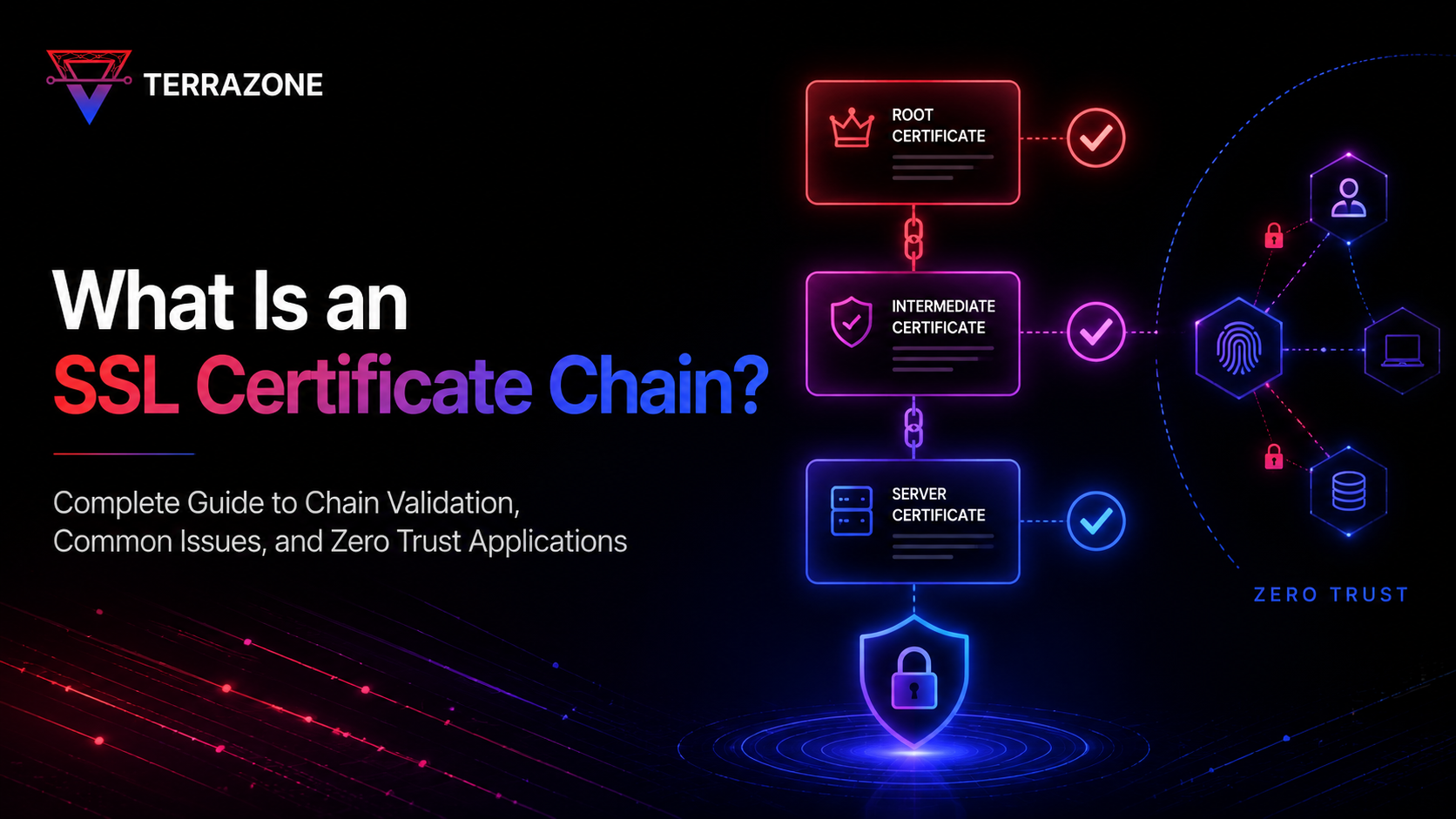
A complete SSL certificate chain consists of three types of certificates, each with a distinct role:
Root certificates sit at the top of the chain. These certificates are self-signed by the Certificate Authority itself and represent the ultimate source of trust in the PKI hierarchy. Root certificates are not transmitted over the network during TLS handshakes – instead, they’re distributed and managed through operating system updates, browser updates, and trust store management systems. Major root CAs include DigiCert, Sectigo, GlobalSign, Let’s Encrypt’s ISRG Root, Entrust, and others. The root certificate’s job is to be the trust anchor; it doesn’t directly sign end-entity certificates in most modern deployments.
Intermediate certificates sit between the root and the leaf. Certificate Authorities use intermediates as an operational and security measure: the root’s private key is kept offline and used only to sign intermediate certificates, while the intermediates do the day-to-day work of signing end-entity certificates. This architecture limits exposure of the root key. If an intermediate is compromised, the CA can revoke and replace it without invalidating every certificate the root has ever endorsed. Many CAs maintain multiple intermediate certificates for different validation levels (DV, OV, EV) or different geographic regions.
Leaf certificates (also called end-entity certificates) are the certificates issued to specific websites, applications, or services. The leaf is what your website presents during TLS handshakes. It contains the domain name, the public key for the actual encrypted communication, validity dates (typically 90 days to 1 year in 2026 deployments), and the digital signature of the intermediate CA that issued it. The leaf is the certificate users actually interact with – but it’s only one piece of the trust path.
The complete chain typically looks like: Root CA → Intermediate CA → Leaf Certificate. Some deployments use two intermediates (Root → Intermediate 1 → Intermediate 2 → Leaf), creating a four-level chain. The trend in 2026 is toward shorter chains where possible, balancing operational simplicity with the security benefits of separating root and intermediate operations.
How Certificate Chain Validation Works
Certificate chain validation involves multiple checks at each level. A browser or client performing chain validation typically executes the following sequence:
Step 1: Signature verification at each link. The client takes the leaf certificate and identifies its issuer. It uses the issuer’s public key (extracted from the issuer’s certificate) to verify the cryptographic signature on the leaf certificate. If the signature validates, the chain proceeds to the next link. The same process repeats for each certificate in the chain until reaching the root.
Step 2: Trust anchor confirmation. Validation succeeds only if the chain terminates in a root certificate that exists in the client’s trust store. A chain ending in an unknown root fails validation regardless of cryptographic correctness – the client has no basis for trusting that root.
Step 3: Validity period check. Every certificate in the chain must be within its validity period. Expired certificates fail validation. Not-yet-valid certificates (with future “Not Before” dates) also fail. The client checks the current time against each certificate’s validity window.
Step 4: Revocation status check. Even valid-looking certificates may have been revoked by their issuing CA. Clients check revocation status through Certificate Revocation Lists (CRLs), which list revoked certificates, or through Online Certificate Status Protocol (OCSP), which provides real-time revocation status for individual certificates. Modern deployments often use OCSP stapling, where the server pre-fetches and caches its own revocation status and includes it with the TLS handshake.
Step 5: Hostname matching. For web-server certificates, the client verifies that the leaf certificate’s Subject Alternative Name (SAN) field includes the hostname the client is trying to reach. A certificate for example.com doesn’t validate for www.different-site.com even if the chain is otherwise valid.
Step 6: Key usage validation. The leaf certificate must include appropriate key usage extensions for its intended purpose. A certificate marked only for client authentication won’t validate as a server certificate. A certificate without server authentication extension fails for web server use.
Step 7: Policy compliance. Some validation paths require specific certificate policy OIDs (Object Identifiers) – for example, EV certificates have specific policy requirements. The client checks these policies if relevant.
When all steps succeed, the client trusts the server’s identity and proceeds with key exchange. When any step fails, the client typically displays a security warning rather than proceeding silently – although the specific user experience varies by browser and the nature of the failure.
Common SSL Certificate Chain Issues
Certificate chains break for several common reasons that web administrators encounter regularly. Understanding these issues helps diagnose and fix the SSL warnings that users see:
Missing intermediate certificates. The most common chain issue: the server presents only its leaf certificate without the intermediate certificates that connect to a trusted root. Browsers can sometimes recover by fetching missing intermediates from “AIA” (Authority Information Access) URLs embedded in the leaf certificate, but this fallback isn’t universal. Some clients (particularly older ones, mobile browsers, and command-line tools like curl) fail when intermediates are missing. The fix is to configure the server to send the complete chain including all intermediates.
Expired certificates. Either the leaf certificate or an intermediate in the chain has passed its expiration date. Browser warnings result. The fix is to renew the expired certificate before the expiration date. Many organizations use automated renewal (typically through Let’s Encrypt and ACME protocol) to prevent expiration incidents.
Untrusted root. The chain terminates in a root certificate that the client doesn’t trust. This commonly happens with internal CAs (organizations operating their own PKI for internal services), with newer or less-established commercial CAs, or with self-signed certificates being used in production where they shouldn’t be. The fix depends on context: for internal CAs, distribute the root certificate to client trust stores; for public-facing services, use a certificate from a CA that browsers trust universally.
Hostname mismatch. The certificate doesn’t include the hostname the user is requesting. This happens when a certificate is issued for example.com but the user requests www.example.com without that hostname listed in the SAN. The fix is to issue or reissue the certificate with all relevant hostnames included as SANs.
Revoked certificates. The certificate has been revoked, typically because the private key was compromised or the certificate was issued in error. The CA published the revocation through CRL or OCSP. The fix is to issue a new certificate; the revoked one cannot be unrevoked.
Chain order errors. Less common but problematic: the server sends the chain in incorrect order. Most modern clients tolerate this but some strict implementations fail. The fix is to ensure the server presents certificates in the correct order: leaf first, then intermediates from closest to leaf to closest to root.
Mixed-mode chain issues. Some advanced configurations involve cross-signed certificates or chains that vary by client. Modern PKI sometimes deploys these intentionally for compatibility (during transitions between root certificates), but incorrect configuration can produce chains that work in some clients and fail in others.
Algorithm deprecation. Older certificates using deprecated cryptographic algorithms (MD5, SHA-1, RSA with insufficient key length) fail validation on modern clients even when the chain structure is correct. The fix is to reissue with modern algorithms (typically SHA-256 with RSA 2048-bit or ECDSA P-256).
How Browsers and Clients Validate Certificate Chains
Different clients implement certificate chain validation with subtle variations. Understanding these differences helps debug chain issues that appear in some clients but not others.
Web browsers (Chrome, Firefox, Safari, Edge) implement extensive validation including certificate transparency checking (verifying certificates appear in public CT logs), HPKP if configured (though deprecated), and various policy enforcement. Browsers maintain their own trust stores in many cases – Mozilla maintains the NSS root store used by Firefox; Microsoft maintains the Windows root store used by Edge; Google maintains the trust store used by Chrome. Apple maintains the trust store used by Safari and other macOS applications.
Operating systems provide TLS implementations that applications use. Windows applications typically use SChannel which references the Windows certificate store. Linux applications typically use OpenSSL with the system’s CA bundle. macOS applications use Secure Transport with the Apple trust store. The OS-level trust store affects validation for any application using the OS’s TLS libraries.
Command-line tools (curl, openssl, wget) have specific behavior. Curl typically uses the system’s CA bundle but can be configured to use specific CA files for validation. OpenSSL’s verification has historically been strict – some chain issues that browsers handle silently produce explicit errors in OpenSSL. This makes openssl s_client a useful debugging tool for chain issues.
Mobile devices have their own behavior. iOS uses Apple’s trust store. Android historically used Google’s trust store but has variations across manufacturers. Mobile applications may bundle their own trust stores or use TLS pinning to restrict acceptable certificates to specific chains.
API clients and SDK libraries implement TLS validation with library-specific behavior. The behavior of Python’s requests library, Java’s TLS implementation, .NET’s HttpClient, and Node.js’s TLS module all have nuances. Most use the underlying OS trust store but some bundle their own root certificates or implement specific validation logic.
Certificate Chains in Modern Zero Trust Architectures
Traditional certificate chain discussions focus on web server certificates – the SSL/TLS that protects HTTPS connections between browsers and websites. Modern Zero Trust architectures extend the certificate chain concept significantly: certificates become the primary identity primitive not just for web servers but for users, workloads, services, and devices across the entire network.
The shift matters because Zero Trust depends on identity as the security boundary rather than network location. Identity must be cryptographically attestable – anyone can claim an identity, but only the legitimate holder can prove it cryptographically. Certificates provide this proof: the certificate contains an identity claim, and possession of the corresponding private key proves the claim. Certificate chains extend this proof through the trust hierarchy that PKI provides.
In Zero Trust deployments, the certificate chain typically includes additional roles beyond the web-server certificate model:
Client authentication certificates present the identity of users or devices accessing protected resources. The client certificate’s chain establishes that the user/device is enrolled in the organization’s identity infrastructure. Mutual TLS (mTLS) involves both the server and client presenting certificates that each side validates – bidirectional chain validation that traditional one-way TLS doesn’t provide.
Workload identity certificates establish the identity of services, containers, and applications communicating with each other. Frameworks like SPIFFE (Secure Production Identity Framework for Everyone) and its reference implementation SPIRE provide automated issuance of short-lived certificates to workloads, with the chain establishing trust in the workload’s identity.
Service mesh certificates secure microservice-to-microservice communication. Service meshes (Istio, Linkerd, Cilium) issue and rotate certificates for each service, using the chains to establish mutual trust between services without relying on network location.
Federation certificates allow trust across organizational boundaries. When organizations establish federated identity relationships, they often cross-sign certificates or establish trust paths that allow certificates issued by one organization to be validated by another.
The architectural pattern of control plane and data plane separation in Zero Trust deployments depends heavily on certificate chains – the control plane components authenticate to each other through mutual TLS, with certificate chains establishing trust between separately-deployed control plane elements. This separation enables distributed Zero Trust architectures that scale across regions, clouds, and organizational boundaries while maintaining cryptographic identity throughout.
Mutual TLS and Certificate Chains for Workload Identity
Mutual TLS (mTLS) extends the certificate chain validation pattern from one-sided (server-only) to bidirectional (both server and client). In mTLS deployments, the server presents its certificate and validates the client’s certificate; the client presents its certificate and validates the server’s certificate. Both validations must succeed for the connection to establish.
mTLS matters for Zero Trust because it provides cryptographic identity attestation in both directions of every connection. A workload connecting to a database proves its identity through its certificate; the database proves its identity through its certificate; both certificates validate through chains that establish trust. The architectural property eliminates entire categories of impersonation attacks – an attacker who reaches the network cannot impersonate a legitimate workload without obtaining that workload’s private key.
The workload identity model that mTLS enables uses certificates differently than traditional web-server PKI. Web-server certificates typically have validity periods measured in months to years; workload identity certificates often have validity periods measured in hours or minutes, with automated rotation. The short lifetimes limit the damage from any private key compromise – a stolen key becomes useless within hours rather than persisting as a threat for the duration of a multi-year certificate.
SPIFFE/SPIRE has become the prominent workload identity framework. SPIFFE defines an identity format (SPIFFE ID – a URI like spiffe://example.com/ns/production/sa/payment-service) and a certificate format (SVID – SPIFFE Verifiable Identity Document) that embeds the SPIFFE ID in standard X.509 certificates. SPIRE provides the runtime that attests workload identity and issues the SVIDs. Major cloud providers (AWS Roles Anywhere, Azure Managed Identities, GCP Workload Identity Federation) implement similar concepts with vendor-specific APIs.
The architectural foundation that combines these patterns into deployed Zero Trust capability is implemented through the truePass Zero Trust Access service, which uses mTLS and certificate chain validation as foundational properties – every connection across the platform involves bidirectional certificate validation with chains that establish identity for both users and workloads through the trust infrastructure the platform manages.
Certificate Chain Considerations for Zero Trust Deployments
Organizations deploying Zero Trust architectures encounter several specific certificate chain considerations that traditional web-server PKI deployments don’t typically address:
Trust hierarchy design. Zero Trust deployments must design the trust hierarchy carefully. Options include using public CAs for everything (operationally simple but limited control), using a private internal CA hierarchy (operationally complex but full control), or hybrid approaches (public CAs for external-facing, private CAs for internal). The choice affects certificate management complexity, trust distribution requirements, and operational continuity considerations.
Certificate lifecycle automation. Manual certificate management doesn’t scale to Zero Trust deployments where thousands of workloads each need their own certificates with short lifetimes. ACME protocol (originally developed for Let’s Encrypt) provides standardized automation for public CA interaction. Internal PKI deployments typically use vendor-specific automation or custom tooling. SPIRE provides automated workload identity issuance and rotation.
Chain distribution and trust store management. Clients need to know which roots and intermediates to trust. For public CAs, the trust store is typically the OS or browser trust store. For internal CAs, organizations must distribute trust store updates to all clients that need to validate internally-issued certificates. The distribution mechanism affects how quickly trust changes can propagate.
Revocation strategy. Short-lived certificates (workload identity SVIDs) reduce reliance on revocation because expired certificates become invalid quickly. Long-lived certificates (traditional web-server certificates) require active revocation infrastructure (CRL, OCSP) to handle key compromise. Zero Trust deployments often combine both approaches.
Cross-organizational trust. Federation relationships between organizations require either shared trust anchors, cross-signed certificates, or explicit trust path configuration. The trust model affects what certificates can be validated and what identity assertions can be honored across organizational boundaries.
Workload identity propagation. When a workload at site A communicates with a workload at site B, the certificate-based identity of the originating workload must propagate appropriately. The pattern of identity-based segmentation that propagates workload identity through certificate chains across distributed deployments enables consistent identity enforcement across the architectural boundaries that traditional certificate models didn’t address.
Compliance evidence. Certificate-based identity produces audit evidence with cryptographic attribution – every operation traces to a specific certificate, which traces to a specific identity. This evidence quality supports continuous monitoring requirements that detection-based audit cannot match.
The combination of these considerations distinguishes mature Zero Trust certificate management from traditional web-server PKI. Organizations approaching Zero Trust often discover that their existing PKI practices, designed for traditional deployments, require significant evolution to support the certificate volume, automation requirements, and architectural patterns that Zero Trust depends on. The broader architectural foundations of Zero Trust Network Access – the patterns that certificate chains support – are documented in the comprehensive guide to what ZTNA means and how it works, which provides the architectural context within which certificate chain management operates.
Frequently Asked Questions
What is an SSL certificate chain in simple terms?
An SSL certificate chain is a sequence of certificates linking your website’s SSL certificate to a Certificate Authority that browsers trust. Browsers don’t directly trust every website’s certificate – they trust a small set of root Certificate Authorities. The chain provides the cryptographic path from your specific certificate, through one or more intermediate authorities, up to a trusted root. When the chain validates correctly, the browser trusts your site’s identity and allows the secure connection. When any link in the chain breaks, users see SSL warnings.
What is the difference between a root, intermediate, and leaf certificate?
A root certificate is self-signed by a Certificate Authority and sits at the top of the trust hierarchy – these are the certificates browsers and operating systems trust inherently. An intermediate certificate is signed by a root (or another intermediate) and used by the CA to issue end-entity certificates, providing operational security by keeping the root key offline. A leaf certificate (end-entity certificate) is the certificate actually issued to a website or service – signed by an intermediate, containing the specific domain name and public key. The complete chain typically goes: Root → Intermediate → Leaf.
Why do certificate chains have intermediate certificates?
Intermediate certificates exist primarily for security and operational reasons. The root certificate’s private key is the ultimate trust anchor – if it’s compromised, every certificate the root has ever signed becomes suspect, and replacing the root requires updating trust stores on millions of clients. By using intermediates for day-to-day issuance, Certificate Authorities can keep root keys offline (often in hardware security modules in physically secure locations) and only use them rarely to sign new intermediates. If an intermediate is compromised, the CA revokes and replaces it without affecting the root.
What causes “incomplete certificate chain” errors?
Incomplete certificate chain errors typically occur when a server presents only its leaf certificate without the intermediate certificates needed to reach a trusted root. The browser receives the leaf and looks for its issuer, but cannot find the intermediate. Some browsers can recover by fetching missing intermediates from URLs embedded in the certificate (AIA fetching), but this fallback isn’t universal – particularly older browsers, mobile clients, and command-line tools often fail. The fix is to configure the server to send the complete certificate chain including all intermediates.
How do I check my SSL certificate chain?
Several tools verify certificate chains. SSL Labs’ SSL Server Test (free, web-based) provides comprehensive chain analysis including missing intermediates, chain order, and trust validation across multiple client perspectives. The openssl command-line tool with “s_client -connect domain:443 -showcerts” displays the certificates the server presents. The “curl -v” command shows certificate validation details. Browser developer tools’ Security tab shows certificate chain information for the current page. For ongoing monitoring, many organizations use certificate monitoring services that alert on chain issues, expiration approaching, or revocation events.
Why does my certificate chain work in browsers but fail in curl or APIs?
This common issue typically reflects different validation strictness. Browsers often fetch missing intermediates from AIA URLs to complete chains, masking server configuration errors. Curl and most API clients don’t perform AIA fetching by default – they validate only the certificates the server explicitly presents. The fix is to ensure your server presents the complete certificate chain in its TLS configuration, not just the leaf certificate. Properly configured servers work in all clients without depending on browser fallback behaviors.
How long are SSL certificates valid?
Public SSL/TLS certificate validity periods have decreased over time. As of 2026, publicly-trusted SSL/TLS certificates can have maximum validity of 398 days (approximately 13 months), with industry discussion of further reducing this to 90 days or shorter. Many organizations use Let’s Encrypt certificates with 90-day validity and automated ACME renewal. Internal CA certificates have organization-controlled validity – typically 1-2 years for internal services with planned migration to shorter lifecycles. Workload identity certificates in Zero Trust deployments often have validity measured in hours, with automated rotation.
How do certificate chains relate to Zero Trust security?
Certificate chains provide the cryptographic foundation for identity attestation in Zero Trust architectures. Where traditional security treats network location as identity, Zero Trust uses certificates to prove identity cryptographically – workloads, users, and devices all present certificates that validate through trust chains. Mutual TLS (mTLS) extends this to bidirectional identity validation, where both sides of every connection prove their identity through certificates. Workload identity frameworks like SPIFFE/SPIRE automate certificate issuance and rotation for cloud-native workloads. The certificate chain validation pattern that secures web servers extends to securing all communication in Zero Trust deployments.
Conclusion
An SSL certificate chain is the sequence of certificates that establishes trust between a server’s SSL/TLS certificate and a Certificate Authority that clients inherently trust. The chain consists of three components: a leaf certificate identifying the specific server, one or more intermediate certificates that the CA uses for operational reasons, and a root certificate that serves as the trust anchor in client trust stores. Validation walks the chain from leaf to root, verifying signatures at each step, checking validity periods and revocation status, and confirming that the chain terminates in a trusted root.
Common certificate chain issues – missing intermediates, expired certificates, untrusted roots, hostname mismatches, revoked certificates, chain order errors – cause the SSL warnings that users encounter. Diagnosing these issues requires understanding the validation process and the tools (SSL Labs, openssl, curl, browser developer tools) that expose chain details.
Modern Zero Trust architectures extend the certificate chain concept significantly. Where traditional PKI focused on web-server certificates with months-to-years validity, Zero Trust deployments use certificates for user identity, workload identity, service-to-service authentication, and federated trust across organizational boundaries. Mutual TLS, SPIFFE/SPIRE, service mesh certificates, and short-lived workload credentials all extend the chain validation pattern into architectures that traditional certificate management didn’t address.
For organizations approaching Zero Trust deployment, the certificate chain considerations evolve from “is my web certificate correctly chained” to “is my certificate infrastructure positioned to support workload-scale identity attestation with automated lifecycle management.” The pattern of the integrated truePass platform that uses certificate-based identity throughout its architecture demonstrates how mature Zero Trust deployments integrate certificate management with the broader identity infrastructure that modern security architectures require.
The certificate chain – a concept that began with HTTPS for web browsers in the 1990s – has matured into foundational infrastructure for modern cybersecurity architectures. Understanding how chains work, why they break, and how Zero Trust architectures extend them provides the foundation for the certificate management practices that secure modern environments.