

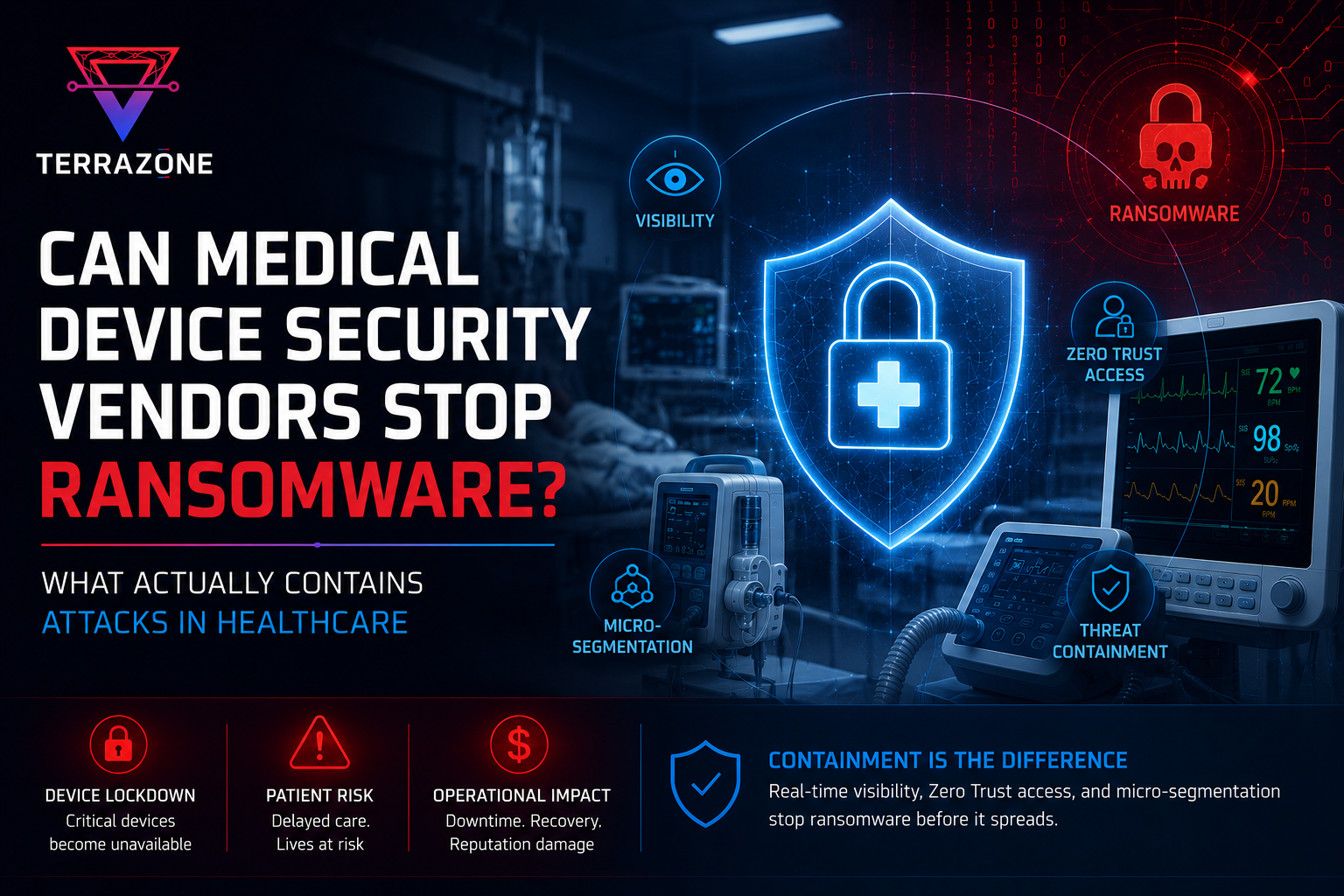
Can Medical Device Security Vendors Stop Ransomware? The Direct Answer
The short answer is nuanced: most medical device security vendors do not stop ransomware directly – they help you see and assess the problem, but the actual containment of an attack depends on a different capability than most of these vendors primarily provide.
The medical device security market is dominated by visibility and discovery vendors – platforms that find connected medical devices, fingerprint them, identify their vulnerabilities, and assess their risk. This is essential work, but visibility is not containment. Knowing that an infusion pump runs an unpatchable operating system doesn’t stop ransomware from reaching it. Identifying that 40 percent of your imaging systems have known vulnerabilities doesn’t prevent an attacker from using one of them to spread laterally across your network.
Ransomware is stopped – in the sense of being contained so it can’t spread and can’t reach life-critical devices – by enforcement: architecture that prevents the lateral movement ransomware depends on. The capability that actually contains ransomware in healthcare is microsegmentation, which isolates devices and network segments so that a compromise in one place cannot propagate to others. Some medical device security vendors provide this enforcement; many provide only the visibility that informs it.
So when a healthcare security leader asks “can medical device security vendors stop ransomware,” the more useful question is: “which layer of medical device security does this vendor provide, and does my program include the enforcement layer that actually contains an attack?” This guide answers that question in depth – explaining how ransomware spreads in healthcare, what different vendors actually do, and what it takes to genuinely contain an attack before it reaches patient care.
The Scale of Healthcare Ransomware in 2026
Understanding whether vendors can stop ransomware requires understanding the threat’s current scale. The data from 2025 and 2026 is stark.
Ransomware has become the dominant attack vector in healthcare. More than 60 percent of confirmed healthcare breaches in 2025 involved ransomware, up from 34 percent in 2021 – a near-doubling in four years. Healthcare remains the most frequently breached industry sector, facing a disproportionate share of all ransomware incidents. The financial impact is severe: the average cost of a healthcare data breach reached $10.9 million in 2025 and is projected to exceed $11.5 million in 2026, more than twice the cross-industry average.
The patient-safety dimension distinguishes healthcare ransomware from other sectors. Projections indicate that the share of hospitals experiencing disrupted care delivery due to ransomware attacks could reach 60 percent, with over 40 percent of US health systems expected to experience a ransomware attack. When ransomware encrypts clinical systems, hospitals revert to paper orders and manual processes, diagnostic imaging and labs stall, and treatment decisions are delayed – turning a cybersecurity incident into a patient-safety emergency.
Medical devices are at the center of this exposure. The average hospital connects between 10,000 and 15,000 IP-enabled medical devices, yet fewer than 30 percent of health systems have deployed any dedicated solution for discovering and monitoring this device population. The attack pattern is consistent: phishing or exposed remote access establishes a foothold, and the ransomware then moves laterally until it reaches valuable or vulnerable targets – including connected medical devices that cannot defend themselves. The architectural shift away from the exposed remote-access methods that enable initial footholds is described in the broader context of why ZTNA architectures replace the VPN and RDP access that ransomware exploits as entry points.
How Ransomware Actually Spreads in Healthcare Networks
To understand whether a vendor can stop ransomware, you have to understand how ransomware operates. Healthcare ransomware attacks follow a predictable lifecycle, and the point at which damage becomes catastrophic is well-defined.
Initial access. The attacker gains a foothold, most commonly through phishing that harvests credentials or through exposed remote access (VPN, RDP). Phishing has been the leading entry point, responsible for a majority of access-point breaches. At this stage, the compromise is contained to a single system or account.
Reconnaissance and credential theft. The attacker explores the network, identifying valuable targets and stealing additional credentials to expand access. In a flat healthcare network, this exploration is unconstrained – the attacker can see and reach a vast range of systems.
Lateral movement. This is the decisive phase. The attacker moves from the initial foothold across the network, reaching ever more valuable and vulnerable targets. In healthcare, lateral movement frequently reaches the medical device fleet – the unpatchable infusion pumps, imaging systems, and patient monitors that cannot resist compromise. The proportion of systems affected in healthcare ransomware incidents has run higher than the cross-sector average, with a majority of computers within targeted organizations impacted.
Encryption and extortion. The attacker deploys ransomware across the systems reached during lateral movement, encrypting data and increasingly stealing it first for double-extortion leverage. Double-extortion tactics have become standard in the large majority of healthcare cases. The time from initial compromise to ransomware deployment has dropped dramatically – attackers move faster than most healthcare security teams can detect and respond.
The critical insight for vendor evaluation: the damage is determined by the lateral movement phase. An attack that’s contained to its initial foothold is an incident; an attack that spreads laterally across a flat network to the medical device fleet and clinical systems is a catastrophe. The difference between the two outcomes is not whether the organization had visibility into its devices – it’s whether the network architecture allowed the lateral movement to happen. This is why preventing lateral movement is the architectural control that determines ransomware outcomes rather than any single detection or discovery capability.
What Medical Device Security Vendors Actually Do
Medical device security vendors fall into categories that solve different parts of the ransomware problem. Understanding which category a vendor belongs to clarifies whether – and how – it contributes to stopping ransomware.
Visibility and discovery vendors (the largest category) discover and fingerprint connected medical devices, classify them by type and manufacturer, identify vulnerabilities, and score risk in clinical context. The leading platforms in this category provide deep device intelligence across hundreds of medical protocols. Their contribution to stopping ransomware is indirect but valuable: they tell you what devices you have, which are vulnerable, and where the risk concentrates. This intelligence is necessary for setting protection policies – but the vendors themselves typically don’t enforce those policies. Many generate segmentation recommendations that depend on separate network infrastructure to implement.
Detection and response vendors monitor for malicious behavior and alert security teams to potential compromises. They can shorten the time to detect an attack in progress. Their contribution to stopping ransomware depends on detection speed relative to the attack’s lateral movement speed – and as attack timelines compress, detection-based response increasingly struggles to outpace fast-moving ransomware. Detection that fires after lateral movement has reached the medical device fleet is too late to prevent the patient-safety impact.
Network access control (NAC) vendors can enforce some segmentation by controlling which devices connect to which network segments, typically through VLAN assignment and switch-level controls. Their contribution to containment is real but carries deployment complexity – VLAN dependencies, lengthy rollouts, and the limitations of network-location-based (rather than identity-based) policy.
Enforcement and containment vendors provide the architectural control that prevents lateral movement directly. Microsegmentation that isolates devices into protected segments – where each device communicates only with explicitly authorized systems – contains ransomware to its initial foothold regardless of detection speed or device patchability. This is the category that genuinely stops ransomware in the containment sense, because it removes the lateral movement that turns a foothold into a catastrophe.
Most “medical device security vendors” that healthcare leaders evaluate belong to the visibility category. They are excellent at what they do, but they answer “what’s at risk” rather than “how is the attack contained.” The containment answer requires the enforcement layer.
Why Visibility Alone Doesn’t Stop Ransomware
The reason visibility vendors don’t stop ransomware on their own is structural, not a criticism of their capability. Consider the logic:
A visibility platform discovers that a hospital has 12,000 connected medical devices, identifies that 3,000 of them run unpatchable legacy operating systems with known vulnerabilities, scores the risk, and recommends segmentation. Every step is valuable. But none of it stops a ransomware attack that’s already moving laterally toward those 3,000 vulnerable devices. The visibility platform has produced knowledge; it hasn’t produced a barrier.
The gap is enforcement. Knowing a device is vulnerable is not the same as preventing a threat from reaching it. The vulnerable infusion pump remains exactly as reachable after the visibility scan as before – unless something architecturally isolates it. In a flat network, ransomware that compromises one system can still reach the infusion pump regardless of how thoroughly the pump’s vulnerabilities have been documented.
This is the specific failure mode that produces catastrophic healthcare ransomware incidents. Organizations with substantial security investment, complete device inventories, and detailed risk assessments still suffer network-wide ransomware spread because the visibility and detection layers, however good, don’t prevent lateral movement. The defensive factors most commonly cited in healthcare ransomware incidents include lack of capacity to monitor and known security gaps – both of which point to the same underlying issue: detection and visibility depend on human response that can’t keep pace with fast-moving attacks, while enforcement contains the attack automatically regardless of response speed.
The financial logic reinforces this. With average healthcare breach costs exceeding $11 million and rising, the investment required for enforcement-layer containment is justified by preventing a single network-wide spread event. The analysis of how a single security incident produces million-dollar breach costs applies directly to healthcare, where the operational disruption and patient-safety dimension push costs above the cross-industry average.
How Microsegmentation Actually Contains Ransomware
Microsegmentation is the enforcement capability that genuinely stops ransomware spread – and understanding how it works clarifies why it succeeds where visibility and detection alone fall short.
Microsegmentation divides the network into isolated segments where each device, or group of devices, communicates only with explicitly authorized systems. The medical device fleet is segmented so that an infusion pump can reach only the specific clinical systems it needs – and nothing else. A patient monitor can communicate only with its authorized monitoring infrastructure. An imaging system connects only to the PACS and clinical workflow systems it requires.
The effect on ransomware is decisive. When an attacker compromises one system and attempts lateral movement, the microsegmentation architecture blocks the movement – the compromised system cannot reach systems it isn’t explicitly authorized to communicate with. The ransomware is contained to its initial foothold. It cannot spread to the medical device fleet because the devices are isolated. It cannot reach clinical systems because the segmentation blocks the lateral paths. The attack that would have been a catastrophe in a flat network becomes a contained incident.
Critically, this containment works regardless of device patchability. The unpatchable infusion pump is protected not by its own (nonexistent) security capability but by the architecture around it. Even if a threat somehow reached the pump, the pump’s isolation prevents the threat from spreading further. This is why microsegmentation is uniquely suited to the medical device reality – it provides protection that doesn’t depend on the device being able to defend itself. The containment approach of microsegmentation that slams shut the lateral pathways attackers depend on addresses precisely the spread mechanism that turns a healthcare ransomware foothold into a network-wide patient-safety emergency.
Identity-based microsegmentation extends this further by basing isolation on authenticated identity rather than network location. Each device’s communication is authorized based on what it is and what it’s permitted to do, not merely where it sits on the network. This granularity is essential in healthcare, where devices move, networks evolve, and location-based policies become brittle. The enforcement happens at the identity level through the architecture implemented in the truePass Zero Trust Access capability, which applies authenticated-identity authorization to every communication rather than trusting devices based on network position.
The Layered Approach That Actually Stops Ransomware
The honest conclusion is that no single vendor “stops ransomware” in isolation – but the right combination does. A healthcare program that genuinely contains ransomware combines layers:
Visibility provides the intelligence. A discovery vendor identifies and classifies the device fleet, assesses vulnerabilities, and informs which devices need isolation and what communication they legitimately require. This intelligence is the foundation for correct segmentation policy.
Enforcement provides the containment. Microsegmentation isolates the devices according to the policies the visibility layer informs, preventing the lateral movement that ransomware depends on. This is what actually stops the spread.
Detection provides the awareness. Monitoring identifies attacks in progress, supporting response and forensics – valuable even though it doesn’t prevent spread on its own.
Access control prevents initial footholds. Zero Trust access that eliminates the exposed VPN and RDP entry points reduces the initial access that starts the attack lifecycle.
The combination matters because each layer addresses a different phase of the ransomware lifecycle. Visibility informs; access control reduces initial access; detection provides awareness; enforcement contains. The layer that most directly answers “can you stop ransomware from spreading to my medical devices” is enforcement – the microsegmentation that prevents lateral movement. Healthcare organizations that have invested heavily in visibility and detection but suffered network-wide ransomware spread typically discover that the missing layer was enforcement.
For healthcare security leaders evaluating whether their medical device security vendors can stop ransomware, the practical assessment is: do we have the enforcement layer? Visibility and detection are necessary but insufficient. The containment that prevents a foothold from becoming a catastrophe comes from microsegmentation that isolates devices regardless of their patchability – and that is the layer healthcare programs most often lack.
What to Look for in Ransomware-Stopping Capability
When evaluating whether a medical device security vendor or architecture can actually contain ransomware, the following questions distinguish genuine containment from visibility that merely informs:
Does it enforce isolation or recommend it? A vendor that recommends segmentation policies but depends on separate infrastructure to enforce them provides intelligence, not containment. Genuine ransomware containment requires direct enforcement of device isolation.
Does it work without patching the devices? Because medical devices overwhelmingly can’t be patched, containment must come from the surrounding architecture. Any capability that depends on the device’s own security posture leaves the unpatchable fleet exposed.
Does it prevent lateral movement specifically? Ransomware spreads through lateral movement. The decisive question is whether the architecture blocks lateral paths between segments – preventing a compromise in one place from reaching others.
Is it agentless? Medical devices can’t run agents. Containment must operate at the network architecture level, isolating devices without requiring software installed on them.
Does it deploy without network redesign? A containment solution that requires re-architecting the hospital network introduces disruption and delay. Effective microsegmentation deploys onto existing infrastructure.
Does it base policy on identity or just network location? Location-based policy (VLAN assignment) is brittle as networks evolve. Identity-based microsegmentation provides durable, granular control that survives network changes.
A vendor or architecture that answers these questions affirmatively can genuinely contain ransomware. A vendor that provides excellent visibility but answers “recommend, not enforce” to the first question helps the defense without stopping the attack.
Frequently Asked Questions
Can medical device security vendors stop ransomware?
Most medical device security vendors do not stop ransomware directly – they provide visibility and discovery (finding and assessing devices) rather than enforcement (containing attacks). Visibility is necessary but insufficient: knowing a device is vulnerable doesn’t prevent ransomware from reaching it. Ransomware is contained by enforcement – specifically microsegmentation that prevents the lateral movement attacks depend on. Vendors that provide microsegmentation enforcement can genuinely contain ransomware; vendors that provide only visibility or detection help the defense without stopping the spread. The most effective programs combine visibility (for device intelligence) with enforcement (for containment).
Why doesn’t device visibility stop ransomware?
Device visibility produces knowledge, not barriers. A visibility platform can identify every connected device, score its vulnerabilities, and recommend segmentation – but none of that prevents ransomware that’s already moving laterally from reaching those devices. The vulnerable device remains exactly as reachable after the scan as before, unless something architecturally isolates it. Visibility informs the defense by identifying what needs protection, but the actual containment requires enforcement that prevents lateral movement. This is why hospitals with complete device inventories still suffer network-wide ransomware spread.
What actually stops ransomware from spreading in a hospital?
Microsegmentation stops ransomware spread by isolating devices and network segments so that each communicates only with explicitly authorized systems. When an attacker compromises one system and attempts lateral movement, the segmentation blocks the movement – the ransomware is contained to its initial foothold and cannot reach the medical device fleet or clinical systems. This containment works regardless of whether individual devices can be patched, because the protection comes from the architecture around the devices rather than the devices’ own security capability.
How does ransomware reach medical devices?
Ransomware reaches medical devices through lateral movement. An attacker first gains initial access (typically through phishing or exposed remote access), then moves laterally across the network, reaching ever more targets. In a flat hospital network, this movement is unconstrained – the attacker can reach the medical device fleet, including unpatchable devices that can’t resist compromise. The medical devices become both targets (encrypted or disabled) and potential pivot points. Preventing this requires blocking lateral movement through microsegmentation, which isolates the devices so an attacker can’t reach them from a compromised foothold.
Can detection and response stop healthcare ransomware?
Detection and response can help but increasingly struggle to stop ransomware on their own. The time from initial compromise to ransomware deployment has dropped dramatically, and attackers often move faster than healthcare security teams can detect and respond. Detection that fires after lateral movement has reached the medical device fleet is too late to prevent patient-safety impact. Detection provides valuable awareness and supports response, but it depends on human reaction speed that fast-moving attacks outpace. Enforcement (microsegmentation) contains the attack automatically regardless of detection speed, which is why it’s the more reliable containment layer.
Why are medical devices so vulnerable to ransomware?
Medical devices are uniquely vulnerable because they overwhelmingly cannot be patched or hardened. They run unpatchable legacy operating systems, locked-down firmware, and FDA-regulated software that can’t be modified without recertification. Many run end-of-life operating systems that no longer receive security updates. Clinical necessity means they often can’t be taken offline. They can’t run security agents. This combination means the devices themselves cannot defend against ransomware – protection must come from the surrounding network architecture. Microsegmentation that isolates these devices provides the protection they can’t provide themselves.
Do I need both a visibility vendor and an enforcement solution to stop ransomware?
For genuine ransomware containment, most hospitals need both. The visibility vendor provides device discovery, classification, and risk assessment – the intelligence needed to set correct isolation policies. The enforcement solution (microsegmentation) implements the isolation that actually contains ransomware spread. Visibility without enforcement leaves devices identified but unprotected; enforcement without visibility lacks the device intelligence to set the right policies. The two layers complement each other: visibility informs which devices need isolation and what they legitimately communicate with, and enforcement makes that isolation real.
How does microsegmentation protect unpatchable medical devices?
Microsegmentation protects unpatchable devices by isolating them into protected segments where they communicate only with explicitly authorized systems. The protection comes from the architecture around the device, not from the device’s own security capability. Even though the device can’t be patched or run security software, the segmentation ensures that ransomware reaching one part of the network can’t reach the isolated device, and a compromise of the device can’t spread further. This makes microsegmentation uniquely suited to medical devices, which can never be hardened themselves but can be protected by architectural isolation that contains threats around them.
Conclusion
Can medical device security vendors stop ransomware? The honest answer is that it depends entirely on what kind of vendor and what “stop” means. The visibility and discovery vendors that dominate the medical device security market do not stop ransomware directly – they provide the essential intelligence about what devices exist and what’s at risk, but they don’t contain the attack. Detection vendors shorten awareness time but increasingly can’t outpace fast-moving ransomware. The capability that genuinely contains ransomware – stopping it from spreading laterally to the medical device fleet and clinical systems – is enforcement, specifically microsegmentation that isolates devices and prevents the lateral movement attacks depend on.
The data makes the stakes clear. With ransomware now involved in the majority of healthcare breaches, average breach costs exceeding $11 million, and the majority of hospitals facing care disruption, the difference between a contained incident and a network-wide catastrophe is decisive. And that difference is determined not by whether an organization had visibility into its devices, but by whether its architecture prevented the lateral movement that turns a foothold into a disaster.
For healthcare security leaders, the practical takeaway is to assess their programs across layers: visibility for device intelligence, access control to reduce initial footholds, detection for awareness, and – most decisively for ransomware containment – enforcement through microsegmentation that isolates devices regardless of their patchability. Organizations that have invested in visibility and detection but lack the enforcement layer have the knowledge to understand their risk without the architecture to contain an attack. The medical device security vendors that can genuinely stop ransomware are those that provide, or integrate with, the microsegmentation enforcement that prevents lateral movement – turning the unpatchable, undefendable medical device fleet into a contained, isolated environment that ransomware cannot spread through, even when it reaches the network.