
The clock is ticking. By September 30, 2027, every Department of Defense component, agency, and their Defense Industrial Base partners must achieve “target level” Zero Trust cybersecurity – or risk losing access to defense contracts.
This isn’t just another compliance checkbox. The DoD’s Zero Trust Strategy represents a fundamental shift in how the Pentagon approaches cybersecurity, and defense contractors who fail to adapt will find themselves locked out of the world’s largest defense market.
Understanding the DoD Zero Trust Strategy
Released in October 2022, the DoD Zero Trust Strategy emerged from a stark reality: adversaries are already inside Pentagon networks, exfiltrating data and exploiting users. Traditional perimeter-based defenses – the digital equivalent of building higher castle walls – simply don’t work when threats originate from within the network itself.
The strategy’s core principle is elegantly simple yet operationally complex: trust nothing, verify everything. No user, device, or application receives implicit trust based on network location or asset ownership. Every access request must be continuously authenticated, authorized, and encrypted.
The Seven Pillars of DoD Zero Trust
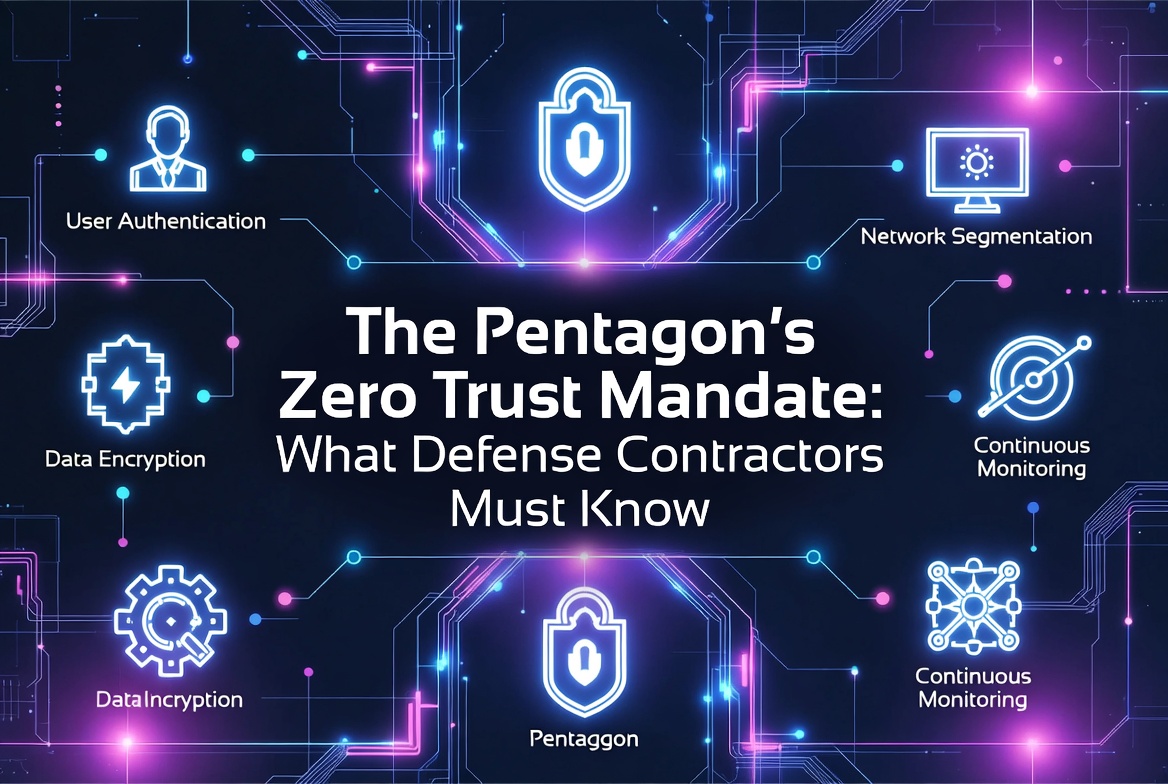
The DoD framework organizes Zero Trust around seven interconnected pillars, each with specific capability requirements:
- User: Continuous verification of user identities through multi-factor authentication and behavioral analytics to detect unauthorized access attempts.
- Device: Security policies ensuring only compliant devices can access DoD systems, with dynamic security posture checks before and during access.
- Network and Environment: Microsegmentation and software-defined perimeters that limit lateral movement and contain breaches.
- Application and Workload: Securing mission-critical applications and workloads through least-privilege access controls.
- Data: Advanced data tagging, protection, and encryption for classified and operational data – the central focus of all Zero Trust activities.
- Visibility and Analytics: Real-time logging, monitoring, and AI/ML-driven threat detection across the entire environment.
- Automation and Orchestration: Automated security responses that reduce human error and accelerate threat response.
Critical Deadlines You Can’t Afford to Miss
The DoD’s roadmap includes 152 Zero Trust activities divided between two phases:
- Target Level (September 30, 2027): 91 capability outcomes forming the baseline requirements. This is the minimum standard that all DoD components and DIB partners must achieve.
- Advanced Level (2032): An additional 61 activities representing the full Zero Trust capability set.
Pentagon officials are clear: this timeline is non-negotiable. As Randy Resnick, Director of the Zero Trust Portfolio Management Office, stated: “We’re 24 months away from our deadline at the end of fiscal year 2027… It’s time to buy and implement. They’re going to need every bit of those 24 months.”
The CMMC Connection
Adding urgency to the Zero Trust mandate, the Cybersecurity Maturity Model Certification (CMMC) 2.0 requirements became effective November 10, 2025. Defense contractors handling Federal Contract Information or Controlled Unclassified Information now face a three-phase implementation:
- Phase 1 (November 2025): Self-assessed CMMC Level 1 and Level 2 status required in applicable solicitations and contracts.
- Phase 2 (November 2026): Third-party assessor (C3PAO) certification required for Level 2 compliance.
- Phase 3 (November 2027): Defense Industrial Base Cybersecurity Assessment Center (DIBCAC) certification required for Level 3.
The convergence of Zero Trust and CMMC requirements means defense contractors must simultaneously address both frameworks – a significant undertaking that demands the right technology partners and solutions.
Meeting the Mandate: TerraZone Solutions for Defense Contractors
For defense contractors seeking to navigate these complex requirements, TerraZone offers an integrated suite of solutions specifically designed to address DoD Zero Trust and CMMC compliance challenges. Learn more about our comprehensive approach at our State, Federal, and Defense Agencies Solutions page.
truePass: Zero Trust Network Access for the Defense Sector
TerraZone’s truePass platform delivers the foundation for achieving DoD Zero Trust compliance across multiple pillars simultaneously. Unlike traditional VPN-based approaches that grant network-wide access before authentication – exposing services to potential attackers – truePass implements true Zero Trust principles:
- Patented Reverse Access Technology: Your network remains hidden from the outside at all times. If adversaries can’t see your infrastructure, they can’t attack it – reducing your attack surface to near zero.
- Pre-Authentication and Pre-Authorization: Every access request must be verified before any network connection is established. No implicit trust, no exceptions.
- Identity-Based Micro-Segmentation: Create isolated network segments based on user identity, limiting lateral movement and containing potential breaches to specific zones.
- Multi-Factor Authentication Support: Integrate with existing MFA solutions including Microsoft Authenticator, Duo, Okta, and others to satisfy the User pillar requirements.
- Flexible Deployment: Deploy on-premises, in the cloud, or in hybrid configurations to match your existing infrastructure and mission requirements.
truePass directly addresses the DoD’s user, device, network, and application pillars while providing the visibility and analytics capabilities essential for continuous compliance monitoring.
Privileged Access Management: Securing Your Most Critical Accounts
Privileged accounts – domain administrators, system administrators, service accounts – represent the keys to your kingdom. Compromise of these credentials provides adversaries with the access they need to move laterally, exfiltrate data, and establish persistent presence. The DoD Zero Trust strategy and CMMC both emphasize rigorous privileged access controls as foundational requirements.
TerraZone’s PAM capabilities address these requirements through:
- Just-in-Time Access: Grant privileged access only when needed, for only as long as needed. Eliminate standing privileges that create unnecessary risk.
- Least Privilege Enforcement: Automatically ensure users have only the minimum access required for their specific roles and current tasks.
- Session Recording and Audit: Capture complete audit trails of all privileged sessions for compliance reporting and forensic investigation.
- Credential Vaulting: Securely store, rotate, and manage privileged credentials without exposing them to end users or applications.
- Third-Party Access Control: Extend the same rigorous access controls to contractors, vendors, and partners accessing your systems.
Continuous Monitoring: The Visibility Pillar in Action
Zero Trust isn’t a one-time implementation – it’s a continuous process requiring real-time visibility into user behavior, device compliance, and data access patterns. TerraZone’s continuous monitoring capabilities provide:
- Behavioral Analytics: AI-driven detection of anomalous user behavior that could indicate compromised credentials or insider threats.
- Device Posture Assessment: Continuous evaluation of device health, including firewall status, running processes, geolocation, and compliance with security policies.
- Full Audit Trail: Comprehensive logging of all “who, what, when, and where” data for every access request and data transaction.
- SIEM Integration: Seamless integration with existing Security Information and Event Management systems to enhance your security operations center capabilities.
- Compliance Reporting: Automated generation of compliance reports demonstrating adherence to DoD Zero Trust and CMMC requirements.
Why This Matters for Your Business
The implications of failing to achieve Zero Trust compliance extend beyond losing a single contract. The DoD’s strategy represents a fundamental reshaping of how the Pentagon evaluates and works with its contractor base. Organizations that lag behind risk:
- Contract Ineligibility: Without proper certification, contractors cannot receive awards, exercise options, or extend contract periods of performance.
- Supply Chain Exclusion: Prime contractors are increasingly requiring subcontractors to demonstrate compliance before including them in bids.
- False Claims Act Exposure: Inaccurate reporting of cybersecurity compliance status creates significant legal liability.
- Competitive Disadvantage: Early adopters of Zero Trust will have a significant edge when competing for contracts requiring advanced cybersecurity postures.
Taking Action: Your Path Forward
The 2027 deadline is approaching faster than most organizations realize. Here’s how to begin your Zero Trust journey:
- Conduct a Security Assessment: Evaluate your current cybersecurity posture against the DoD Zero Trust pillars and CMMC requirements to identify gaps.
- Map Your CUI and FCI: Understand where controlled information resides, how it flows, and who has access to determine your required compliance level.
- Prioritize High-Impact Investments: Focus on solutions that address multiple Zero Trust pillars simultaneously – platforms like TerraZone’s truePass that integrate identity, access, network segmentation, and monitoring capabilities.
- Engage Your Supply Chain: Work with subcontractors and partners to ensure flowdown compliance throughout your ecosystem.
- Document Everything: Begin building the audit trails and compliance documentation you’ll need to demonstrate adherence to assessors.
Conclusion
The Pentagon’s Zero Trust mandate isn’t a distant future requirement – it’s an urgent present reality. Defense contractors who act now to implement comprehensive Zero Trust architectures will position themselves for continued success in the federal marketplace. Those who delay risk finding themselves unable to compete for the contracts that sustain their businesses.
TerraZone stands ready to partner with defense contractors on this critical journey. Our integrated suite of solutions – truePass Zero Trust Network Access, Privileged Access Management, and Continuous Monitoring – provides the technological foundation you need to achieve compliance while strengthening your overall security posture.
Visit terrazone.io to learn how we can help your organization meet the Pentagon’s Zero Trust mandate – and transform your cybersecurity from a compliance burden into a competitive advantage.