

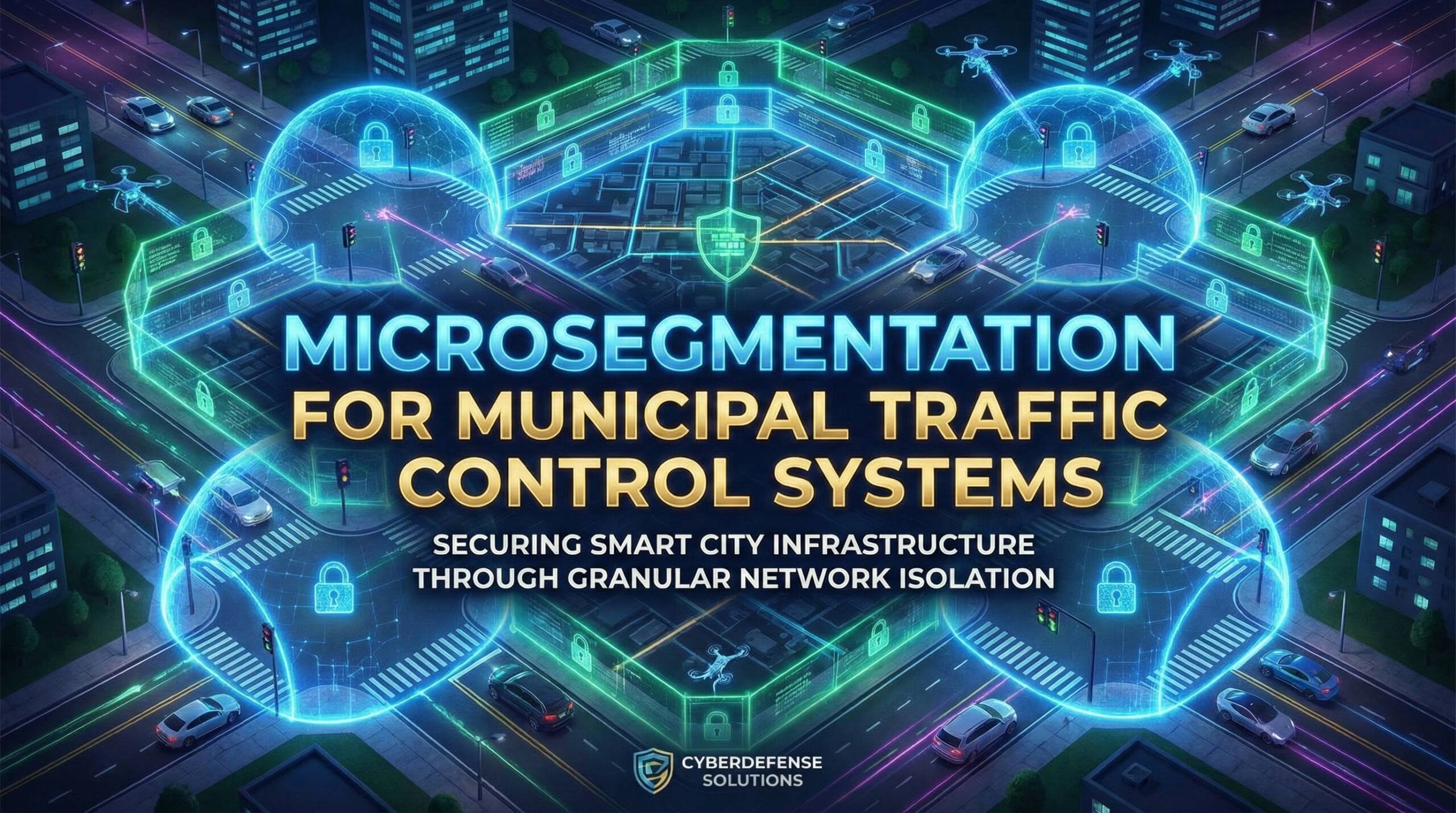
In February 2024, a sophisticated ransomware attack struck the City of Hamilton, Ontario, crippling approximately 80 percent of its municipal network-including its traffic signal system management. The incident ultimately cost the city over $18.3 million in recovery and remediation expenses, with their cyber insurance claim denied due to insufficient multi-factor authentication controls. This single attack demonstrates the cascading consequences when municipal infrastructure falls to cyber threats.
Traffic control systems represent one of the most vulnerable yet critical components of modern urban infrastructure. According to research from UC Berkeley’s Center for Long-Term Cybersecurity, cybersecurity experts rank smart traffic signals among the highest-risk technologies deployed by municipalities-vulnerable in technical terms, attractive to sophisticated threat actors, and capable of generating severe impacts when compromised.
This article examines the comprehensive risk landscape facing municipal traffic control systems, explores how microsegmentation provides essential protection for this critical infrastructure, and demonstrates how TerraZone’s security architecture addresses the unique challenges of securing operational technology (OT) environments within homeland security contexts.
The Critical Infrastructure at Stake
Understanding Municipal Traffic Control Architecture
Modern traffic control systems have evolved far beyond simple timed signals. Today’s municipal traffic infrastructure comprises an interconnected ecosystem of components:
Traffic Signal Controllers: The computerized devices at each intersection that manage signal timing, phase sequencing, and coordination with adjacent intersections. These controllers run embedded operating systems and communicate over municipal networks.
Central Traffic Management Systems (CTMS): Software platforms that provide centralized monitoring, control, and optimization of traffic signals across a city. Operators can adjust timing plans, respond to incidents, and coordinate signals for emergency vehicle preemption.
Communication Networks: The wired and wireless infrastructure connecting field devices to central systems. This may include fiber optic cables, cellular connections, dedicated radio frequencies, or increasingly, connections to municipal area networks and the internet.
Detection Systems: Sensors including inductive loop detectors, video cameras, radar, and increasingly, connected vehicle (V2I) receivers that feed real-time traffic data to controllers and management systems.
Peripheral Systems: Emergency vehicle preemption systems, transit signal priority equipment, dynamic message signs, and increasingly, integration points with autonomous vehicle infrastructure.
This complexity creates what security professionals call a large “attack surface”-numerous potential entry points for malicious actors.
Comprehensive Risk Assessment: The Threat Landscape
Technical Vulnerabilities in Traffic Control Systems
Research from multiple institutions has documented significant security weaknesses in traffic control infrastructure:
Table 1: Technical Vulnerabilities in Traffic Control Systems
Vulnerability Category | Specific Issues | Prevalence |
Default Credentials | Factory default usernames/passwords unchanged | Very High |
Unencrypted Communications | Traffic between controllers and management systems transmitted in cleartext | High |
Legacy Protocols | NTCIP 1202 standard lacks modern security features | Universal |
Outdated Firmware | Controllers running unpatched software with known vulnerabilities | High |
Internet Exposure | Management interfaces accessible from public internet | Moderate-High |
Wireless Vulnerabilities | Unprotected radio communications for signal coordination | High |
Physical Access | Field cabinets with inadequate physical security | Variable |
In 2014, University of Michigan researchers demonstrated they could seize control of nearly 100 wirelessly networked traffic lights in an unnamed Michigan city. They found factory default usernames and passwords, unencrypted radio communications, and a lack of secure authentication between components. A decade later, many of these fundamental issues persist across municipal deployments nationwide.
More recently, in 2024, security researcher Andrew Lemon discovered that traffic light controllers from major manufacturer Econolite were exposed on the internet with default credentials, potentially allowing attackers to manipulate signal timing remotely. The vulnerability affected the NTCIP 1202 communications standard-present in virtually all modern signal systems.
Attack Vectors and Threat Scenarios
Traffic control systems face threats from multiple vectors:
Network-Based Attacks
Attackers with network access can potentially:
- Manipulate signal timing to create gridlock or dangerous conditions
- Disable emergency vehicle preemption during critical response
- Disrupt coordinated “green wave” timing causing increased congestion
- Access video feeds for surveillance or reconnaissance
Table 2: Network Attack Vectors
Vector | Method | Potential Impact |
Remote Access Exploitation | Compromising internet-exposed management interfaces | Full system control |
Lateral Movement | Moving from compromised IT systems to OT networks | Signal manipulation |
Man-in-the-Middle | Intercepting unencrypted controller communications | Data modification |
Wireless Interception | Capturing and replaying radio-based commands | Local signal control |
Supply Chain Compromise | Malicious firmware or software updates | Persistent access |
Physical Attacks
Field equipment presents physical attack opportunities:
- Direct access to controller cabinets for hardware manipulation
- Installation of rogue devices on communication networks
- Tampering with sensors to inject false data
Insider Threats
Municipal employees and contractors with system access represent a significant risk:
- Disgruntled employees sabotaging systems
- Credential theft or sharing
- Accidental misconfiguration causing outages
Threat Actors and Their Motivations
Different adversaries target traffic infrastructure for varying purposes:
Nation-State Actors: UC Berkeley research identifies nation-states as the most effective threat actors for smart city infrastructure. Traffic control manipulation could support:
- Pre-positioning for conflict scenarios
- Intelligence gathering through traffic pattern analysis
- Demonstration of capability to cause disruption
Cybercriminals: Ransomware groups increasingly target municipal infrastructure:
- The City of Hamilton attack demonstrates traffic systems as ransomware targets
- Attackers may threaten signal manipulation to pressure ransom payments
- Data theft from connected surveillance systems
Terrorists and Extremists: Traffic manipulation could amplify attack impacts:
- Creating gridlock to prevent emergency response
- Causing accidents at targeted locations
- Disrupting evacuation routes during emergencies
Hacktivists: Political motivations may drive attacks:
- Demonstrating government vulnerability
- Protesting surveillance capabilities
- Causing disruption during significant events
Thrill Seekers: Even unsophisticated attackers pose risks:
- Exploiting default credentials for amusement
- Causing localized disruptions
- Proof-of-concept attacks that expose broader vulnerabilities
Impact Assessment: When Traffic Systems Fail
The consequences of traffic control system compromise extend far beyond inconvenience:
Table 3: Impact Categories and Severity Assessment
Impact Category | Specific Consequences | Severity |
Public Safety | Increased accident risk, emergency response delays | Critical |
Economic | Traffic congestion costs, business disruption | High |
Operational | Manual traffic control requirements, overtime costs | Significant |
Reputational | Public trust erosion, political consequences | Moderate-High |
Cascading Effects | Impacts on connected systems, regional traffic | Variable |
Recovery Costs | System restoration, forensic investigation | $5-20M+ |
Public Safety Impacts
Manipulated traffic signals directly threaten lives:
- Conflicting green lights causing intersection accidents
- Extended red phases preventing emergency vehicle passage
- Disabled pedestrian crossing signals endangering vulnerable road users
- Disrupted “green wave” timing increasing aggressive driving
Research from the University of Maryland analyzed how cyberattacks on road networks can cause massive disruptions. Their modeling showed that even limited signal manipulation could create gridlock affecting emergency response times-potentially costing lives when ambulances, fire trucks, or police cannot reach emergencies.
Economic Consequences
Traffic disruption carries substantial economic costs:
- The Texas A&M Transportation Institute estimates congestion costs Americans over $87 billion annually in wasted time and fuel
- Targeted attacks during peak hours could multiply these costs in affected areas
- Business losses from delivery delays, employee tardiness, and customer access disruption
Cascading System Failures
Modern traffic infrastructure connects to numerous dependent systems:
- Transit signal priority systems affecting bus schedules
- Emergency vehicle preemption for fire, police, and EMS
- Connected vehicle (V2I) communications for autonomous vehicles
- Adaptive signal control systems responding to real-time conditions
Compromise of the central management system could cascade to all connected components.
The Microsegmentation Solution
Why Traditional Security Approaches Fail
Conventional perimeter security is insufficient for traffic control environments:
IT/OT Convergence Challenges: Traffic management systems increasingly connect to enterprise IT networks for data sharing, reporting, and remote access. Traditional firewalls struggle to protect OT systems while enabling necessary communications.
Legacy System Constraints: Traffic controllers often run embedded systems that cannot support modern security agents. Many components are decades old and never designed for networked environments.
Operational Requirements: Traffic systems must operate continuously. Security measures that cause latency or downtime are unacceptable when public safety depends on real-time signal operation.
Distributed Architecture: Unlike centralized data centers, traffic infrastructure spans hundreds or thousands of field locations. Protecting each endpoint with traditional approaches is impractical.
Microsegmentation: The Foundation of Traffic System Security
Microsegmentation addresses these challenges by creating granular security boundaries around individual system components:
Definition and Principles
Microsegmentation divides networks into small, isolated segments-potentially down to individual devices or workloads. Each segment has its own security policies controlling what can communicate with it and how. This approach:
- Limits lateral movement by attackers who breach one component
- Contains damage from compromised systems to affected segments only
- Enables precise access control based on identity and function
- Provides visibility into traffic patterns for anomaly detection
Table 4: Microsegmentation Benefits for Traffic Control Systems
Benefit | Traditional Approach | Microsegmentation Approach |
Breach Containment | Attacker moves freely within flat network | Compromised controller isolated from others |
Access Control | Coarse network-level restrictions | Precise application-level policies |
Visibility | Limited insight into internal traffic | Complete communication flow mapping |
Legacy Support | Requires agent installation | Identity-based without device agents |
Operational Impact | Inline inspection adds latency | Policy enforcement without processing delay |
Applying Microsegmentation to Traffic Infrastructure
Effective microsegmentation for traffic control requires systematic segmentation across the architecture:
Segment 1: Field Devices
Each intersection controller operates in its own security segment:
- Can communicate only with designated management systems
- Cannot directly communicate with other controllers (preventing lateral movement)
- Restricted to specific protocols and ports required for legitimate operation
Segment 2: Communication Networks
Network infrastructure isolated from general municipal networks:
- Dedicated VLANs or segments for traffic control communications
- No direct paths between traffic networks and enterprise IT
- Encrypted connections for any data traversing shared infrastructure
Segment 3: Central Management
Traffic management platforms in protected segments:
- Operator workstations isolated from general office networks
- Database servers accessible only from authorized applications
- Management interfaces not exposed to internet
Segment 4: Integration Points
Connections to external systems carefully controlled:
- Transit priority systems with limited, defined access
- Emergency vehicle preemption through secure channels
- Data feeds to partner agencies through controlled gateways
Table 5: Microsegmentation Architecture for Traffic Control
Component Category | Segment Isolation | Permitted Communications | Security Policy |
Intersection Controllers | Individual per intersection | Central management only (inbound commands, outbound status) | No controller-to-controller traffic |
Detection Systems | Grouped by type/location | Controllers (sensor data), management (video/analytics) | Read-only data transmission |
Central Management | Dedicated segment | Controllers (commands), workstations (operator access) | Multi-factor authentication required |
Operator Workstations | Isolated from enterprise | Management systems only | Role-based access enforcement |
Integration Gateways | DMZ-style segment | Specific external partners, defined data types | Protocol and content inspection |
Backup Systems | Air-gapped segment | One-way replication from management | No direct operational access |
TerraZone’s Approach to Traffic Control Security
Zero Trust Architecture for Critical Infrastructure
TerraZone implements Zero Trust principles specifically designed for homeland security and critical infrastructure environments:
Never Trust, Always Verify: Every access request to traffic control systems is authenticated and authorized regardless of origin. Network location grants no implicit trust-operators must prove their identity and authorization for each session.
Least Privilege Access: Users and systems receive minimum necessary access. A traffic engineer adjusting signal timing cannot access video surveillance feeds unless specifically authorized for that function.
Continuous Verification: Access is not a one-time event. TerraZone continuously validates that sessions remain authorized, devices remain compliant, and behavior remains normal throughout system interaction.
Reverse Access Technology for OT Environments
TerraZone’s patented Reverse Access Technology addresses the unique challenges of protecting operational technology:
No Inbound Connections: Traffic management systems establish outbound connections only. Field controllers and management platforms present no open ports to potential attackers-there is nothing to scan, probe, or exploit.
Invisible Infrastructure: From an attacker’s perspective, traffic control systems simply don’t exist on the network. Port scans return nothing. Vulnerability probes find no targets. The attack surface effectively disappears.
Maintained Operational Capability: Despite this invisibility, authorized operators maintain full access. Connections are brokered through the TerraZone gateway without exposing internal systems.
Identity-Based Microsegmentation
TerraZone’s microsegmentation operates on identity rather than network addresses:
Device Identity: Each traffic controller is identified by cryptographic credentials, not IP addresses. If a device is replaced or an IP changes, security policies follow the device identity automatically.
User Identity: Operators access systems based on their authenticated identity and assigned roles. A supervisor can access different functions than a technician, regardless of which workstation they use.
Application Identity: Communications between applications are controlled based on application identity. The signal timing application can reach controllers; a compromised analytics application cannot pivot to signal manipulation.
Adaptive Mode for Traffic Environments
TerraZone’s adaptive mode learns normal traffic control operations before enforcing restrictions:
Behavioral Baselining: The system observes communication patterns-which controllers talk to which management systems, what protocols are used, typical data volumes and timing.
Anomaly Detection: Once baselines are established, unusual patterns trigger alerts. A controller suddenly communicating with an unknown system, or unusual command patterns, indicate potential compromise.
Progressive Enforcement: Policies can be implemented gradually, starting in monitor-only mode to validate that legitimate operations won’t be disrupted before blocking unauthorized communications.
Implementation Strategy
Phase 1: Assessment and Discovery (Weeks 1-4)
Successful implementation begins with comprehensive understanding:
Asset Inventory: Document all traffic control components-controllers, management systems, communication paths, integration points. Many municipalities lack complete inventories of their traffic infrastructure.
Communication Mapping: Identify all data flows between components. TerraZone’s discovery capabilities automatically map communications to reveal the actual traffic patterns in the environment.
Risk Assessment: Evaluate each component and communication path for vulnerability and potential impact. Prioritize protection efforts based on risk.
Baseline Establishment: Capture normal operational patterns to inform policy development.
Table 6: Assessment Phase Deliverables
Deliverable | Content | Use |
Asset Inventory | Complete list of all traffic control components | Policy scoping |
Communication Map | All data flows between systems | Segmentation design |
Vulnerability Assessment | Known weaknesses and exposures | Remediation prioritization |
Risk Register | Threats, likelihood, and potential impact | Resource allocation |
Operational Baseline | Normal communication patterns | Anomaly detection tuning |
Phase 2: Architecture Design (Weeks 5-8)
Design microsegmentation architecture aligned with operational requirements:
Segment Definition: Determine appropriate granularity-individual devices, functional groups, or geographic clusters based on risk and operational needs.
Policy Development: Create access control policies specifying permitted communications between segments. Policies should reflect actual operational requirements while eliminating unnecessary access.
Integration Planning: Design connections to existing security infrastructure-SIEM platforms, identity providers, incident response systems.
Phase 3: Pilot Deployment (Weeks 9-14)
Begin with limited deployment to validate the approach:
Pilot Selection: Choose a subset of intersections representing various configurations and communication patterns.
Monitor Mode Deployment: Implement TerraZone in observation mode, validating that policies correctly capture legitimate operations.
Policy Refinement: Adjust policies based on observed traffic, eliminating false positives while maintaining security.
Table 7: Pilot Success Criteria
Criterion | Measurement | Target |
Operational Continuity | Signal operations unaffected | 100% |
Policy Accuracy | Legitimate traffic correctly permitted | >99.9% |
Detection Capability | Simulated attacks identified | >95% |
Staff Readiness | Operators trained and comfortable | All required personnel |
Phase 4: Production Rollout (Weeks 15-24)
Expand protection to full traffic infrastructure:
Phased Deployment: Roll out in geographic or functional stages, maintaining rollback capability throughout.
Continuous Monitoring: Track system performance and security metrics throughout deployment.
Documentation: Maintain current documentation of segmentation architecture and policies.
Phase 5: Optimization (Ongoing)
Continuous improvement maintains security posture:
Policy Tuning: Refine policies based on operational experience and evolving threats.
Technology Updates: Incorporate new capabilities as traffic systems modernize.
Exercise and Testing: Regular security exercises validate detection and response capabilities.
Regulatory and Compliance Considerations
CISA Transportation Systems Sector Guidelines
The Cybersecurity and Infrastructure Security Agency (CISA) identifies the Transportation Systems Sector as one of 16 critical infrastructure sectors. CISA’s guidance emphasizes:
- Risk-based security approaches
- Network segmentation as a key control
- Continuous monitoring for anomalous activity
- Incident response planning and exercises
TerraZone’s microsegmentation directly supports CISA’s recommended security architecture.
NIST Cybersecurity Framework Alignment
The NIST Cybersecurity Framework provides a structured approach to critical infrastructure protection:
Table 8: NIST Framework Alignment
NIST Function | TerraZone Capability |
Identify | Asset discovery, communication mapping |
Protect | Microsegmentation, Zero Trust access control |
Detect | Behavioral monitoring, anomaly detection |
Respond | Automated containment, incident logging |
Recover | Protected backups, documented restoration procedures |
State and Local Requirements
Many states have adopted cybersecurity requirements for critical infrastructure:
- Some require security assessments for traffic systems
- Others mandate incident reporting for critical infrastructure
- Federal grant programs increasingly require cybersecurity controls
Municipalities should verify applicable requirements and ensure microsegmentation implementation satisfies compliance obligations.
Measuring Success
Security Metrics
Track security improvements from microsegmentation:
Table 9: Security Key Performance Indicators
Metric | Measurement | Target |
Attack Surface Reduction | Exposed services/ports | >90% reduction |
Lateral Movement Paths | Possible attacker paths | <5 approved paths |
Mean Time to Detect | Anomaly identification speed | <15 minutes |
Segmentation Coverage | Protected components | 100% |
Policy Violations | Blocked unauthorized access | Track and investigate all |
Operational Metrics
Ensure security doesn’t impede operations:
Metric | Measurement | Target |
Signal Operations Availability | System uptime | 99.99% |
Operator Access | Authorized access success rate | >99.9% |
Maintenance Windows | Time required for security updates | <4 hours monthly |
False Positive Rate | Legitimate traffic blocked | <0.1% |
The Business Case for Investment
Cost of Inaction
The City of Hamilton’s $18.3 million recovery cost demonstrates the financial risk of inadequate security. This figure includes:
- Incident response and forensic investigation
- System restoration and remediation
- Overtime for manual operations
- Legal and regulatory costs
- Reputational damage (harder to quantify)
Many municipalities operate with cyber insurance, but coverage limitations or claim denials-as Hamilton experienced-can leave cities fully exposed.
Return on Investment
Microsegmentation investment delivers measurable returns:
Risk Reduction: Significantly reduced probability of successful attacks against protected infrastructure.
Incident Containment: When breaches occur, microsegmentation limits damage scope and recovery costs.
Compliance Efficiency: Simplified audit preparation and documentation for regulatory requirements.
Operational Visibility: Communication mapping reveals network issues beyond security concerns.
Insurance Benefits: Demonstrated security controls may reduce premiums or improve coverage terms.
Conclusion: Protecting the Infrastructure That Moves Our Cities
Municipal traffic control systems represent critical infrastructure that directly affects public safety, economic activity, and quality of life in communities across the nation. The convergence of legacy operational technology with modern networked systems has created security challenges that traditional approaches cannot address.
Microsegmentation provides the granular protection these systems require-containing threats, limiting damage, and maintaining operational continuity even when individual components are compromised. TerraZone’s approach combines Zero Trust architecture, Reverse Access Technology, and identity-based microsegmentation to create comprehensive protection for traffic infrastructure without disrupting the real-time operations that keep our cities moving.
The threat landscape continues to evolve. Nation-state actors, cybercriminals, and other adversaries recognize traffic systems as attractive targets. The question facing municipal leaders is not whether to invest in protection, but whether they can afford the consequences of leaving critical infrastructure vulnerable.
To explore how TerraZone can protect your municipal traffic control infrastructure, visit TerraZone Solutions for Homeland Security Systems or schedule a consultation at terrazone.io.