

Quick Summary
ZTNA (Zero Trust Network Access) is a security framework that replaces the traditional “trust what’s inside the network” model with a “never trust, always verify” approach. Instead of a VPN that grants broad network access after a single authentication event, ZTNA verifies every user, every device, and every access request-continuously, in real time. The result: a dramatically reduced attack surface, secure remote and hybrid work, granular access control, and built-in regulatory compliance.
The ZTNA market is projected to grow from $1.34 billion in 2025 to $4.18 billion by 2030, at a CAGR of 25.5%. In 2025, 65% of enterprises are planning to replace traditional VPNs with ZTNA, and Gartner estimates that at least 70% of new remote access deployments now use ZTNA rather than VPN services.
What Is ZTNA?
Zero Trust Network Access is a security model that fundamentally changes how organizations manage access to digital resources. The core principle is straightforward: never trust, always verify.
Unlike traditional security models that automatically trust anyone inside the corporate network perimeter, ZTNA assumes that every access request-whether it originates from corporate headquarters or a coffee shop on the other side of the world-is untrusted until proven otherwise. The model was formally defined in NIST SP 800-207 (2020), which established Zero Trust architecture principles as the recognized standard for enterprise security.
Gartner defines ZTNA as “products and services that create an identity and context-based, logical-access boundary that encompasses an enterprise user and an internally hosted application or set of applications. The applications are hidden from discovery, and access is restricted via a trust broker to a collection of named entities, which limits lateral movement within a network.”
Technical Definition
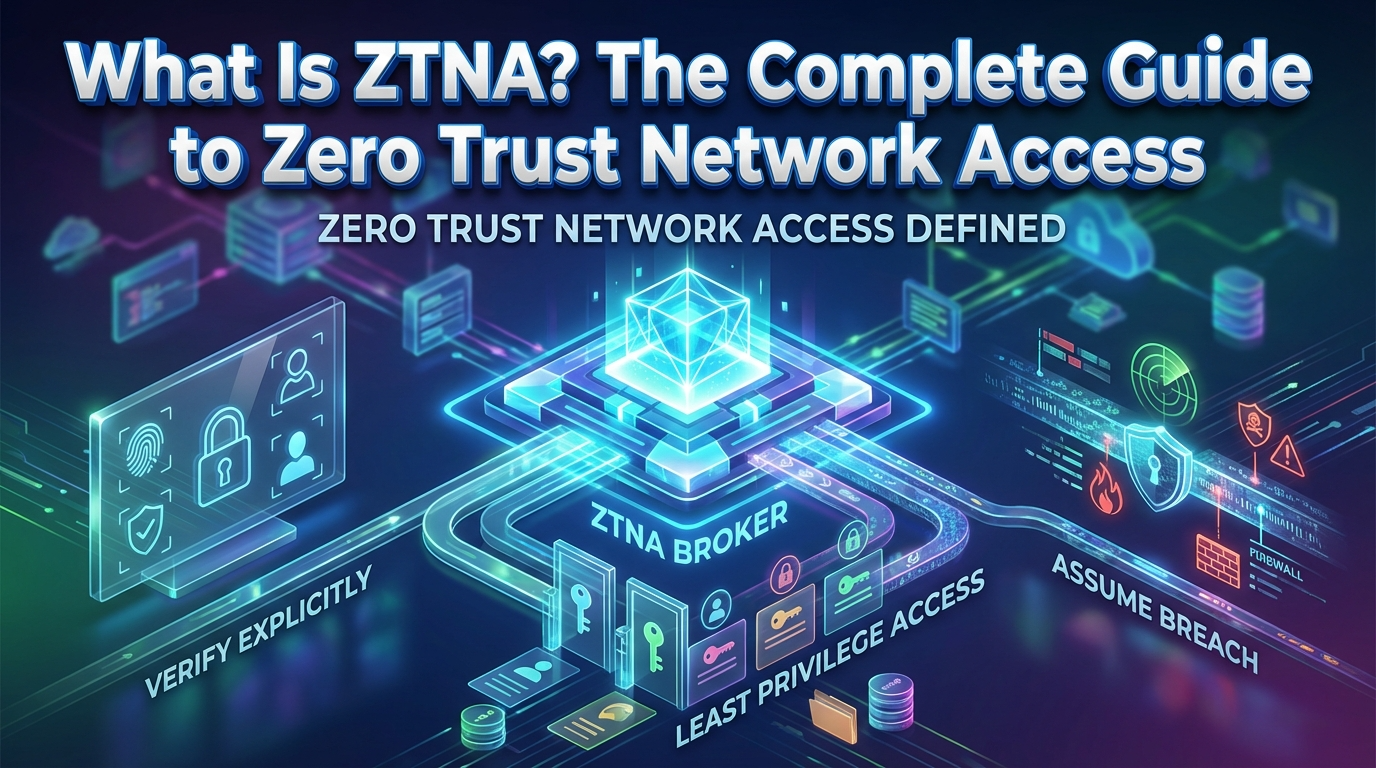
ZTNA provides secure, flexible, and segmented access to enterprise applications and resources based on three foundational principles:
Explicit Verification. Every access request is authenticated against user identity, device security posture, geographic location, time of access, network type, and behavioral patterns. No request is approved based on network location alone.
Least Privilege Access. Each user receives access only to the specific resources required for their role-nothing more. A marketing analyst can access the CRM and content management system but cannot reach the financial database or development servers, even if all systems reside on the same physical network.
Assume Breach. The architecture is designed under the assumption that a breach has already occurred or could occur at any moment. This drives microsegmentation, continuous session validation, and strict controls on lateral movement between resources.
Why ZTNA Is Essential in 2026
The shift to ZTNA is not a technology trend-it is a necessary response to structural changes in how organizations operate and how attackers exploit them.
The Hybrid Workforce Is Permanent
Over 60% of knowledge workers now work outside the office at least part of the week. The traditional “castle and moat” model-where everything inside the corporate network is considered safe-is irrelevant when employees connect from homes, airports, coworking spaces, and client sites across the globe. VPNs were designed for occasional remote access, not for permanent distributed workforces.
Credential-Based Attacks Dominate
Credential-based attacks now account for approximately 80% of all breaches. When an attacker obtains a username and password, a traditional VPN grants access to the entire network. ZTNA grants access to a single application only-and only if the device passes posture checks, the location is consistent, the behavior matches established patterns, and multi-factor authentication succeeds.
Cloud Migration Invalidates Perimeter Defense
Organizations have moved the majority of their applications and data to cloud environments-AWS, Azure, GCP, and SaaS platforms. When 70% or more of enterprise resources no longer reside inside the corporate network, defending only the network perimeter provides no protection. ZTNA secures access to the resource itself, regardless of where it is hosted.
Regulatory Requirements Are Tightening
Regulations including GDPR, HIPAA, PCI DSS 4.0, the EU’s Digital Operational Resilience Act (DORA), NYDFS Part 500, and NIST SP 800-207 mandate granular access controls, continuous verification, and comprehensive audit trails. ZTNA provides these capabilities as an inherent part of its architecture-not as an add-on configuration.
How ZTNA Works: The Complete Access Flow
Understanding ZTNA requires understanding its core components and the end-to-end access process.
Step 1: Access Request and Identity Verification
When a user attempts to access an enterprise resource, the request is first routed to a Policy Enforcement Point (PEP). The user must verify their identity through multi-factor authentication (MFA) combining a password with a second factor-an authenticator app, biometric scan, or FIDO2 hardware key. Identity and Access Management (IAM) systems such as Microsoft Entra ID, Okta, or Google Workspace validate the user’s identity against the enterprise identity store.
Step 2: Device Posture Assessment
Simultaneously, the system evaluates the security posture of the connecting device: Is the operating system patched to the current version? Is endpoint protection active and updated? Is disk encryption enabled? Is the device enrolled in mobile device management (MDM)? Are there known vulnerabilities or suspicious software present? The depth of this assessment varies by ZTNA vendor-some check only basic parameters, while others perform continuous posture evaluation throughout the session.
Step 3: Context Evaluation
The policy engine evaluates additional contextual factors: geographic location (is the user connecting from an unexpected country?), time of access (is this outside normal working hours?), network type (corporate Wi-Fi, home network, or public hotspot?), and behavioral patterns (does this request deviate from the user’s established access patterns?).
Step 4: Access Decision and Authorization
Based on the aggregate evaluation of identity, device posture, and context, the policy engine makes an access decision: full access to the requested resource, partial access (read-only, for example), a request for additional authentication (step-up MFA), or denial with the request logged for audit.
Step 5: Continuous Monitoring
Unlike VPN, which authenticates once at connection and then trusts the session indefinitely, ZTNA continuously monitors the session throughout its duration. If device posture changes-for example, if endpoint protection is disabled-access is revoked. If anomalous behavior is detected-such as a session suddenly executing administrative commands when authorized for read-only access-the session is terminated or requires re-authentication. Every action is recorded in a complete audit log.
The critical distinction: VPN creates a “tunnel” into the entire network. ZTNA creates an encrypted connection directly to the specific application. The user never “enters the network”-they receive access only to the individual resource authorized for them.
ZTNA vs. VPN: Complete Comparison
Parameter | Traditional VPN | ZTNA |
Trust model | Implicit trust after connection-“inside = safe” | Zero trust-continuous verification on every request |
Access scope | Broad access to the entire network | Access to a specific application only |
Authentication | Once, at connection | Continuous-throughout the entire session |
Lateral movement | Attacker can move freely across the network | Blocked-each resource is isolated |
Internet exposure | VPN server exposed with a public IP address | Resources are hidden-no direct internet exposure |
User experience | Often slow, perceived as an added layer | Direct and fast-transparent to the user |
Scalability | Difficult to scale-creates bottlenecks | Cloud-native, scales elastically |
Cost model | Dedicated hardware + licenses + maintenance | Typically SaaS-predictable, lower TCO |
Cloud compatibility | Limited-designed for on-premises resources | Built for cloud, hybrid, and multi-cloud |
Compliance | Limited audit trails | Complete audit trail, built-in compliance |
When VPN Is Still Relevant
ZTNA does not necessarily replace VPN entirely in every scenario. VPN may remain useful for IT teams performing full-network maintenance operations, or in legacy environments that do not support modern authentication integration. The recommended approach is incremental: start with ZTNA for critical applications, expand coverage gradually, and maintain VPN as a fallback during migration until full replacement is achieved.
ZTNA vs. Traditional Security Models
The “Castle and Moat” Model
Traditional security assumes that if you cross the moat (firewall, VPN), you are trusted. The problem: once an attacker breaches the perimeter, they move freely through the entire network.
The ZTNA Model: “Every Door Is Locked”
In ZTNA, even if an attacker gains access to one resource, every other resource is a separately locked door. Access to one application grants zero access to any other application.
The fundamental differences:
Static vs. Dynamic. Traditional security relies on fixed rules. ZTNA adapts access decisions in real time based on changing context-location, device state, behavior, risk score.
Perimeter-Based vs. Identity-Based. Traditional security protects the location. ZTNA protects the access-based on who you are, not where you are.
Implicit Trust vs. Earned Trust. Traditional models grant automatic trust after initial authentication. ZTNA rebuilds trust with every request.
Core Architectural Principles
Microsegmentation
Instead of a flat network where every system can communicate with every other system, ZTNA divides the network into small, isolated segments. Each segment contains a specific application or resource with independent access controls. Microsegmentation controls east-west traffic (workload-to-workload communication), while ZTNA controls north-south traffic (user-to-application access). Together, they create a comprehensive Zero Trust architecture where both user access and internal application communication are governed by identity-based policies.
Continuous Authentication
Unlike VPN’s one-time authentication, ZTNA performs ongoing verification: continuous device posture monitoring, behavioral pattern analysis, dynamic risk scoring, and automatic access revocation when anomalies are detected.
Application-Level Access
ZTNA does not grant “network access”-it grants access to a specific application through an encrypted tunnel. The user has no visibility or connectivity to anything else on the network. This architectural principle eliminates the lateral movement that enables the majority of successful breaches.
End-to-End Encryption
All communication between user and resource is encrypted using TLS 1.3 or a dedicated encrypted tunnel, protecting against eavesdropping and man-in-the-middle attacks.
Centralized Policy Engine
All access decisions are made by a central policy engine that evaluates in real time: user identity (who?), device security posture (from what?), requested resource (to what?), context-location, time, network (under what circumstances?), and data sensitivity level (what is the risk?).
Network Architecture: How Connections Are Established
One of the most consequential technical decisions in ZTNA is how the connection between user and application is established. This architectural choice directly affects security posture, attack surface, and resilience.
Service-Initiated (Inside-Out) Architecture
Most cloud-delivered ZTNA solutions deploy connectors alongside applications. These connectors establish outbound connections to the ZTNA broker in the cloud. Users connect to the broker, which routes traffic through the existing outbound tunnel. No inbound firewall ports are required on the application side. This is the architecture used by Zscaler, Cloudflare, and most cloud-native ZTNA vendors.
Reverse-Access Architecture
Reverse-access architecture takes this further. The application-side components initiate all connections outbound, and the broker never pushes traffic inbound. The firewall remains in a permanent deny-all state for inbound traffic. There are no listening services, no open ports, and no discoverable IP addresses. The application infrastructure is completely invisible to the public internet-there is nothing to scan, nothing to exploit, nothing to target with DDoS.
This distinction is significant for organizations with high-value targets-government agencies, financial institutions, defense contractors, and critical infrastructure operators-where even the possibility of external reconnaissance against application infrastructure is unacceptable.
ZTNA and SASE: How They Relate
What Is SASE?
SASE (Secure Access Service Edge) is a broader security framework that combines networking and security services in a unified, cloud-delivered model. SASE includes ZTNA (Zero Trust Network Access), SWG (Secure Web Gateway) for internet traffic filtering, CASB (Cloud Access Security Broker) for SaaS security, FWaaS (Firewall as a Service), and SD-WAN for software-defined wide area networking.
The Relationship
ZTNA is a core component within the SASE architecture. SASE is the umbrella-ZTNA is one of the key mechanisms underneath it. While ZTNA focuses on access control, SASE provides comprehensive end-to-end protection including internet security, cloud application security, and network optimization.
When ZTNA Is Sufficient vs. When SASE Is Needed
ZTNA alone is appropriate for organizations whose primary challenge is replacing VPN and securing remote access to specific applications. Full SASE is appropriate for organizations that want a consolidated solution covering secure access, internet protection, SaaS security, and network optimization-all as a unified cloud service. Many organizations adopt ZTNA as the first step toward broader SASE adoption.
Eight Benefits of ZTNA
1. Attack Surface Reduction
ZTNA does not expose the corporate network to the internet. Resources are invisible to potential attackers-no public IP address, no open port, no discoverable service. The attack surface shrinks dramatically compared to VPN, where the VPN concentrator itself is a permanent internet-facing target.
2. Lateral Movement Prevention
Even if an attacker compromises one account or device, they cannot move to other parts of the network. Identity-based segmentation ensures that each resource is isolated, and the impact of any single breach is contained to the minimum possible scope.
3. Insider Threat Protection
Least-privilege access policies limit every user-including those with malicious intent-to only the resources required for their role. The system also flags anomalous behavior: an employee who suddenly attempts to access data unrelated to their job function triggers an alert and may have access restricted.
4. Improved User Experience
Unlike VPN, which users perceive as slow and cumbersome, ZTNA provides direct, fast access to applications. There is no need to “connect to VPN”-the user opens the application, and authentication happens in the background. This results in reduced latency, improved application performance, and a transparent, intuitive experience.
5. Elastic Scalability
Cloud-native ZTNA scales automatically. There is no need to add VPN hardware, purchase additional licenses, or build geographically redundant VPN infrastructure. As the organization grows, the solution grows with it.
6. Complete Visibility and Control
ZTNA provides centralized visibility into every access request, connection attempt, and user behavior. This includes comprehensive audit logs for every action, real-time session monitoring, anomaly detection and alerting, and automated compliance reports.
7. Regulatory Compliance
ZTNA’s granular access controls provide a clear audit trail that enables organizations to demonstrate compliance with GDPR, HIPAA, PCI DSS 4.0, SOC 2, ISO 27001, DORA, and NIST SP 800-207. The continuous verification and detailed logging are inherent requirements of these frameworks-and inherent capabilities of ZTNA.
8. Cost Reduction
Organizations that migrate from VPN to ZTNA typically report 30–50% cost savings, including elimination of VPN hardware costs, reduced bandwidth requirements, decreased management and maintenance overhead, and lower breach risk (and associated costs). The average cost of a data breach reached $4.88 million in 2024, according to IBM-making the risk reduction alone a significant financial driver.
Who Needs ZTNA?
Enterprise organizations with complex networks, multiple endpoints, and thousands of users derive the greatest value from ZTNA’s granular microsegmentation and centralized policy enforcement.
Organizations with hybrid or remote workforces need secure access from any location without dependency on a centralized VPN gateway.
BYOD environments where employees use personal devices require ZTNA’s ability to enforce security policies based on device posture-even on devices the organization does not own.
Cloud and multi-cloud organizations running applications across AWS, Azure, GCP, and SaaS platforms need access security that is independent of resource location.
Highly regulated industries-finance, healthcare, government, defense-derive particular value from ZTNA’s detailed access controls and audit trails that satisfy examiner scrutiny.
Managed service providers (MSP/MSSP) can offer ZTNA as a service and manage centralized access policies across multiple client organizations.
How to Implement ZTNA: Step-by-Step Guide
Step 1: Discovery and Baseline
Before deployment, map the current environment: inventory all applications (on-premises, cloud, SaaS), document user access patterns (who accesses what, from where, on which devices), map network traffic flows, and identify critical assets requiring priority protection.
Step 2: Policy Design
Design access policies based on Role-Based Access Control (RBAC)-define access by job function, risk level-apply stricter controls to sensitive resources, and contextual conditions-policies that adapt based on location, device, network, and time.
Step 3: Pilot
Start with a controlled deployment: select 50–100 users and 2–3 critical applications. Deploy in monitor mode before full enforcement. Collect user feedback and resolve integration issues at low blast radius.
Step 4: Gradual Rollout
Expand incrementally: add applications, extend to additional user groups, move VPN to “backup” status while expanding ZTNA coverage, and validate that user experience remains acceptable at each stage.
Step 5: Optimization and Continuous Improvement
Analyze monitoring data and refine access policies based on actual usage patterns. Implement automation-automatic response to anomalies, adaptive access controls that adjust in real time. Conduct periodic security reviews and penetration testing focused on ZTNA bypass scenarios.
Common ZTNA Implementation Challenges
Legacy System Integration
Older systems not designed for modern authentication can complicate ZTNA deployment. The solution: use agent-based connectors or reverse proxies that front legacy applications with modern authentication. Start with modern applications and expand to legacy systems incrementally.
User Adoption and Cultural Change
Employees accustomed to VPN may resist the transition. The solution: clear communication about benefits, end-user training, and selection of a ZTNA solution with a seamless user experience that reduces friction rather than adding it.
Policy Management Complexity
Managing granular permissions for thousands of users and hundreds of applications requires discipline. The solution: RBAC automation, integration with HR systems for automatic provisioning and deprovisioning, and regular access review cycles.
Performance Impact
Some ZTNA solutions introduce additional latency through authentication layers. The solution: select a vendor with points of presence (PoPs) geographically close to your user population, and validate real-world latency during the pilot phase.
Initial Migration Cost
While ZTNA reduces costs long-term, the initial investment can be significant. The solution: a phased approach that spreads investment over time, and an ROI calculation that quantifies breach risk reduction alongside infrastructure savings.
How to Evaluate ZTNA Vendors: Key Criteria
Not all ZTNA solutions are equal. When evaluating vendors, assess the following:
Deployment architecture: Agent-based, agentless, or universal (both). Does it support on-premises, cloud, and hybrid deployment?
Application coverage: Does it support web applications, thick clients (RDP, SSH), legacy protocols (SMB, SFTP), and database access-or only HTTP/S?
Identity integration: Does it integrate with your existing IdP (Okta, Microsoft Entra ID, Google Workspace)? Does it support phishing-resistant MFA (FIDO2)?
Device posture assessment: How deep are the device checks? Does it assess OS version, EDR status, encryption, and compliance continuously or only at connection?
Network architecture: Service-initiated (inside-out) or reverse-access? Does the firewall need open inbound ports?
Microsegmentation integration: Does the vendor offer integrated east-west traffic controls, or is microsegmentation a separate product?
Privileged access management: Does the solution support session recording, just-in-time access, and credential rotation for administrative access?
Scalability: Global PoP infrastructure, latency impact, bandwidth capacity, and auto-scaling capabilities.
Compliance readiness: Audit trail completeness, SIEM integration, and mapping to NIST, PCI DSS, HIPAA, GDPR, DORA, and SOC 2 requirements.
Total cost of ownership: Per-user licensing, infrastructure costs, migration effort, and VPN retirement savings.
Frequently Asked Questions
What is the difference between ZTNA and Zero Trust?
Zero Trust is the overarching security philosophy-a framework that says “never trust, always verify.” ZTNA is a specific technology implementation of that philosophy applied to network access. Zero Trust is the concept; ZTNA is the tool that enforces it for application and resource access.
Does ZTNA replace firewalls and VPN?
Not necessarily all at once. ZTNA complements existing security measures. Firewalls remain relevant for network perimeter protection. VPN may persist for specific use cases such as full-network maintenance by IT teams or legacy environments that cannot support modern authentication. Over time, ZTNA is expected to replace VPN as the primary access solution for most organizations-65% of enterprises are already planning this transition.
How long does ZTNA implementation take?
Timelines depend on organizational size and complexity. A pilot deployment typically takes 2–4 weeks. Full production rollout ranges from 3–12 months depending on the number of applications, users, and integration requirements.
Is ZTNA suitable for small organizations?
Yes. Cloud-delivered ZTNA solutions such as Cloudflare Access offer free tiers for up to 50 users. SaaS-based ZTNA solutions starting at $5–15 per user per month make the technology accessible to small and mid-sized organizations with predictable costs and simple deployment.
How does ZTNA support regulatory compliance?
ZTNA provides granular, documented access controls, complete audit trails recording every access request and action, continuous monitoring and anomaly detection, and automated policy enforcement. These capabilities directly satisfy requirements in GDPR, HIPAA, PCI DSS 4.0, SOC 2, ISO 27001, DORA, and NIST SP 800-207.
What is the difference between ZTNA and SDP?
SDP (Software Defined Perimeter) describes a software-defined network boundary. ZTNA and SDP share similar principles, but ZTNA is a broader concept that also encompasses policy engines, dynamic risk assessment, IAM integration, and continuous session validation-beyond boundary creation alone.
Does ZTNA affect application performance?
ZTNA typically improves performance compared to VPN because access routes directly to the application rather than through a centralized VPN gateway bottleneck. Some solutions may add milliseconds of latency for the authentication layer-imperceptible to most users. Select a vendor with PoPs geographically close to your user population to minimize any latency impact.
What happens if the cloud ZTNA service goes down?
Leading ZTNA vendors maintain SLAs of 99.99% or higher with globally distributed points of presence. Organizations should also prepare a fallback plan-such as an emergency VPN-for critical access during any service disruption. For organizations that cannot tolerate dependency on external cloud services, on-premises ZTNA deployment eliminates this concern entirely.
Does ZTNA support non-web applications?
Yes. Advanced ZTNA solutions support all application types: web (HTTP/S), SSH, RDP, VoIP, database protocols, SFTP, SMB file sharing, and legacy protocols including AS400 terminal access-through a combination of agent-based and agentless access methods. Verify specific protocol support with each vendor before deployment.
What does ZTNA cost?
Costs vary significantly. Cloud-based solutions start at approximately $5–15 per user per month. Enterprise solutions with advanced features can reach $25–50+ per user per month. Factor in implementation, training, integration, and the savings from retiring VPN infrastructure when calculating total cost of ownership.
Conclusion
ZTNA is not just another security technology-it represents a paradigm shift in how organizations approach access security. The transition from “trust what’s inside” to “verify every request” is essential in an environment where employees work from everywhere, resources are distributed across cloud and on-premises infrastructure, attackers are more sophisticated than ever, and regulatory requirements are tightening globally.
The ZTNA market’s projected growth from $1.34 billion to $4.18 billion by 2030 reflects the reality that organizations across every industry recognize this shift as necessary. The transition does not need to be a “big bang” migration-a phased approach starting with critical applications is the proven path for most organizations.
Organizations that adopt ZTNA today will be better protected, more operationally flexible, and more cost-efficient than those that remain on traditional access models. The question is no longer whether to adopt ZTNA, but how quickly the transition can be executed.