
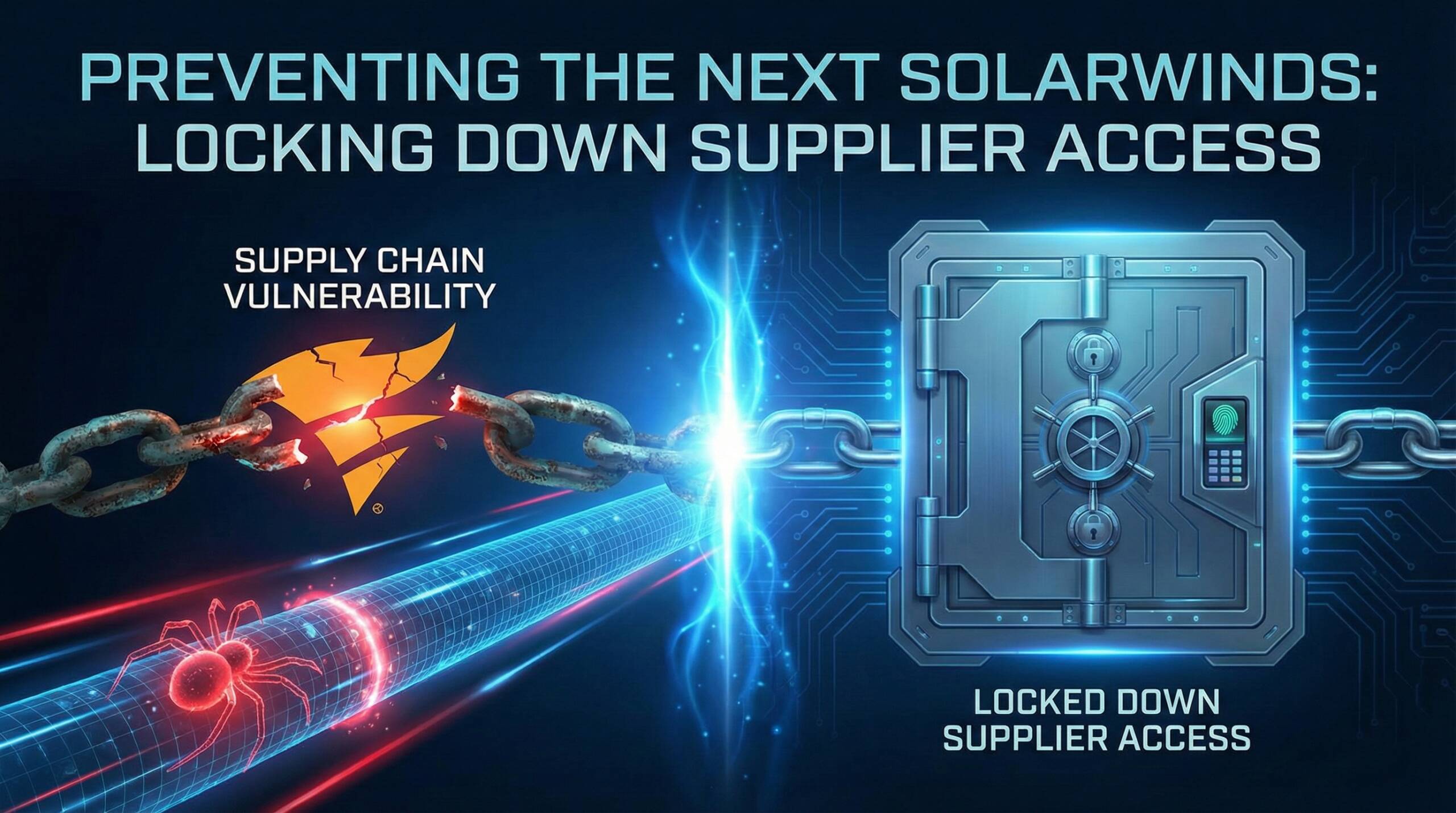
In December 2020, the cybersecurity world witnessed what many consider the most sophisticated supply chain attack in history. Russian state-sponsored hackers compromised SolarWinds’ Orion software update mechanism, distributing malicious code to approximately 18,000 organizations worldwide-including Fortune 500 companies and critical U.S. government agencies. Five years later, the lessons of SolarWinds remain urgently relevant as supply chain attacks have not merely continued but accelerated dramatically.
According to SecurityScorecard’s 2025 Global Third-Party Breach Report, at least 35.5% of all data breaches now originate from third-party compromises-a 6.5% increase from 2023. The data is likely an undercount, as many organizations remain unaware of or choose not to disclose the third-party origins of their breaches. The message is stark: while security teams fortify their own networks, attackers are finding ways in through the back door-exploiting vendors, suppliers, and software providers to infiltrate organizations without ever touching carefully monitored perimeters.
This article examines the evolving third-party threat landscape, analyzes how attackers exploit supplier access, and demonstrates how TerraZone’s security architecture prevents the next SolarWinds by fundamentally changing how organizations grant and control vendor access.
The Third-Party Threat Landscape: 2025 Reality
The Scale of the Problem
The statistics paint a concerning picture of third-party risk:
Table 1: Third-Party Breach Statistics (2025)
Metric | Value | Source |
Breaches originating from third parties | 35.5% | SecurityScorecard 2025 |
Year-over-year increase in third-party breaches | 6.5% | SecurityScorecard 2025 |
Breaches extending to fourth parties | 4.5% | SecurityScorecard 2025 |
Ransomware attacks with third-party component | 41.4% | SecurityScorecard 2025 |
Average cost of third-party/supply chain breach | $4.91 million | IBM Cost of Data Breach 2025 |
Organizations citing third-party risk as major challenge | 54% | World Economic Forum 2025 |
Security leaders concerned about supply chain cyber risks | 88% | SecurityScorecard Survey |
The implications are clear: more than one in three breaches now come through third parties. Attackers aren’t breaking in-they’re logging in with your partners’ credentials while you’re busy patching your own systems.
Industries Under Siege
Third-party breach risk varies significantly across industries, with some sectors facing disproportionate exposure:
Table 2: Third-Party Breach Rates by Industry
Industry | Third-Party Breach Rate | Change from Average |
Retail, Hospitality, and Consumer Goods | 52.4% | +16.9% |
Technology, Telecommunications, and Media | 47.3% | +11.8% |
Energy, Utilities, and Critical Infrastructure | 46.7% | +11.2% |
Travel, Transportation, and Logistics | 45.3% | +9.8% |
Manufacturing, Automotive, and Construction | 36.2% | +0.7% |
Cross-Industry Average | 35.5% | – |
Financial Services, Insurance, and Real Estate | 33.6% | -1.9% |
Healthcare, Pharmaceuticals, and Biotechnology | 32.2% | -3.3% |
Government, Defense, and Aerospace | 29.5% | -6.0% |
Education | 11.0% | -24.5% |
The retail and hospitality sector stands out with over half of all breaches involving third parties. Technology companies face a dual position-both enabling third-party attacks on customers and suffering attacks via their own vendors. Energy and critical infrastructure, despite representing only 3% of total breaches, face a disproportionately high third-party breach rate of nearly 47%.
The Attack Vectors
Understanding how attackers exploit third-party relationships is essential for defense:
Table 3: Top Third-Party Breach Enablers (2025)
Attack Vector | Percentage of Third-Party Breaches |
File transfer software vulnerabilities | 14.0% |
Cloud products and services | 8.25% |
Foreign subsidiaries and acquisitions | 7.75% |
Payment card data breaches | 7.25% |
Pharmaceutical distribution and clinical trial support | 7.0% |
Unspecified vendors | 6.5% |
CRM and communications services | 5.5% |
Unnamed software and IT products | 4.5% |
Healthcare administrative services | 4.25% |
Domestic subsidiaries and acquisitions | 4.0% |
File transfer software remains the most exploited third-party access point, with the Cl0p ransomware group particularly prolific in exploiting vulnerabilities in Cleo software to launch large-scale attacks. Just two vulnerability exploits in file transfer software caused 63.5% of all vulnerability-based breaches.
Why Traditional Vendor Access Fails
The VPN Problem
For decades, organizations relied on Virtual Private Networks to provide vendor access. The approach seemed logical: create an encrypted tunnel for authorized parties to reach internal resources. But this model carries fundamental flaws that attackers have learned to exploit:
Broad Network Access: VPNs typically grant access to entire network segments rather than specific applications. Once connected, a vendor can potentially reach systems far beyond their legitimate needs-exactly the lateral movement opportunity attackers seek.
Static Credentials: VPN credentials often remain unchanged for extended periods. Compromised credentials provide persistent access until discovered, which can take months.
Limited Visibility: Traditional VPNs provide minimal insight into what vendors actually do once connected. Sessions may be logged, but detailed activity monitoring is often absent.
Scalability Challenges: Managing VPN access for hundreds or thousands of vendors becomes administratively burdensome. Shortcuts emerge-shared credentials, overly broad permissions, delayed revocations.
The Zscaler ThreatLabz 2025 VPN Risk Report reveals that 81% of organizations plan to adopt zero trust by 2026, driven by the security risks, performance challenges, and operational complexity of VPNs. The message is clear: VPNs were designed for a different era and cannot meet modern third-party security requirements.
The Trust Problem
Traditional vendor relationships operate on an assumption of trust that attackers exploit. Once a vendor is “approved,” their access continues largely unquestioned until something goes wrong. This model fails to account for:
Vendor Compromise: Even trustworthy vendors can be compromised. SolarWinds was a legitimate, trusted vendor-until their build system was infiltrated.
Changing Personnel: The individuals accessing your systems through a vendor relationship change over time. The technician you vetted may have left; the person using their credentials may be unknown.
Scope Creep: Vendor access granted for specific purposes often expands informally. A support technician who needed access to one application somehow has credentials that reach production databases.
Supply Chain Depth: Your vendor has vendors. The 2025 data shows 4.5% of breaches extend beyond third parties to involve fourth parties-one breach triggers multiple organizational failures.
The TerraZone Approach: Zero Trust for Supplier Access
Core Principles
TerraZone’s approach to supplier access fundamentally inverts the traditional model. Instead of granting broad access and hoping vendors behave appropriately, TerraZone ensures that:
No Implicit Trust: Every access request is authenticated and authorized, regardless of whether it originates from a known vendor relationship.
Application-Level Access: Vendors connect to specific applications, not networks. A maintenance contractor accessing a support system cannot pivot to financial databases.
Continuous Verification: Access is not a one-time event. Sessions are monitored continuously, and authorization can be revoked instantly if anomalies are detected.
Complete Visibility: Every vendor action is logged, providing the audit trail necessary for security investigation and compliance demonstration.
Reverse Access Technology: Eliminating the Attack Surface
TerraZone’s patented Reverse Access Technology fundamentally changes how supplier access works:
Traditional Approach:
- Organization opens firewall ports for vendor access
- VPN concentrators or jump servers listen for inbound connections
- Attackers can probe, scan, and exploit these exposed services
TerraZone Reverse Access:
- Internal systems establish outbound connections only
- No inbound ports exposed to the internet
- Vendors connect to TerraZone’s gateway, which brokers access without exposing internal infrastructure
Table 4: Traditional VPN vs. TerraZone Reverse Access
Characteristic | Traditional VPN | TerraZone Reverse Access |
Exposed Ports | Multiple (VPN, management, etc.) | Zero |
Attack Surface | Visible to internet scanning | Invisible |
Lateral Movement Risk | High (network-level access) | Minimal (application-level only) |
Credential Compromise Impact | Broad access until revocation | Limited to authorized applications |
Session Visibility | Basic connection logging | Complete activity recording |
Access Revocation Speed | Manual process, potential delays | Instant, automated capability |
As one TerraZone customer noted: “Thanks to TerraZone’s unique Reverse-Access mechanism, we were able to give our clients access to internal systems without opening sensitive ports in our firewall. While other solutions required extensive infrastructure changes, we found that we could achieve stronger security with less effort.”
Microsegmentation: Containing the Inevitable
Even the best prevention fails occasionally. When it does, microsegmentation limits the damage:
Identity-Based Segmentation: Access policies are tied to verified identities, not network locations. A compromised vendor credential cannot be used from an unauthorized device or location.
Granular Boundaries: Each application, system, or data repository operates within its own security segment. Compromise of one segment does not automatically grant access to others.
Adaptive Mode: TerraZone learns normal vendor behavior patterns and flags anomalies. If a vendor who typically accesses systems during business hours suddenly connects at 3 AM from an unusual location, the system alerts security teams-or blocks access automatically.
Table 5: Microsegmentation for Vendor Access Control
Component | Segmentation Approach | Vendor Access Policy |
Production Applications | Individual per application | Specific vendors per application, MFA required |
Development/Test Environments | Separate from production | Vendor access restricted to non-production |
Sensitive Data Repositories | Isolated segment | No direct vendor access; data sanitization for support |
Administrative Interfaces | Highly restricted segment | Time-limited, session-recorded access only |
Backup Systems | Air-gapped segment | No vendor access permitted |
TruePass: Secure, Controlled Vendor Sessions
TerraZone’s TruePass solution delivers the capabilities essential for secure vendor access management:
Just-In-Time Provisioning: Vendor access is granted only when needed and automatically expires when the work is complete. No standing privileges accumulate over time.
Session Recording: Complete recordings of vendor sessions provide forensic capability and accountability. Vendors know their actions are logged; inappropriate behavior is deterred and detectable.
Device Posture Verification: Before access is granted, TruePass verifies that vendor devices meet security requirements-current patches, approved configurations, required security software.
Multi-Factor Authentication: Credentials alone never suffice. Even if vendor credentials are compromised, attackers cannot access systems without the second factor.
Table 6: TruePass Vendor Access Capabilities
Capability | Description | Security Benefit |
Just-In-Time Access | Time-limited access windows | Eliminates standing privileges |
Session Recording | Complete activity capture | Forensics and deterrence |
Device Posture | Security verification before access | Blocks compromised devices |
MFA Enforcement | Multi-factor for all vendor access | Credential theft mitigation |
Granular Permissions | Application-level access control | Prevents lateral movement |
Automated Revocation | Instant access termination | Rapid incident response |
Real-World Application: Securing Common Vendor Scenarios
IT Service Providers
IT managed service providers (MSPs) represent one of the highest-risk vendor categories. They require administrative access to multiple systems, often across numerous client environments. When an MSP is compromised, all their clients are potentially exposed.
Traditional Approach: MSP technicians receive VPN credentials and administrative accounts with broad access. The same credentials may be used across multiple client environments.
TerraZone Approach: Each technician authenticates individually with MFA. Access is granted only to specific systems requiring maintenance. Sessions are recorded. If a technician’s credentials are compromised, attackers gain access only to the specific applications that technician was authorized to reach-and only during an active, authenticated session.
Software Vendors Providing Support
Software vendors frequently need access to production systems to diagnose issues or apply patches. This access is inherently risky-the vendor’s personnel are touching systems that process sensitive data.
Traditional Approach: Support tickets are opened, and vendor technicians connect via VPN or remote desktop. They may have standing credentials that provide broad access regardless of the specific issue.
TerraZone Approach: Access is provisioned for specific support incidents and expires when the ticket is closed. Technicians can reach only the applications they support-not the broader environment. Activity is logged and can be correlated with ticket documentation.
Cloud and SaaS Integrations
Modern organizations consume numerous cloud services that require integration with internal systems. Each integration represents a potential attack vector.
Traditional Approach: API keys or service accounts are created with the permissions needed for integration. These credentials may be overly broad and rarely rotated.
TerraZone Approach: Integrations are implemented through TerraZone’s secure gateway with granular permissions. Access is limited to specific data and functions required for the integration. Unusual patterns-such as sudden large data exports-trigger alerts.
File Transfer and Data Exchange
The 2025 data shows file transfer software as the leading third-party breach enabler. Organizations regularly exchange sensitive files with vendors, partners, and customers.
Traditional Approach: FTP servers, cloud storage shares, or file transfer applications with standing credentials and minimal monitoring.
TerraZone Approach: TerraZone’s Secure MFT (Managed File Transfer) provides encrypted transfer with complete audit trails. Recipients authenticate before accessing files. Content inspection can identify sensitive data and enforce policies.
As one TerraZone customer described: “TerraZone brought together all the layers of data security-from encryption to scanning-into one cohesive solution. This unified approach streamlined our entire sharing and distribution workflow, eliminating the need for multiple standalone tools.”
Real-World Attack Scenarios: How Third-Party Breaches Unfold
Understanding how supply chain attacks actually happen helps organizations recognize vulnerabilities in their own vendor relationships. The following five scenarios illustrate common attack patterns-and how TerraZone’s architecture would prevent or contain each one.
Scenario 1: The Compromised MSP Technician
The Attack: A managed service provider (MSP) supporting dozens of mid-sized companies experiences a phishing attack. One technician clicks a malicious link, and attackers harvest their credentials. Because the MSP uses the same VPN credentials across multiple client environments, attackers now have potential access to 47 different organizations. They begin methodically exploring each client network, identifying high-value targets for ransomware deployment.
The Damage: Within 72 hours, attackers have deployed ransomware across 12 client organizations. Recovery costs exceed $15 million collectively. Three clients suffer permanent data loss. The MSP faces lawsuits and ultimately closes.
How TerraZone Prevents This: With TerraZone’s architecture, the compromised credentials would provide access only to specific applications the technician was authorized to reach-and only from authorized devices. The attacker’s attempt to use credentials from an unrecognized device would trigger immediate blocking. Even if device verification was somehow bypassed, application-level access would prevent network exploration. The attacker could not pivot from a support application to domain controllers or file servers. Session monitoring would detect unusual access patterns, and automated alerts would notify security teams before lateral movement could begin.
Scenario 2: The Software Update Weaponization
The Attack: Attackers compromise the build environment of a software vendor providing a widely-used business application. They inject malicious code into a routine software update. When customers apply the update-following security best practices to keep software current-they unknowingly install backdoor access. The malicious code phones home to attacker-controlled servers, establishing persistent access that bypasses all perimeter defenses.
The Damage: This SolarWinds-style attack affects 2,300 organizations over six months before detection. Attackers exfiltrate sensitive data from government agencies, defense contractors, and financial institutions. The full scope of compromise remains unknown years later.
How TerraZone Prevents This: TerraZone’s microsegmentation limits the impact of compromised software. Even if malicious code executes within an application, it cannot communicate with unauthorized external servers-outbound connections are controlled as strictly as inbound. The malware’s attempt to reach command-and-control infrastructure would be blocked. Additionally, the compromised application would be unable to access other network segments; the backdoor would be contained within its microsegment, unable to reach the sensitive systems attackers actually want. Behavioral monitoring would flag unusual outbound communication attempts, alerting security teams to investigate.
Scenario 3: The Terminated Contractor’s Revenge
The Attack: A contractor working on a sensitive project is terminated after a dispute with management. Unknown to the organization, the contractor had created undocumented access methods during their engagement-a personal account with administrative privileges, a VPN configuration saved to their personal device, and credentials shared with a colleague still employed by the contracting firm. Three weeks after termination, the contractor uses these preserved access methods to delete critical project data and exfiltrate intellectual property to a competitor.
The Damage: The organization loses two years of R&D work. Competitive advantage evaporates as a rival brings a similar product to market first. Legal action against the contractor succeeds but recovers only a fraction of the actual losses.
How TerraZone Prevents This: TerraZone’s just-in-time access model eliminates standing credentials entirely. The contractor never had persistent credentials to preserve-access was granted for specific sessions and expired automatically. When the contractor’s engagement ended, their identity was removed from authorized users, instantly terminating all access regardless of any credentials they might have retained. The personal device they used would fail device posture verification. Even if the colleague’s credentials were attempted, MFA tied to the colleague’s personal authentication device would block unauthorized use. Complete session recording during the contractor’s legitimate access would provide evidence for investigation and prosecution.
Scenario 4: The Cloud Integration Exploitation
The Attack: An organization integrates a popular SaaS platform with their internal systems, creating API connections that allow data synchronization. The SaaS provider experiences a breach that exposes API keys and integration credentials for thousands of customers. Attackers use these credentials to access customer environments through the trusted integration pathway-appearing as legitimate SaaS platform traffic.
The Damage: Attackers access sensitive customer data through 340 organizations before the SaaS provider detects and discloses the breach. The integration pathway provided deeper access than organizations realized, including write access to production databases. Several organizations suffer data manipulation that goes undetected for weeks.
How TerraZone Prevents This: TerraZone’s approach to integration security enforces granular controls on automated connections. The SaaS integration would be limited to specific data types and operations-read access to designated fields, not write access to entire databases. Rate limiting and behavioral analysis would detect unusual data access patterns. Even with valid credentials, the integration could not exceed its defined permissions. When the SaaS provider disclosed the breach, TerraZone’s instant revocation capability would terminate the integration immediately while a secure replacement was established. Complete audit logging would reveal exactly what data was accessed during the exposure window.
Scenario 5: The Supply Chain Cascade
The Attack: Attackers compromise a small software component vendor-a company providing a logging library used by dozens of larger software products. The malicious code inserted into the logging library is subtle, activating only under specific conditions. When larger vendors incorporate the compromised library into their products, they unknowingly distribute the malware to their own customers. The attack eventually reaches thousands of end-user organizations through multiple intermediary products-a fourth-party breach cascading through the supply chain.
The Damage: Organizations with no direct relationship to the original compromised vendor find themselves breached. The attack path is so convoluted that many victims never identify the true source. Attribution is difficult, remediation is complex, and trust in the software supply chain is fundamentally shaken.
How TerraZone Prevents This: TerraZone’s defense-in-depth approach provides protection even against attacks entering through deeply trusted software. Microsegmentation ensures that even legitimate applications operate with minimum necessary permissions-a logging library cannot access network resources, exfiltrate data, or communicate with external servers. The malicious functionality, even if present in the code, cannot execute its intended actions because the application lacks the permissions required. Behavioral monitoring would detect attempts by a logging component to perform functions outside its expected behavior profile. The attack would be contained and detected long before achieving its objectives, regardless of how many supply chain layers it traversed to reach the organization.
The Common Thread
Each scenario shares a common element: traditional security models trusted the access pathway because it appeared legitimate. Attackers exploit this trust, whether through compromised credentials, weaponized software updates, retained access, integration abuse, or supply chain depth.
TerraZone’s architecture assumes that any access pathway-regardless of how trusted it appears-could potentially be compromised. By eliminating implicit trust, enforcing application-level access, implementing continuous verification, and maintaining complete visibility, TerraZone transforms vendor access from a vulnerability into a controlled, monitored, and defensible capability.
Table 10: Scenario Summary-Traditional Security vs. TerraZone Protection
Scenario | Traditional Outcome | TerraZone Protection |
Compromised MSP Technician | 12 organizations breached, $15M+ damages | Credential useless without authorized device; no lateral movement possible |
Software Update Weaponization | 2,300 organizations compromised over 6 months | Malware contained within microsegment; C2 communications blocked |
Terminated Contractor Revenge | 2 years R&D lost, IP stolen | No persistent credentials; access terminated instantly at engagement end |
Cloud Integration Exploitation | 340 organizations breached via API | Granular integration permissions; instant revocation upon disclosure |
Supply Chain Cascade | Thousands breached through fourth-party | Malicious functionality blocked by application permissions; behavioral detection |
Implementation Roadmap
Phase 1: Assessment and Discovery (Weeks 1-6)
Vendor Inventory: Document all third-party relationships with system access. Many organizations discover vendors they didn’t know had access during this phase.
Access Mapping: For each vendor relationship, identify what systems they can reach, what credentials they hold, and what activities they typically perform.
Risk Assessment: Evaluate each vendor relationship for risk factors:
- Sensitivity of systems accessed
- Breadth of access granted
- Frequency and nature of access
- Vendor’s own security posture
- Regulatory implications
Gap Analysis: Compare current vendor access controls against TerraZone’s Zero Trust model. Identify highest-risk gaps requiring immediate attention.
Table 7: Vendor Risk Assessment Framework
Risk Factor | Low Risk | Medium Risk | High Risk |
System Sensitivity | Non-production | Business applications | Production/financial/PII |
Access Breadth | Single application | Multiple applications | Network-level |
Access Frequency | Rare/scheduled | Regular | Always-on |
Vendor Security Maturity | SOC 2, ISO 27001 | Basic controls | Unknown |
Monitoring Capability | Complete logging | Partial | None |
Phase 2: Architecture Design (Weeks 7-10)
Segmentation Design: Define microsegmentation architecture for vendor access, determining appropriate granularity based on risk assessment findings.
Policy Development: Create access policies for each vendor category, specifying:
- Authentication requirements
- Permitted applications
- Time-of-day restrictions
- Session duration limits
- Monitoring requirements
Integration Planning: Plan integration with existing identity providers, SIEM platforms, and ticketing systems.
Phase 3: Pilot Deployment (Weeks 11-16)
High-Risk Vendors First: Begin with vendors representing highest risk-those with broad access, sensitive system access, or recent security concerns.
Parallel Operation: Initially, TerraZone operates alongside existing access methods, allowing validation without disrupting operations.
Policy Refinement: Adjust policies based on operational experience, addressing edge cases and workflows not anticipated during design.
Table 8: Pilot Phase Success Criteria
Criterion | Measurement | Target |
Vendor Onboarding Time | Time to provision new vendor access | <4 hours |
Access Request Processing | Time to grant specific access | <15 minutes |
False Positive Rate | Legitimate access incorrectly blocked | <0.5% |
Session Recording Coverage | Percentage of vendor sessions recorded | 100% |
Security Incident Detection | Anomalous activity identified | All simulated tests |
Phase 4: Production Rollout (Weeks 17-26)
Phased Migration: Transition remaining vendor relationships to TerraZone in structured phases, prioritized by risk and operational complexity.
Legacy Retirement: Decommission traditional VPN access and standing credentials as vendors migrate to the new model.
Compliance Alignment: Update vendor agreements and documentation to reflect new access requirements and security controls.
Phase 5: Optimization (Ongoing)
Continuous Monitoring: Review vendor access patterns, identify anomalies, and refine policies.
Vendor Security Assessment: Leverage visibility into vendor behavior to assess their security practices and identify concerning patterns.
Automation Enhancement: Implement automated provisioning and deprovisioning tied to vendor management systems and support ticketing.
Measuring Success
Security Metrics
Track improvements in vendor access security:
Table 9: Security Key Performance Indicators
Metric | Before TerraZone | Target | Measurement Method |
Exposed vendor access ports | Multiple | Zero | Network scanning |
Standing vendor credentials | Hundreds | Zero | Access management audit |
Mean time to revoke vendor access | Days-weeks | <1 hour | Process measurement |
Vendor session recording coverage | 0% | 100% | System reporting |
Lateral movement paths for vendors | Many | Defined application only | Security assessment |
Third-party breach incidents | Baseline | 80% reduction | Incident tracking |
Operational Metrics
Ensure security improvements don’t impede vendor productivity:
Metric | Target | Measurement Method |
Vendor access provisioning time | <4 hours | Workflow timing |
Vendor session establishment time | <30 seconds | Performance monitoring |
False positive access blocks | <0.5% | Support ticket analysis |
Vendor satisfaction | Positive/neutral | Survey feedback |
Compliance Metrics
Demonstrate compliance with relevant regulations and frameworks:
Requirement | TerraZone Capability |
SOC 2 Third-Party Management | Complete audit trail, access controls |
HIPAA Business Associate Requirements | Minimum necessary access, monitoring |
PCI DSS Third-Party Access | MFA, session logging, least privilege |
GDPR Processor Requirements | Access limitation, audit capability |
NIST CSF Third-Party Risk | Continuous monitoring, incident response |
The Business Case for Action
Cost of Inaction
Third-party breaches carry substantial costs:
- Average breach cost: $4.91 million for third-party/supply chain compromises (IBM 2025)
- Extended detection time: Third-party breaches take longer to identify and contain than direct attacks
- Regulatory penalties: GDPR fines for inadequate third-party controls can reach 4% of global revenue
- Reputational damage: Customers hold organizations responsible for breaches regardless of origin
Return on Investment
TerraZone deployment delivers measurable returns:
Risk Reduction: Eliminating exposed vendor access ports, implementing continuous monitoring, and enforcing least privilege significantly reduce the probability of third-party breach.
Operational Efficiency: Automated provisioning, centralized management, and streamlined workflows reduce administrative burden. One customer reported their “IT team’s operational workload” significantly decreased after implementing TerraZone’s TruePass.
Compliance Simplification: Complete audit trails and policy enforcement simplify compliance demonstration and reduce audit preparation costs.
Incident Response Speed: When anomalies occur, TerraZone’s visibility and automated revocation capabilities enable rapid response-minutes rather than days.
Conclusion: Preventing the Next Supply Chain Attack
Five years after SolarWinds, supply chain attacks have not diminished-they’ve intensified. More than one in three breaches now comes through third parties. Attackers have learned that bypassing your perimeter defenses through your trusted vendors is often easier than attacking you directly.
Traditional vendor access models-VPNs providing broad network access, standing credentials that persist indefinitely, limited visibility into vendor activities-cannot meet this threat. Organizations must fundamentally change how they grant and control supplier access.
TerraZone’s approach combines Reverse Access Technology, Zero Trust architecture, microsegmentation, and comprehensive monitoring to provide secure vendor access without the risks of traditional methods:
- No exposed ports: Reverse Access eliminates the attack surface that enables vendor-originated breaches
- Application-level access: Vendors reach specific applications, not networks-preventing lateral movement
- Continuous verification: Every session is authenticated, authorized, and monitored throughout its duration
- Complete visibility: Session recording and detailed logging provide accountability and forensic capability
- Instant revocation: When threats emerge, access can be terminated immediately
The next SolarWinds-style attack is being planned right now. The question is not whether it will target supply chain relationships-that’s certain. The question is whether your organization’s vendor access controls will prevent attackers from reaching your critical systems through your trusted partners.
TerraZone’s patented technology is deployed in 22 countries, protecting organizations that cannot afford to trust vendors implicitly. To explore how TerraZone can secure your supplier relationships and prevent your organization from becoming the next supply chain victim, visit terrazone.io or schedule a consultation with our team.