

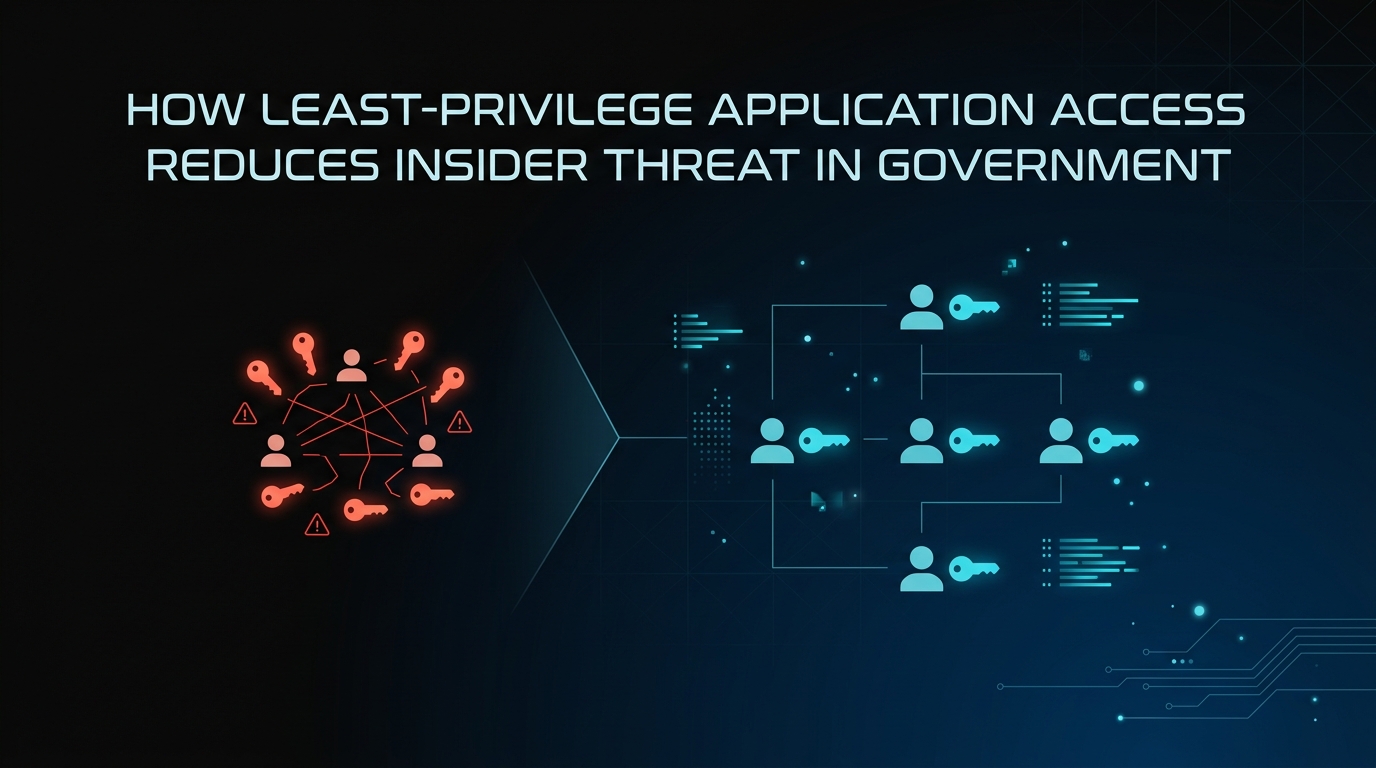
Why Insider Threat Cannot Be Solved With Network-Level Access Controls
Defense Security Officers (DSOs) reading this article have already built insider threat programs. The DCSA-required Insider Threat Programs are operational. The CDSE training is documented. The vigilance campaign messaging reaches the workforce. The policies, procedures, and reporting requirements that Executive Order 13587 mandates are in place.
What Defense Security Officers face in 2026 is not a policy gap. It is an architectural gap. The insider threat programs work as designed against the threat model they were designed for – disgruntled employees deliberately exfiltrating classified information, contractors with excessive access to sensitive systems, foreign agents using credentialed access to collect intelligence. These threats are real. The programs address them. The Manning case, the Snowden case, the Vasquez case, and the Reality Winner case all confirm both the threat and the necessity of formal insider threat programs.
The architectural gap is different. Modern insider threat – including the negligent and compromised insider categories that Ponemon’s 2025 data shows account for 75% of incidents – exploits the gap between “the user has authorized access to the network” and “the user has authorized access to this specific operation, on this specific system, at this specific time, with this specific evidence trail.” Network-level access controls grant the first. Least-privilege application access grants the second. The first is what most government environments actually deploy. The second is what reduces insider damage materially.
This article documents how least-privilege application access – implemented as an architectural property rather than as a policy aspiration – reduces insider threat in government environments. It addresses the specific control models, the audit evidence requirements, the integration with existing DCSA/CDSE programs, and the architectural patterns that produce measurable reduction in insider damage potential.
The Insider Threat Reality in Government Environments: 2025-2026 Data
Before discussing controls, the magnitude of the problem needs to be specific. Industry data combined with government-specific incident analysis produces the following:
Volume is increasing. Ponemon’s 2025 study documented 7,868 insider incidents – more than double the 3,269 incidents in 2018. Securonix reported 76% of organizations experienced insider attacks in the past year, up from 66% in 2019. The trend is consistent across all sectors including government.
Cost is increasing faster than volume. Ponemon/DTEX data shows insider risk costs reaching $19.5 million per organization annually in 2026, up from $17.4 million in 2025 and $8.76 million in 2018 – a 123% increase since 2018, outpacing inflation by a wide margin. Containment alone costs $247,587 per incident.
Most incidents are non-malicious. Ponemon 2025 found 55% of incidents are caused by employee negligence, 20% by credential theft (compromised insiders), and only 25% by malicious intent. The control framework that addresses only malicious insiders misses 75% of the actual incident volume.
Detection takes time. IBM’s 2024 Cost of a Data Breach Report documented credential-based attacks averaging 292 days to identify and contain, with malicious insider cases averaging 287 days. The detection gap is structural – distinguishing legitimate authorized activity from harmful authorized activity is genuinely difficult without granular evidence.
Government has additional complications. DCSA’s National Insider Threat Awareness Month materials emphasize that government insider threats include not only data exfiltration but also “loss or degradation of departmental resources or capabilities” – a broader threat model than typical commercial environments face. The classified information environment, the security clearance lifecycle, and the foreign intelligence collection threat all add dimensions that commercial insider threat programs do not address.
For Defense Security Officers, the implication is direct: insider threat programs that focus on monitoring, training, and response (the “detect and respond” pillar) need to be paired with architectural controls that limit insider damage potential (the “prevent and constrain” pillar). The architectural controls reduce the volume and severity of incidents that the monitoring program then has to detect and respond to.
The Difference Between Network Access and Application Access
The architectural distinction at the heart of this article is the difference between network-level access and application-level access. The distinction sounds technical but has direct insider threat implications.
Network-level access: The user authenticates once (typically via VPN, jump server, or domain logon). The authentication grants network reachability – the user is “on the network” with whatever lateral movement the network configuration permits. From there, additional authentication may be required for specific applications, but the network position is established. A user with valid credentials can typically discover, enumerate, and probe other network resources beyond their authorized applications. This is the model most government environments deploy at the unclassified level and at many SIPRNet enclaves.
Application-level access: The user authenticates per session, for a specific application, with specific authorized operations. They never establish “network presence” – they reach the application directly through an identity-aware proxy, with no network-level reachability to other resources. A user authorized for the Personnel Security System cannot reach the Logistics Management System on the same server, even though both run in the same environment.
The difference matters for insider threat in two specific ways:
Compromised credential containment. A compromised credential in a network-access model gives the attacker (or unauthorized user) the same lateral movement potential the legitimate user had. Manning’s credentials, when used by Manning, granted SIPRNet network access and the ability to query multiple systems beyond what the work assignment required. Application-level access constrains the credential’s blast radius to the specific applications that identity is authorized for.
Negligent insider scope. A negligent insider (the 55% of incidents) typically causes damage by accessing systems they had access to but should not have used for the specific operation in question. Network-level access models default to “if you can reach it, you can use it.” Application-level access models default to “if it’s not authorized for this specific operation, you cannot use it for that operation” – even if you have nominal access to the system.
The architectural shift from network-level to application-level access is what CISA ZTMM describes as Advanced maturity in the Networks pillar and the Applications and Workloads pillar. It is what OMB M-22-09 requires as the model for federal civilian agencies. It is what DoD ZTS Target capabilities operationalize for FY2027. The shift is not a feature change. It is a model change.
What “Least Privilege” Actually Means in Practice
The term “least privilege” has been used in cybersecurity for decades, but its operational implementation varies dramatically across environments. For Defense Security Officers, the practical question is what least privilege looks like when implemented as an architectural property.
Least privilege in an application access architecture has six specific properties:
Property 1: Per-user, per-application authorization. Every user has explicit authorization for specific applications. The default is no access. Authorization is granted based on the work assignment, role, security clearance level, and need-to-know – not on group membership in a network domain.
Property 2: Per-session re-evaluation. Authorization is evaluated at the start of every session, not assumed from a prior session. A user whose role changed since the last session has different authorization for this session. A user whose device is no longer compliant has authorization revoked. A user whose security clearance was suspended cannot establish a new session.
Property 3: Per-operation policy enforcement. Within an authorized session, individual operations are policy-evaluated. A user authorized to read documents in a specific repository may not be authorized to download them, copy them, or print them. The operation level is the enforcement level – not the application level.
Property 4: Time-bounded sessions. Authorization expires. Standing access is the exception, not the default. Most operations are time-bounded by the work assignment that justifies them. Vendor access expires when the work order closes. Contractor access expires when the contract ends. Privileged sessions expire when the maintenance window closes.
Property 5: Identity-attributed audit. Every operation is logged with named identity attribution. Not “an admin account performed this operation” – “user Smith, authorized for role X, performed operation Y on system Z at timestamp T.” The audit evidence supports both real-time monitoring and post-incident investigation.
Property 6: Continuous verification. Within long sessions, authorization is re-evaluated based on context changes. Geographic location change may trigger re-authentication. Privilege elevation may require additional MFA. Behavioral anomalies may suspend the session for review.
These six properties together produce least privilege as an architectural property – not as a policy aspiration. The Defense Security Officer can document each property as a specific control rather than as a goal. The application of these properties to OT environments – particularly defense facilities with industrial systems alongside IT infrastructure – is documented in the Zero Trust application of the Purdue Model, where least privilege at the IT/OT boundary becomes operationally critical.
For Defense Security Officers evaluating the architectural model, a comprehensive examination of the best Zero Trust platform for federal agencies provides the procurement-level framework that maps the six properties to specific platform capabilities – particularly for environments operating at multiple classification levels with separate ATO requirements.
How Least Privilege Reduces Each Insider Threat Category
The Ponemon insider threat taxonomy provides three categories: malicious insiders (25% of incidents), negligent insiders (55%), and compromised insiders/credential theft (20%). Least-privilege application access reduces damage potential differently in each category.
Reducing Malicious Insider Damage
Malicious insiders operate with valid credentials and authorized access. The control problem is not authentication – they are who they claim to be. The control problem is constraining what their authorized access actually permits.
Least-privilege application access reduces malicious insider damage through three mechanisms:
Operation scope constraint. The malicious insider cannot perform operations they are not authorized for, even if they have access to the system. The Manning scenario – where SIPRNet network access enabled queries against systems Manning had no work-related need to access – does not apply when access is application-specific and operation-bounded.
Temporal scope constraint. Standing access is replaced by time-bounded access. A malicious insider planning to act has a smaller window of opportunity. Access that was needed for a specific work assignment expires when the assignment ends.
Audit visibility. Every operation is logged with identity attribution. The malicious insider’s actions produce evidence at the time of action – not weeks or months later when investigators reconstruct the activity. Detection time compresses from 287 days (industry average) toward something measurable in days for organizations with comprehensive audit visibility.
The architectural pattern does not prevent every malicious insider action. It reduces the action’s scope and increases the probability of detection. For Defense Security Officers operating environments where malicious insider risk includes foreign intelligence collection, the audit evidence quality is the primary defense. The identity-based segmentation approach extends conventional segmentation by treating workload identity as the primary segmentation attribute – addressing the lateral movement potential that traditional IP-based segmentation does not constrain effectively.
Reducing Negligent Insider Damage
Negligent insiders cause 55% of incidents. The control problem is preventing well-intentioned users from causing damage through inappropriate use of authorized access – using a personal email to share a sensitive document, downloading classified information to a personal device, sharing credentials with a colleague to expedite a task, accessing systems “to check something” outside the work assignment that justifies the access.
Least-privilege application access reduces negligent insider damage through:
Operation policy enforcement. The negligent action is often blocked at the policy enforcement layer rather than depending on the user remembering policy. Email transfers of sensitive content can be blocked at the file transfer layer with CDR scanning. Downloads to non-compliant devices can be blocked at the session establishment layer with device posture verification.
Just-in-time access reduction. Users have access only when they need it, for the duration they need it. The “I have access so I might as well check” temptation is reduced when access requires explicit authorization for the specific work assignment.
Friction at the right places. Policy enforcement creates appropriate friction at decision points – “are you sure you want to send this externally?” – that prompt the user to consider whether the action matches the authorization context.
For Defense Security Officers, the reduction in negligent insider incidents is often the highest-volume benefit. Most insider threat program operational time is consumed by negligent incidents. Reducing the volume frees the program to focus on the higher-severity malicious and compromised categories.
Reducing Compromised Insider (Credential Theft) Damage
Credential theft is the costliest per-incident category at $779,707 (Ponemon 2025). The control problem is that an attacker with valid credentials appears legitimate. Detection requires distinguishing the compromised session’s behavior from legitimate sessions – extremely difficult without granular evidence.
Least-privilege application access reduces compromised insider damage through:
Phishing-resistant MFA. The credential theft scenario assumes username/password compromise. Phishing-resistant MFA (PIV/CAC, FIDO2/WebAuthn) blocks the attacker from establishing a session with stolen credentials alone. Per-session MFA blocks the attacker from continuing a session by replaying captured tokens.
Device posture verification. The attacker connecting from an untrusted device fails device posture checks. Even with valid credentials and a captured MFA token, the session does not establish.
Behavioral anomaly detection. The compromised session’s behavior – different geographic location, different times, different access patterns – produces detectable anomalies. The architectural property of identity-attributed audit makes the anomalies observable; the absence of network-level reachability constrains the damage that occurs before detection.
The 287-day average dwell time for malicious insider cases compresses dramatically when credential-based attacks are constrained by per-session MFA and device posture verification. The compromised credential is no longer sufficient by itself – additional factors must align for the attacker to succeed. A practical guide on stopping lateral movement at the IT-OT and cross-classification boundaries documents the detection and containment patterns that make compromised insider sessions observable before significant damage occurs.
A practical examination of how government CISOs consolidate cross-network security into a single Zero Trust platform documents the architectural consolidation pattern that produces consistent insider threat controls across the multiple environments most defense organizations operate (NIPRNet, SIPRNet, contractor enclaves, coalition partner networks).
Integration with DCSA, CDSE, and Executive Order 13587 Programs
Defense Security Officers reading this article are operating within an established compliance framework. The architectural recommendations need to map to existing program elements rather than creating parallel structures.
Executive Order 13587 (2011)
EO 13587 established the requirement for federal agencies handling classified information to implement formal Insider Threat Programs. The order requires senior official designation, reporting structures, training programs, and information sharing across agencies. The order does not specify architectural controls – it specifies program elements.
Architectural controls implementing least-privilege application access support EO 13587 program elements directly. The audit evidence the architecture produces feeds into the program’s analytical capability. The reduced insider damage potential reduces the volume of incidents the program responds to. The identity-attributed audit trail supports the program’s information sharing requirements.
DCSA Insider Threat Program Requirements
DCSA establishes the Defense Insider Threat Management Analysis Capability (DITMAC) and operates the DoD-wide insider threat program coordination. DCSA requirements for cleared contractor facilities and government components include specific Insider Threat Program elements that the architectural controls support:
- User Activity Monitoring (UAM): The session recording produced by least-privilege application access architectures provides the granular UAM evidence DCSA programs require.
- Information sharing with hub: The architectural audit trail exports to insider threat hubs in formats consistent with DCSA reporting expectations.
- Continuous Evaluation/Continuous Vetting: The behavioral signal data the architecture produces (access patterns, device posture trends, anomaly indicators) supports continuous evaluation programs.
CDSE Training and Awareness Materials
CDSE’s training programs, vigilance campaigns, and awareness materials educate the workforce on insider threat indicators and reporting. The architectural controls reduce the threat surface that the training addresses – the insider who acts inappropriately faces architectural friction in addition to policy expectations. The training-and-architecture combination is more effective than either alone.
Continuous Vetting and Trusted Workforce 2.0
The DoD’s Trusted Workforce 2.0 initiative shifts security clearance reinvestigation from periodic to continuous. The architectural audit evidence produced by least-privilege application access provides the behavioral signal data that continuous vetting programs use as inputs. The integration is direct: the architecture produces the data; the vetting program consumes it.
For Defense Security Officers planning the architectural integration, a comprehensive guide to NSA Zero Trust Implementation Guidelines addresses the specific Phase One and Phase Two activities that align with insider threat program requirements – particularly the audit evidence production and identity attribution capabilities that satisfy both NSA ZIG activities and DCSA program requirements.
The Architectural Pattern That Implements Least Privilege
A specific architectural pattern implements the six properties of least privilege described above. The pattern combines four elements:
Element 1: Identity-Aware Proxy. All access to applications passes through a proxy that performs identity verification, authorization check, device posture verification, and policy evaluation before forwarding the request to the application. The proxy is the enforcement point – not the application’s native access control.
Element 2: Per-Session Authentication with Phishing-Resistant MFA. Every session begins with authentication. PIV/CAC for federal personnel and DoD components. FIDO2/WebAuthn for personnel without PIV/CAC. Per-session re-verification under conditions that warrant elevated assurance (privilege elevation, sensitive operations, geographic anomalies).
Element 3: Per-Operation Policy Enforcement. Within authenticated sessions, individual operations are policy-evaluated. The policy engine considers identity, role, device posture, location, time, and operation context. The policy decision is logged with the operation.
Element 4: Integrated Session Recording. Every privileged session is recorded – video, keystrokes, file operations. The recording exports to enterprise SIEM and to insider threat program analytical tools.
The four elements together produce least-privilege application access as an architectural property. The Defense Security Officer can document each element as a specific control with specific evidence.
The platform that delivers all four elements in a single integrated deployment – designed specifically for cross-network defense and government use cases – is documented in the truePass Gravity three-layer configuration. The three layers (Reverse Access, SMB Proxy with CDR, Zero Trust Application Access with session recording) map to the four elements as a complete implementation rather than as supplementary products bolted onto generic ZTNA.
The broader TerraZone solutions portfolio for state, federal, and defense agencies extends this approach across the cross-classification environments that defense organizations typically operate.
How the Pattern Maps to Specific Insider Threat Scenarios
The pattern’s effect becomes concrete when mapped to specific insider threat scenarios that Defense Security Officers actually face.
Insider Threat Scenario | Network-Access Model Outcome | Least-Privilege Application Access Outcome |
Cleared employee accesses systems beyond work assignment | Possible if network reachability exists; detection depends on monitoring | Blocked at proxy; only authorized applications accessible |
Departing contractor retains access for “few more days” | Standing access continues until manually revoked | Time-bounded access expires automatically; manual extension requires reauthorization |
Cleared employee shares credentials with colleague | Both can use credentials; activity attributed to credential owner | Per-session MFA breaks shared credential use; device posture differs |
External attacker compromises insider credentials | Network access if MFA can be defeated; lateral movement possible | Session blocked at device posture check; MFA per operation prevents replay |
Negligent download of sensitive content to personal device | Often successful; device posture not verified | Blocked at session establishment; non-compliant device cannot reach application |
Privileged user performs unusual bulk export | May go undetected if pattern matches normal admin behavior | Recorded with identity attribution; behavioral analysis flags anomaly |
Vendor with shared account performs unauthorized operation | Activity attributed to shared account; individual identity unknown | Named vendor accounts; operation attributed to specific individual |
Cleared employee transfers files to personal email | DLP may catch; depends on tool sophistication | File transfers go through CDR scanning; per-operation policy enforcement |
Compromised admin account used after-hours from foreign IP | Possible if admin account works from anywhere | Session establishment fails geographic check; behavioral anomaly flagged |
Researcher continues accessing data after project ends | Manual revocation required; often delayed | Time-bounded access expires automatically with project closure |
The matrix reveals the pattern: network-access models depend on detection and response capabilities to address insider threat scenarios. Least-privilege application access models prevent or constrain many scenarios architecturally before they require detection. The volume of incidents reaching the response phase is reduced; the incidents that do reach response have more granular evidence supporting investigation.
What This Means for the Insider Threat Program Operational Model
For Defense Security Officers operating Insider Threat Programs, the architectural shift changes the operational model in three specific ways.
Detection becomes more focused. Network-access models produce volumes of low-signal alerts because every authorized session has lateral movement potential. Least-privilege application access models produce fewer but higher-signal alerts because operations are pre-filtered by architectural policy enforcement. The analytical capacity of the program shifts from volume processing to investigation depth.
Investigation becomes more efficient. The audit trail produced by identity-attributed application access supports investigation directly. The investigator does not need to correlate logs from multiple sources to reconstruct activity – the trail is unified, identity-attributed, and operation-specific. The 287-day average dwell time for malicious insider cases compresses for organizations with this evidence quality.
Prevention becomes architectural. The Insider Threat Program no longer relies primarily on training, policy, and monitoring to prevent damage. Architectural controls prevent or constrain damage at the operation level. The program’s prevention pillar gets a substrate it previously lacked.
The combined effect is a more effective Insider Threat Program with the same staffing – or the same effectiveness with fewer resources. For Defense Security Officers operating in a budget-constrained environment with growing threat volume, this is the operational case for the architectural shift.
Frequently Asked Questions
Does this approach replace our existing UAM/User Activity Monitoring tools?
No. UAM tools (Forcepoint, Veriato, ObserveIT, Microsoft Defender for Endpoint) provide endpoint-level activity monitoring that complements least-privilege application access. The application access architecture provides session-level evidence (what was accessed, by whom, with what authorization). UAM provides endpoint-level evidence (what the user did within a session, what local actions occurred). Mature insider threat programs use both, with audit trails consolidated in the program’s analytical platform.
How does this integrate with our existing PIV/CAC infrastructure?
The architectural pattern uses PIV/CAC as the primary authentication factor for all federal employees and DoD personnel. Per-session MFA leverages PIV/CAC for re-authentication under elevated conditions. The integration is native – PIV/CAC is the expected authenticator, not a configuration option.
What about classified networks (SIPRNet, JWICS)?
The architectural pattern deploys at all classification levels with classification-appropriate authentication tokens. SIPRNet deployments use SIPR tokens. JWICS deployments use TS-cleared tokens. The architecture remains consistent; the identity infrastructure changes by classification level. ATO reuse from unclassified deployment significantly compresses the classified ATO timeline (typically 85-90% SSP reuse based on industry data).
How does this affect our DCSA reporting requirements?
The architectural audit trail satisfies DCSA UAM reporting requirements with identity-attributed session evidence. The SIEM export format is configurable to match DCSA hub requirements. The continuous evaluation/continuous vetting data feeds (access patterns, device posture trends, behavioral anomalies) export to the formats DITMAC and component insider threat hubs accept.
What if our personnel resist the additional authentication friction?
Per-session MFA does add friction compared to once-per-day VPN authentication. The friction is calibrated to risk – routine application access with PIV/CAC is comparable to standard PIV/CAC-protected SSO. Privilege elevation and sensitive operations require additional authentication that is genuinely more friction. In practice, personnel adapt within 30-60 days of deployment, particularly when the architectural changes also eliminate VPN sign-on workflows that were operationally painful in their own right.
How long does deployment typically take?
For a typical defense organization with 5,000-15,000 users across multiple classification levels, full deployment takes 12-18 months. Phase 1 (architecture decision and pilot) takes 4-6 months. Phase 2 (component-wide deployment at the lowest classification level) takes 4-6 months. Phase 3 (cross-classification expansion) takes 6-12 months. Insider threat reduction is measurable from Phase 2 onward.
Does this work for contractor populations?
Yes. The architectural pattern handles contractor access through named contractor accounts, time-bounded sessions, and full session recording. The contractor’s identity infrastructure (their own AD, not the agency’s) is federated into the access policy. When the contract ends, the contractor’s federated trust is revoked – access expires automatically.
What about cleared personnel with multiple roles or rotating assignments?
The architectural pattern supports role-specific authorization that adjusts dynamically. Personnel with multiple roles see different application sets based on the active role. Rotating assignments produce automatic access changes without requiring manual provisioning/deprovisioning cycles. The Trusted Workforce 2.0 continuous evaluation framework integrates directly with the access decisions.
Conclusion
Defense Security Officers operate Insider Threat Programs that work as designed against the threat model they were designed for. The programs reduce insider damage. The training reaches the workforce. The monitoring produces evidence. The reporting satisfies DCSA requirements.
The architectural gap is structural. Network-level access models leave damage potential that least-privilege application access models eliminate. The 75% of incidents that come from negligent and compromised insiders particularly benefit from architectural constraints because policy and training alone do not prevent the vast majority of negligent and credential-theft scenarios.
The architectural pattern is documented. The four elements – identity-aware proxy, per-session phishing-resistant MFA, per-operation policy enforcement, integrated session recording – map directly to the six properties of least privilege. The pattern integrates with existing DCSA, CDSE, and EO 13587 program elements rather than replacing them.
For Defense Security Officers evaluating the architectural shift, the practical question is not whether to shift but how quickly. The CISA ZTMM Advanced maturity targets, the DoD ZTS FY2027 deadline, the OMB M-22-09 implementation requirements, and the Trusted Workforce 2.0 continuous evaluation framework all assume least-privilege application access as the operational model. The agencies that deploy the architecture by 2026 have stronger insider threat reduction, better audit evidence, and clearer compliance posture than agencies still operating network-access models.
The Insider Threat Program does not become unnecessary. It becomes more focused, more effective, and supported by an architectural substrate that prevents many incidents the program previously had to detect and respond to. The 75% of insider incidents that are non-malicious – and the 25% that are – both benefit from constraining damage potential at the architectural level. The Defense Security Officer who builds this combination produces an insider threat program that addresses the threat reality of 2026 rather than the threat reality of 2014.