

Why FedRAMP Compliance Is an Architectural Question, Not a Control Checklist
Government CISOs evaluating cloud connectivity solutions for federal environments encounter a recurring pattern: vendors arrive with FedRAMP authorization claims, control mapping spreadsheets, and compliance assertions – but the underlying architectures vary dramatically in how they actually satisfy the controls. Two vendors with identical FedRAMP authorization status can have fundamentally different security postures depending on whether their architecture satisfies the controls structurally or through compensating implementations.
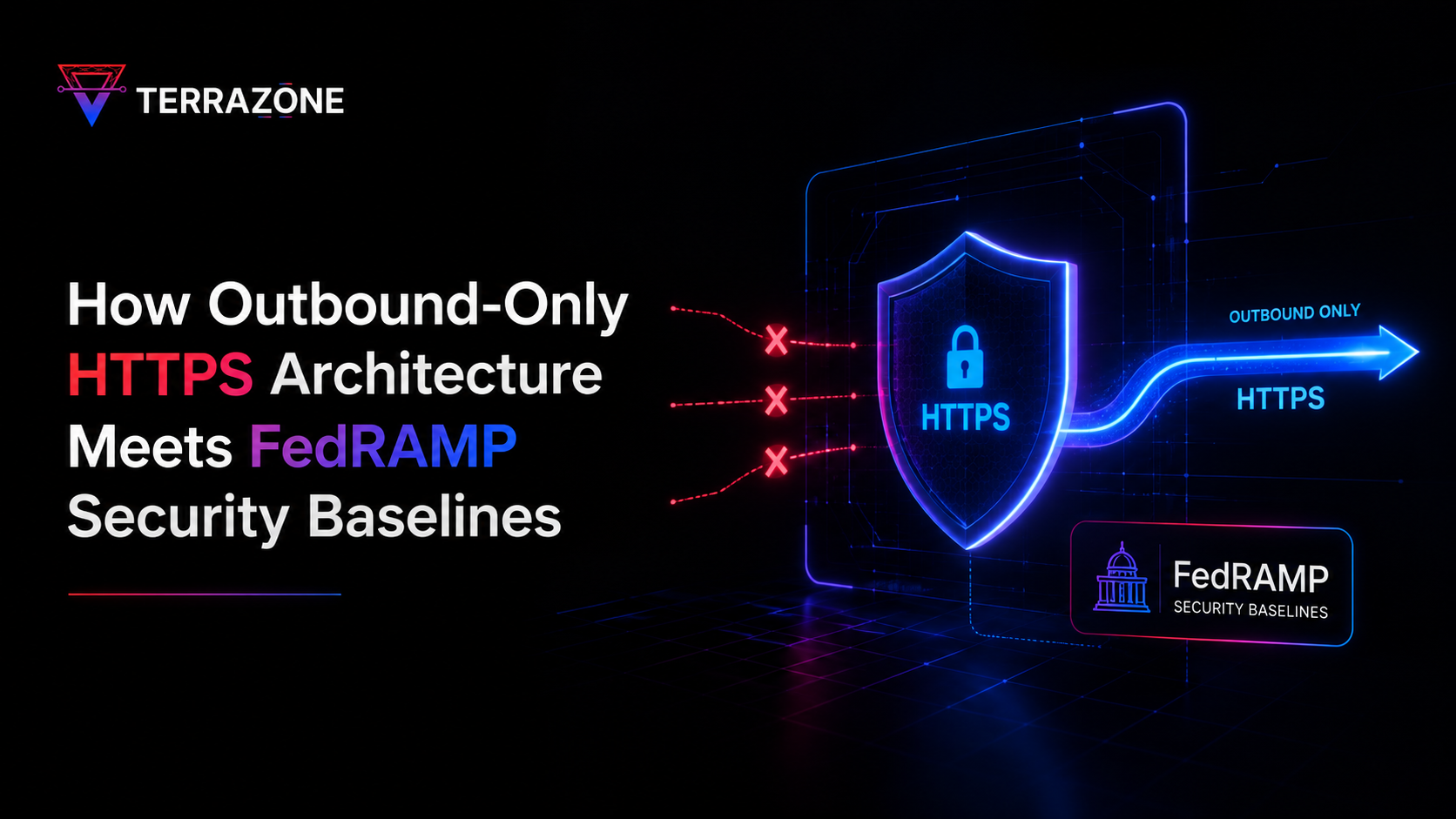
The outbound-only HTTPS architecture pattern – sometimes called Reverse Access – is one of the architectural approaches that satisfies multiple FedRAMP control families through structural design rather than configuration. The pattern eliminates inbound listeners on protected networks. Internal components establish outbound HTTPS connections to external gateways. The gateways broker authorized traffic. The protected network never accepts inbound connections from the internet, from cloud services, or from anywhere outside the boundary.
This architectural property changes how multiple FedRAMP controls get satisfied. Boundary protection requirements (SC-7 family) that traditional architectures address through firewall rules and intrusion prevention systems become structurally satisfied because there’s no inbound traffic to protect against. Access enforcement requirements (AC family) that traditional architectures address through layered controls become enforceable at the connection establishment level. Audit requirements (AU family) that traditional architectures address through log aggregation become attributable at the application-operation level.
This article documents how the outbound-only HTTPS architecture pattern satisfies FedRAMP security baselines across all three impact levels – Low, Moderate, and High – with specific control mapping, architectural detail, and deployment guidance for federal environments. The audience is Government CISOs and senior security architects evaluating connectivity solutions for federal cloud-connected environments, federal OT/critical infrastructure, and federal multi-network architectures.
The Outbound-Only HTTPS Architecture: Technical Definition
The outbound-only HTTPS architecture inverts the connection direction that traditional internet-facing services rely on. The pattern works as follows:
A protected network – typically containing applications, data, services, and operations that must remain isolated from internet-based attack surfaces – has zero inbound listeners on its external boundary. No service on the protected network accepts incoming connections from outside the boundary. The firewall configuration permits only outbound connections; inbound is blocked entirely.
An internal component, sometimes called an Access Controller or Connector, resides inside the protected network. This component establishes outbound HTTPS connections to an external gateway. The gateway is positioned outside the protected network – typically in a DMZ, a cloud-hosted service tier, or a third-party-managed environment that satisfies its own authorization requirements.
Users, services, or applications that need access to resources inside the protected network connect to the external gateway. The gateway authenticates them, applies policy, and brokers their authorized traffic to the internal Access Controller through the existing outbound HTTPS connection. The brokered traffic appears to the protected network as a response to its own outbound request – never as an inbound connection.
The architectural properties this produces:
No inbound attack surface. Port scanners, vulnerability scanners, and reconnaissance tools find no listening services on the protected network’s external boundary. There is nothing to scan, nothing to fingerprint, nothing to exploit.
No CVE-class structural vulnerability. The vulnerability classes that have affected VPN concentrators, gateways, and remote access products throughout 2023-2025 – CitrixBleed, Ivanti Connect Secure, CitrixBleed 2, multiple Fortinet FortiOS vulnerabilities – depend on the existence of an inbound listener that processes pre-authentication traffic. Outbound-only architectures eliminate the listener category entirely.
Boundary protection by structure rather than configuration. Traditional architectures rely on firewall rules, intrusion prevention systems, and network access controls to enforce boundary protection. These controls require correct configuration, ongoing maintenance, and continuous monitoring. Outbound-only architectures eliminate the inbound traffic that these controls were designed to filter – the structural property does what the controls were trying to enforce.
Identity attribution at the architectural level. Because the gateway authenticates users and applications before brokering traffic, every connection that reaches the protected network carries identity attribution. This is fundamental to how the architecture satisfies access enforcement and audit requirements at FedRAMP Moderate and High levels.
The pattern depends on the gateway being trustworthy. If the gateway is compromised, an attacker could potentially leverage the brokered connections. Implementations address this through mutual TLS authentication between gateway and internal controller, ephemeral credentials with short lifetimes, hardware-backed cryptographic keys, and continuous integrity verification of the gateway infrastructure itself.
FedRAMP SC-7 Boundary Protection: Structural Satisfaction
The SC-7 (Boundary Protection) control family in NIST SP 800-53 and the FedRAMP baselines is the architecturally significant control set for connectivity solutions. FedRAMP Moderate requires SC-7 plus enhancements (1), (3), (4), (5), (7), (8), (10), (12), (13), (18), and (20). FedRAMP High adds further enhancements including (10), (11), (14), (18), (20), (21), (22), and (24).
The outbound-only HTTPS architecture satisfies the foundational SC-7 requirement and several specific enhancements structurally:
SC-7 (Boundary Protection) Base Control. The control requires “monitoring and controlling communications at the external boundary of the system and at key internal boundaries within the system.” Outbound-only architecture satisfies this by eliminating uncontrolled inbound communications entirely. The boundary is enforced by absence of listening services rather than by inspection of incoming traffic.
SC-7(5) Deny by Default – Allow by Exception. Traditional architectures implement this through firewall rules that default to deny inbound and permit specific exceptions. Outbound-only architecture eliminates the exceptions because there are no legitimate inbound services to permit. The default deny is absolute.
SC-7(7) Prevent Split Tunneling for Remote Devices. Remote users connecting through the outbound-only architecture access only the authorized applications brokered through the gateway. There is no network-level access that could be split-tunneled. The architectural pattern satisfies this through the application-specific access model.
SC-7(11) Restrict Incoming Traffic. The control requires that the system “only allows incoming communications from authorized sources to be routed to authorized destinations.” Outbound-only architecture satisfies this by definition – there is no incoming traffic to the protected network. The traffic that reaches internal resources arrives only as responses to outbound requests initiated by the internal controller.
SC-7(20) Dynamic Isolation and Segregation. The control requires that the system “provide the capability to dynamically isolate or segregate organizational system components.” Outbound-only architectures combined with identity-based segmentation can isolate specific users, applications, or workloads at the connection establishment level – without the network reconfiguration that traditional architectures require for dynamic isolation.
The structural satisfaction of these controls matters for authorization documentation. Federal CISOs preparing System Security Plans (SSPs) for systems using outbound-only architecture can describe these controls as “satisfied by architectural design” rather than as “satisfied by configuration of [specific firewall/IPS/NAC product].” The former is easier to validate, easier to defend during assessment, and easier to maintain through continuous monitoring.
FedRAMP AC Family: Access Enforcement Through Identity Attribution
The AC (Access Control) family in FedRAMP baselines requires identity-attributed access enforcement across multiple control specifications. The outbound-only HTTPS architecture combined with Zero Trust application-level access satisfies these requirements through structural identity integration rather than layered identity controls.
AC-3 Access Enforcement. The control requires the system to “enforce approved authorizations for logical access to information and system resources.” Outbound-only architectures with Zero Trust access enforcement evaluate authorization at every connection establishment – not once at session start. The gateway authenticates the user (typically via PIV/CAC for federal personnel, FIDO2/WebAuthn for non-personnel users, or SAML/OIDC assertions from authorized identity providers). Each requested operation against an internal application is evaluated against authorization policy before the gateway brokers the connection.
AC-4 Information Flow Enforcement. The control requires the system to “control the flow of information within the system and between connected systems based on” defined flow policies. Outbound-only architectures with Zero Trust access enforcement provide flow control at the application-protocol level. The gateway sees not just network connections but the specific application operations being requested – file uploads, database queries, application functions, administrative actions. Flow control policies can address operation-level concerns that network-level controls cannot.
AC-17 Remote Access. The control requires the system to “establish and document usage restrictions, configuration/connection requirements, and implementation guidance for each type of remote access allowed.” Outbound-only architectures satisfy this by providing a single architectural pattern for all remote access – federal personnel, contractors, partners, third-party vendors all access through the same identity-attributed brokered architecture. The documentation describes one pattern rather than multiple pattern variations.
AC-20 Use of External Information Systems. The control addresses connections to systems outside the organizational boundary. For federal systems integrating with FedRAMP-authorized cloud services, this control becomes architecturally significant. Outbound-only architectures simplify the AC-20 documentation because the integration uses standard outbound HTTPS – no inbound exception to document, no boundary modification to authorize, no additional attack surface to maintain.
The combined architectural effect: federal CISOs evaluating AC family compliance for connectivity solutions find that outbound-only architectures with Zero Trust enforcement satisfy these controls through fewer, simpler architectural decisions than traditional layered approaches require. The pattern integrates with the federal identity infrastructure investments already required by HSPD-12, FIPS 201, and OMB M-22-09.
The Zero Trust application-level access component that delivers this satisfaction is detailed in the truePass Zero Trust Access service, which integrates with federal identity providers and produces the identity-attributed access enforcement that AC family controls require at FedRAMP Moderate and High baselines.
FedRAMP AU Family: Audit Requirements and Identity Attribution
The AU (Audit and Accountability) family in FedRAMP baselines requires comprehensive audit generation, identity attribution of audited events, and audit record protection. The outbound-only HTTPS architecture with Zero Trust access enforcement produces audit evidence that satisfies these requirements through structural identity attribution rather than through retrospective log correlation.
AU-2 Audit Events. The control requires the organization to “identify the types of events that the system is capable of logging in support of the audit function.” Outbound-only architectures with Zero Trust enforcement log every connection establishment, every application operation, every authorization decision, and every session lifecycle event. The events have inherent identity attribution because the gateway authenticated the user before brokering the connection.
AU-3 Content of Audit Records. The control requires audit records to contain information establishing “what type of event occurred, when the event occurred, where the event occurred, the source of the event, the outcome of the event, and the identity of any individuals or subjects associated with the event.” Outbound-only architectures with Zero Trust enforcement satisfy each element by design – the gateway captures all six fields as a natural property of the connection establishment process.
AU-12 Audit Generation. The control requires the system to “provide audit record generation capability for the auditable events.” Outbound-only architectures with integrated session recording produce continuous audit generation across the full session lifecycle – not just at session start. Federal CISOs accustomed to traditional VPN logs (which capture connection establishment but not in-session activity) find that outbound-only architectures with session recording produce dramatically more comprehensive audit evidence.
AU-14 Session Audit. The enhancement requires the system to “provide the capability for authorized users to select a user session to capture/record or view/hear.” This is particularly important for FedRAMP High and for systems handling sensitive personnel data. Outbound-only architectures with Zero Trust enforcement support session recording at the application protocol level – recording not just network traffic but the specific application operations performed during the session.
The identity attribution property – that every audit event traces to a named individual rather than to a session, account, or IP address – distinguishes the audit evidence from what traditional architectures produce. Federal incident response, forensic analysis, and insider threat programs all benefit from this attribution at the source rather than reconstructed through log correlation after the fact.
The identity attribution component is implemented in the identity-based segmentation service, which integrates identity throughout the access path so that audit events carry identity attribution at the architectural level rather than as a post-processing addition.
FedRAMP CA-3 System Interconnections: Simplifying Authorization
The CA-3 (System Interconnections) control requires federal agencies to authorize interconnections between systems and to document the security characteristics of each interconnection. For federal agencies integrating with FedRAMP-authorized cloud services or with third-party-managed environments, CA-3 documentation often becomes a significant authorization burden.
Outbound-only HTTPS architectures simplify CA-3 documentation in several ways:
No new inbound interconnection. The system continues to use standard outbound HTTPS to reach external services. The interconnection direction is consistent with normal web traffic patterns. The CA-3 documentation describes outbound access to an authorized cloud service rather than a new inbound connection requiring special authorization.
Existing boundary controls satisfy SC-7. The outbound HTTPS traffic flows through existing boundary controls – perimeter firewalls, web proxies, DNS filtering, TLS inspection (where authorized). The architecture does not require boundary modification, new firewall exceptions, or new attack surface.
Authentication and authorization happen at the application layer. The CA-3 documentation can reference the application-layer authentication and authorization mechanisms rather than network-layer controls. This typically simplifies the security boundary discussion because the boundary is enforced at the application protocol rather than at the network.
Continuous monitoring inherits from the existing posture. The continuous monitoring requirements that accompany CA-3 authorization can rely on the existing logging, audit, and monitoring infrastructure that the agency operates for general internet egress. No new monitoring infrastructure is required.
For federal agencies whose architecture decisions affect dozens of CA-3 interconnections – common in agencies with mature cloud adoption – the cumulative documentation simplification is substantial. The pattern scales: each new FedRAMP-authorized cloud service the agency adopts becomes one more outbound HTTPS endpoint rather than one more inbound interconnection requiring full architectural review.
Mapping Across FedRAMP Impact Levels
The outbound-only HTTPS architecture pattern applies across all three FedRAMP impact levels – Low, Moderate, and High – with the depth of implementation increasing at higher levels.
FedRAMP Low. The Low baseline addresses systems where loss of confidentiality, integrity, or availability would have limited adverse effect. Outbound-only architectures satisfy the Low baseline SC-7, AC-3, AC-17, AU-2, and AU-12 requirements through the architectural pattern described above. The implementation focus is on getting the basic outbound-only pattern operational with foundational identity integration.
FedRAMP Moderate. The Moderate baseline is the most commonly required level for federal agency cloud services. It adds enhancements across SC-7 (boundary protection), AC family (access enforcement), AU family (audit), CA family (assessment and authorization), and IA family (identification and authentication). Outbound-only architectures with integrated Zero Trust access enforcement and session recording satisfy the Moderate enhancements through the structural patterns documented in this article.
FedRAMP High. The High baseline addresses systems where loss of confidentiality, integrity, or availability would have severe or catastrophic adverse effect. It adds enhancements that require dynamic isolation (SC-7(20)), application-level audit (AU-14), and continuous monitoring with specific evidence requirements. Outbound-only architectures with full Zero Trust enforcement, session recording, and identity-based microsegmentation satisfy the High baseline through architectural patterns that scale from Moderate to High without requiring fundamentally different implementations.
The cross-baseline applicability matters for federal CISOs managing multiple systems at different impact levels. A single architectural pattern that satisfies Low through High simplifies operational management, reduces vendor sprawl, and produces consistent security postures across the agency’s portfolio. Specific federal environments – particularly those combining IT and OT, multi-classification networks, or federated multi-agency operations – benefit from the architectural pattern’s applicability across the full impact range.
The microsegmentation capability that supports SC-7(20) dynamic isolation at FedRAMP High is delivered through the next-generation microsegmentation service, which extends identity-based controls from network access to workload-to-workload communication – the architectural foundation for the dynamic isolation that High baseline systems require.
Federal IT-OT Connectivity: The Specific Architecture Challenge
Federal environments increasingly require connectivity between IT systems (which typically operate under FedRAMP, FISMA, and CISA frameworks) and OT systems (which operate under IEC 62443, NIST SP 800-82, and sector-specific frameworks like NERC CIP for electric utilities). The connectivity requirement creates an architectural challenge that outbound-only HTTPS architectures specifically address.
The traditional approach for IT-OT connectivity in high-security federal environments has been the data diode – a hardware device that physically permits traffic in only one direction. Data diodes satisfy SC-7 boundary protection requirements absolutely (traffic cannot flow backward across them), but they create operational limitations. Vendors cannot remotely update firmware on equipment behind the diode. Threat intelligence cannot be applied to OT traffic crossing the diode. Audit data from OT systems cannot be efficiently delivered to IT-side analytics. Operational tickets, work orders, and authorized vendor access all require manual processes that work around the diode’s structural limitations.
The outbound-only HTTPS architecture pattern, properly implemented for IT-OT environments, provides a different solution. The protected OT network establishes outbound HTTPS connections to a gateway. The gateway brokers authorized vendor access, authorized maintenance traffic, and authorized telemetry flows. Identity attribution applies to every operation. Content inspection (Content Disarm and Reconstruction for files crossing the boundary) inspects firmware updates and configuration changes before they reach OT devices.
The architectural property that makes this work: the connection direction is still outbound (satisfying SC-7), but the brokered traffic supports operational requirements that data diodes structurally prevent. Federal agencies operating critical infrastructure, defense industrial base manufacturing, energy systems, water systems, and transportation systems all face this trade-off between absolute security (data diode) and operational viability (controlled bidirectional access).
The integrated three-layer architecture – Reverse Access plus SMB proxy with CDR plus Zero Trust application access – is what the truePass Gravity platform delivers in production for federal IT-OT connectivity scenarios. The platform addresses the specific federal challenge: maintaining the boundary protection that data diodes provide while enabling the operational connectivity that modern federal OT requires.
Authorization Path: ATO and Continuous Monitoring Considerations
Government CISOs evaluating outbound-only HTTPS architectures need to address the authorization process – Authority to Operate (ATO) under FISMA for federal systems, Provisional ATO (P-ATO) under FedRAMP for cloud services, and ongoing continuous monitoring under both frameworks.
ATO Process Implications. Outbound-only architectures typically simplify the ATO process because the architectural pattern satisfies multiple control families through structural design. The System Security Plan (SSP) can describe controls as “satisfied by architectural design – see Section X.Y for architectural detail” rather than as “satisfied by configuration of [specific product] – see Section X.Y for configuration baseline.” The simpler control description simplifies the security control assessment by the Assessment Organization.
Continuous Monitoring Implications. FedRAMP and FISMA continuous monitoring requires ongoing evidence collection demonstrating that controls remain effective. Outbound-only architectures with integrated session recording and identity-attributed audit produce comprehensive evidence streams naturally. The evidence available for continuous monitoring includes connection establishment logs, authentication events, authorization decisions, application operation records, and session recordings – all with identity attribution and timestamps.
Authorization Boundary Considerations. The authorization boundary for systems using outbound-only architectures often differs from traditional architectures. The gateway and brokering infrastructure may be inherited from a separately-authorized service. The internal access controller and the protected network constitute the system being authorized. The interconnection between them is documented through CA-3. This separation can simplify authorization scoping for agencies whose Cloud Service Offerings span multiple environments.
Inheritance from FedRAMP-Authorized Services. When the gateway component is operated by a FedRAMP-authorized service provider, federal agencies can inherit specific controls from the provider’s authorization rather than implementing them independently. The inheritance reduces the agency’s own control implementation burden – but requires careful documentation of inheritance boundaries and customer responsibilities.
The authorization process for systems combining the outbound-only HTTPS architecture with federal identity integration, classified network compatibility, and OT connectivity is non-trivial. Government CISOs typically engage with assessment organizations early in the deployment process to align the architectural approach with the assessment methodology before significant implementation work commits to a specific design.
Practical Deployment for Federal Environments
Federal CISOs deploying outbound-only HTTPS architectures typically follow a phased approach that respects existing infrastructure and authorization timelines:
Phase 1: Architectural Validation and Authorization Preparation. The architecture is validated against the agency’s specific authorization requirements before significant deployment. The assessment organization is engaged early. The System Security Plan structure is drafted with the architectural pattern reflected throughout the relevant control families.
Phase 2: Parallel Deployment with Existing Connectivity. The outbound-only architecture is deployed alongside existing connectivity solutions. No production impact. The new architecture connects to test environments and a limited set of production resources for validation. Existing connectivity continues to serve operational requirements.
Phase 3: Initial Production Migration. The first production user populations and applications migrate to the new architecture. Typically administrators and contractors migrate first because the audit and identity attribution improvements are most valuable for these populations. Existing connectivity remains available for users not yet migrated.
Phase 4: Population-Wide Migration. Remaining user populations and applications migrate based on operational priorities. The phased approach allows organizational change management to keep pace with technical migration. Authorization documentation is updated as each population migrates.
Phase 5: Legacy Connectivity Decommissioning. Once all populations and applications have migrated, the legacy connectivity infrastructure can be decommissioned. The authorization boundary is updated to reflect the simplified architecture. The continuous monitoring scope is updated.
Phase 6: Continuous Refinement. Policy refinement based on operational data. New applications onboarded to the architecture as they’re deployed. The continuous monitoring evidence is reviewed regularly and used to improve the deployment.
The timeline for federal deployments typically runs 12-24 months from initial architectural decision to legacy decommissioning, with authorization activities running in parallel. The phased approach allows the agency to demonstrate progressive improvement to oversight bodies, accumulate authorization evidence, and refine the deployment based on operational experience before committing to full migration.
How the Architectural Pattern Combines with Microsegmentation
The outbound-only HTTPS architecture handles the boundary – the connection between the protected network and the outside world. But FedRAMP baselines (particularly at the High level) also require internal segmentation – controls on lateral movement within the protected network.
Identity-based microsegmentation provides the internal counterpart to outbound-only boundary protection. The same identity attribution that the boundary gateway applies to inbound brokered traffic is applied to lateral connections within the protected network. Workload-to-workload communication requires authentication and authorization. Lateral movement that traditional flat networks would permit becomes structurally blocked at the segmentation layer.
The combined pattern produces an architecture that satisfies both the boundary protection requirements (SC-7 family) and the internal access enforcement requirements (AC family) through consistent identity-attributed controls. The control documentation describes one pattern operating at two scopes – boundary and internal – rather than describing two different patterns that must be consistent through configuration discipline.
The TerraZone truePass platform implements this combined pattern in production federal deployments, providing the outbound-only HTTPS architecture at the boundary plus identity-based microsegmentation within the protected network, integrated through a single identity and policy layer that simplifies both operational management and authorization documentation.
Compliance Frameworks That Align With FedRAMP Outbound Architecture Patterns
Federal CISOs often manage compliance against multiple frameworks simultaneously. The outbound-only HTTPS architecture pattern aligns with several frameworks that overlap with FedRAMP:
FISMA and NIST SP 800-53. FedRAMP is FISMA’s cloud-specific application of NIST SP 800-53. The architectural patterns that satisfy FedRAMP also satisfy FISMA for non-cloud federal systems. The mapping is direct.
CJIS Security Policy v6.0. Criminal Justice Information Services systems have specific requirements that overlap with FedRAMP Moderate and High. The outbound-only architecture pattern satisfies CJIS boundary protection requirements (CJIS Policy section 5.10) and the AC family requirements (CJIS Policy section 5.5). State and local law enforcement agencies integrating with federal CJIS systems benefit from the architectural pattern.
DoD Zero Trust Strategy. The DoD Zero Trust Strategy with its FY2027 Target capabilities aligns closely with the architectural patterns documented in this article. Defense agencies and defense contractors implementing the DoD strategy find that outbound-only HTTPS architectures provide a foundation that satisfies both the strategy’s specific capabilities and the FedRAMP baselines that defense cloud services require.
CMMC Level 2 and Level 3. Defense contractors operating under CMMC face requirements that overlap with FedRAMP Moderate for CUI handling. The outbound-only architecture pattern satisfies CMMC AC family and SC family controls through the same structural design that satisfies FedRAMP.
Executive Orders and CISA Directives. Executive Order 14028 (Improving the Nation’s Cybersecurity) and subsequent CISA Binding Operational Directives have driven federal agencies toward Zero Trust architectures. Outbound-only HTTPS architectures are one of the architectural patterns that satisfies these requirements without requiring fundamental network redesign.
The cross-framework applicability matters for federal CISOs whose responsibilities span multiple compliance regimes. A single architectural pattern that satisfies FedRAMP, FISMA, CJIS, DoD ZT Strategy, CMMC, and CISA directives reduces complexity, improves consistency, and produces defensible security postures across the portfolio.
Frequently Asked Questions
What is outbound-only HTTPS architecture?
Outbound-only HTTPS architecture is a network design pattern where the protected network establishes outbound HTTPS connections to external gateways but never accepts inbound connections from outside its boundary. The internal access controllers initiate connections out; the external gateways broker authorized traffic back through the existing outbound connections. The pattern eliminates the inbound listener that traditional architectures rely on, removing the primary attack surface that vulnerability scanners and exploits target. It’s sometimes called Reverse Access architecture.
Does outbound-only architecture satisfy FedRAMP requirements?
Yes, outbound-only HTTPS architecture satisfies multiple FedRAMP control families through structural design. SC-7 boundary protection requirements are satisfied because there are no inbound connections to protect against. AC family access enforcement requirements are satisfied through identity-attributed brokered access. AU family audit requirements are satisfied through identity-attributed session recording. CA-3 interconnection documentation is simplified because the connection direction is standard outbound rather than requiring new inbound exceptions. The pattern applies across FedRAMP Low, Moderate, and High baselines.
How does outbound-only architecture relate to data diodes?
Data diodes physically permit traffic in only one direction and provide absolute boundary protection – but they prevent operational connectivity that modern federal environments require. Outbound-only HTTPS architectures provide similar boundary protection (no inbound traffic) while supporting controlled bidirectional connectivity through authenticated, identity-attributed brokered access. For federal IT-OT environments where data diodes have been the traditional choice, outbound-only architectures with content inspection (CDR), identity-attributed access, and session recording provide an alternative that maintains boundary protection while enabling firmware updates, vendor access, and operational telemetry.
What FedRAMP impact levels can outbound-only architecture support?
Outbound-only HTTPS architecture applies across all three FedRAMP impact levels – Low, Moderate, and High. The architectural pattern remains consistent; the depth of implementation increases at higher levels. FedRAMP High adds enhancements like dynamic isolation (SC-7(20)) and application-level audit (AU-14) that require additional layers – identity-based microsegmentation for dynamic isolation, full session recording for application-level audit. These additions extend the base pattern rather than replacing it.
How does outbound-only architecture handle authentication and authorization?
Outbound-only architectures combine with Zero Trust application-level access enforcement to handle authentication and authorization. The external gateway authenticates users through federal identity infrastructure (PIV/CAC, federation through SAML/OIDC). The gateway evaluates authorization against policy for each requested operation, not just at session establishment. The authorization decision is made before the gateway brokers the connection to the internal access controller. Identity attribution flows through the architecture to every audit event, supporting AU family audit requirements at FedRAMP Moderate and High levels.
How long does deployment take for federal environments?
Federal deployments of outbound-only HTTPS architecture typically run 12-24 months from initial architectural decision to legacy infrastructure decommissioning. The timeline includes architectural validation with assessment organizations (months 1-3), parallel deployment alongside existing infrastructure (months 3-6), phased user migration (months 6-18), and legacy decommissioning (months 18-24). Authorization activities run in parallel with deployment activities. The phased approach allows the agency to accumulate authorization evidence, demonstrate progressive improvement to oversight bodies, and refine the deployment based on operational experience.
What compliance frameworks does outbound-only architecture satisfy beyond FedRAMP?
The outbound-only HTTPS architecture pattern satisfies multiple compliance frameworks that overlap with FedRAMP requirements. FISMA (the broader federal framework that FedRAMP applies to cloud services), CJIS Security Policy v6.0 (for criminal justice information systems), DoD Zero Trust Strategy (with FY2027 Target capabilities), CMMC Levels 2 and 3 (for defense contractors handling CUI), and Executive Order 14028 / CISA Binding Operational Directives all align with the architectural pattern. Federal CISOs managing multiple compliance regimes benefit from a single architectural pattern that satisfies all of them.
How does outbound-only architecture differ from VPN-based remote access?
VPN-based remote access requires an inbound listener – a VPN concentrator that accepts incoming connections from remote users. The listener is the attack surface that CitrixBleed, Ivanti Connect Secure, CitrixBleed 2, and similar vulnerabilities have targeted throughout 2023-2025. Outbound-only architectures eliminate the listener category entirely. Remote users connect to a gateway outside the protected network; the gateway authenticates them and brokers their authorized traffic to internal access controllers via outbound HTTPS connections that the controllers initiated. The structural difference satisfies FedRAMP SC-7 boundary protection requirements through architecture rather than through configuration and monitoring of the listener.
Conclusion
The outbound-only HTTPS architecture pattern satisfies FedRAMP security baselines through structural design rather than through configuration of layered controls. The pattern eliminates inbound listeners on protected networks, replacing them with internal access controllers that establish outbound connections to external gateways. The gateways authenticate users, evaluate authorization policy, and broker authorized traffic back through the existing outbound connections.
The control families this satisfies – SC-7 boundary protection, AC family access enforcement, AU family audit and accountability, CA-3 system interconnections – represent the architecturally significant controls in FedRAMP Low, Moderate, and High baselines. The structural satisfaction simplifies authorization documentation, reduces ongoing configuration burden, and produces audit evidence with identity attribution that traditional architectures generate through retrospective log correlation.
For Government CISOs evaluating connectivity solutions for federal cloud-connected environments, federal IT-OT integrations, and federal multi-network architectures, the outbound-only HTTPS architecture pattern offers an architectural foundation that aligns with multiple compliance frameworks simultaneously. The pattern integrates with federal identity infrastructure, supports continuous monitoring requirements, and scales from Low through High baselines without requiring fundamentally different implementations at higher levels.
The architectural decision is significant because it shapes the agency’s security posture across multiple systems and authorization boundaries. Federal CISOs making this decision benefit from engaging assessment organizations early, validating the architectural approach against specific agency requirements, and following a phased deployment that accumulates authorization evidence while preserving operational continuity. The pattern is well-established, the compliance alignment is documented, and the implementation guidance is mature enough to support production federal deployments at every impact level.